
Every product we send from Coorong Candle Co. travels in packaging we've chosen with care, because there's no point crafting eco-friendly soy candles if they arrive wrapped in materials that harm the environment. That commitment is exactly why the APCO Sustainable Packaging Guidelines matter to us, and to any Australian business serious about reducing its packaging footprint. Published by the Australian Packaging Covenant Organisation, these guidelines set out a clear framework for designing, sourcing, and recovering packaging responsibly.
The guidelines are built around 10 Principles of sustainable packaging design, each targeting a specific stage of the packaging lifecycle. Together, they support Australia's 2025 National Packaging Targets, goals that call for 100% of packaging to be reusable, recyclable, or compostable.
This article breaks down all 10 principles, explains where to access the official PDF documentation, and covers practical steps for implementation. Whether you're a small-batch producer like us or a larger operation, you'll find what you need to align your packaging with APCO's standards.
What the APCO guidelines are and who they apply to
The APCO Sustainable Packaging Guidelines are an official framework published by the Australian Packaging Covenant Organisation (APCO), a not-for-profit organisation that oversees Australia's national approach to sustainable packaging. The guidelines provide a structured set of principles that businesses can follow when designing, sourcing, and managing packaging materials across the full product lifecycle.
The foundation of the guidelines
APCO developed these guidelines to help signatories of the Australian Packaging Covenant meet their legal and voluntary obligations under the covenant. The covenant itself is a co-regulatory arrangement between industry and government, meaning it carries real weight. If your business manufactures, imports, or sells packaged goods in Australia, you're likely operating within the scope of this framework, whether you've formalised your commitment to APCO or not.
The Australian Packaging Covenant is a co-regulatory framework, meaning both government policy and industry participation drive compliance expectations.
These guidelines draw on internationally recognised principles and adapt them for Australia's specific waste recovery infrastructure, giving your packaging decisions a clear, locally relevant benchmark to measure against.
Who needs to follow them
Any Australian business that places packaged products into the market should treat the APCO guidelines as a baseline. This includes small-batch producers, e-commerce retailers, and large-scale manufacturers. The guidelines apply regardless of your packaging format or material type, covering everything from cardboard mailers to glass jars to flexible plastic wrapping.
For businesses that sign the covenant formally, compliance reporting becomes mandatory on an annual basis. Even if you haven't signed, aligning with the guidelines puts your packaging strategy ahead of incoming regulation and reduces the risk of your materials being rejected by kerbside recovery systems across Australian councils.
Why the APCO guidelines matter in Australia
Australia generates significant packaging waste each year, and without a coordinated national framework, much of it ends up in landfill rather than recovery streams. The APCO sustainable packaging guidelines give businesses a structured way to reduce that impact, setting clear expectations that align with Australia's broader waste policy agenda and the national targets due by the end of 2025.
Following these guidelines positions your business ahead of regulatory change, not scrambling to catch up after it arrives.
The business case for compliance
Australia's recycling and recovery infrastructure varies significantly between states and local councils, which makes consistent packaging design critical. When your packaging materials don't match what local systems can process, they get sorted out and sent to landfill regardless of how they're labelled on the box. The guidelines help you design packaging that works within real-world constraints, not just on paper.
Aligning with these standards isn't only about environmental responsibility. Retailers, procurement teams, and consumers increasingly scrutinise packaging credentials before making purchasing decisions. Demonstrating compliance with APCO's framework strengthens your brand credibility and reduces the risk of penalties as mandatory reporting requirements continue to tighten across Australian industry sectors.
The 10 sustainable packaging principles explained
The APCO sustainable packaging guidelines organise their requirements around 10 core principles spanning the full packaging lifecycle, from material selection through to end-of-life recovery. Each principle targets a specific decision point, giving your business a clear checklist to work through when evaluating or redesigning any packaging format.
Applying all 10 principles together, rather than selecting only the convenient ones, is what moves your packaging from surface-level compliance to genuine environmental impact.
Principles 1 to 5: design and material choices
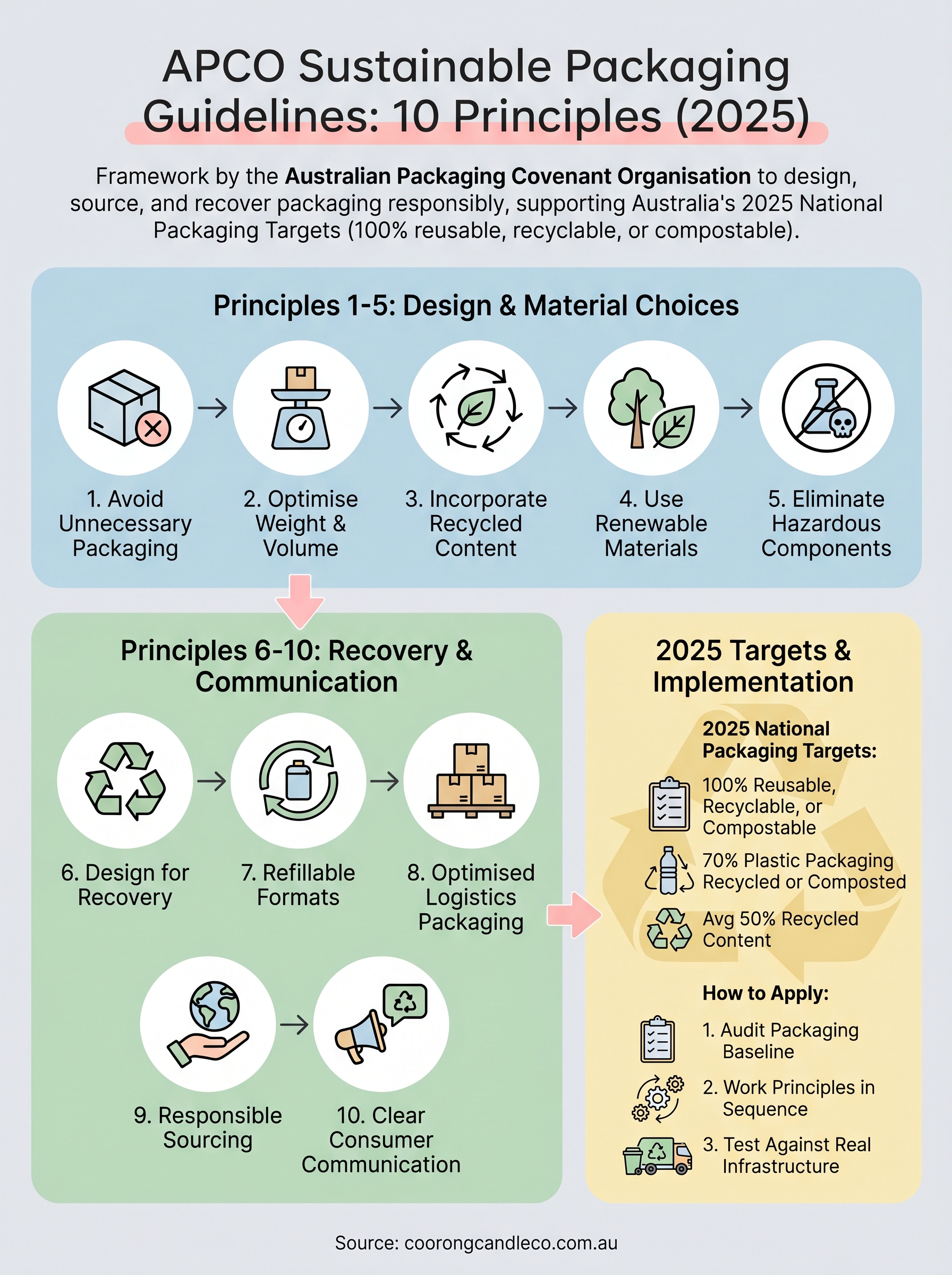
These first five principles focus on what goes into your packaging. They ask you to avoid unnecessary packaging, optimise weight and volume, incorporate recycled content, use renewable materials where practical, and eliminate hazardous components such as PVC and heavy metals that block recovery.
Principles 6 to 10: recovery and communication
Your final five principles shift focus toward how packaging performs after use. Designing for recovery ensures materials re-enter kerbside streams, while the remaining principles cover refillable formats, optimised logistics packaging, responsible sourcing of raw materials, and clear consumer communication about correct disposal.
How the guidelines link to the 2025 packaging targets
The APCO sustainable packaging guidelines were built specifically to drive progress toward Australia's 2025 National Packaging Targets, a set of industry-wide commitments established under the Australian Packaging Covenant. These targets call for 100% of packaging to be reusable, recyclable, or compostable, for 70% of plastic packaging to be recycled or composted, and for an average of 50% recycled content across all packaging.
Each of the 10 principles maps directly onto one or more of these targets, giving your business a clear pathway to measurable progress.
How the principles translate into target outcomes
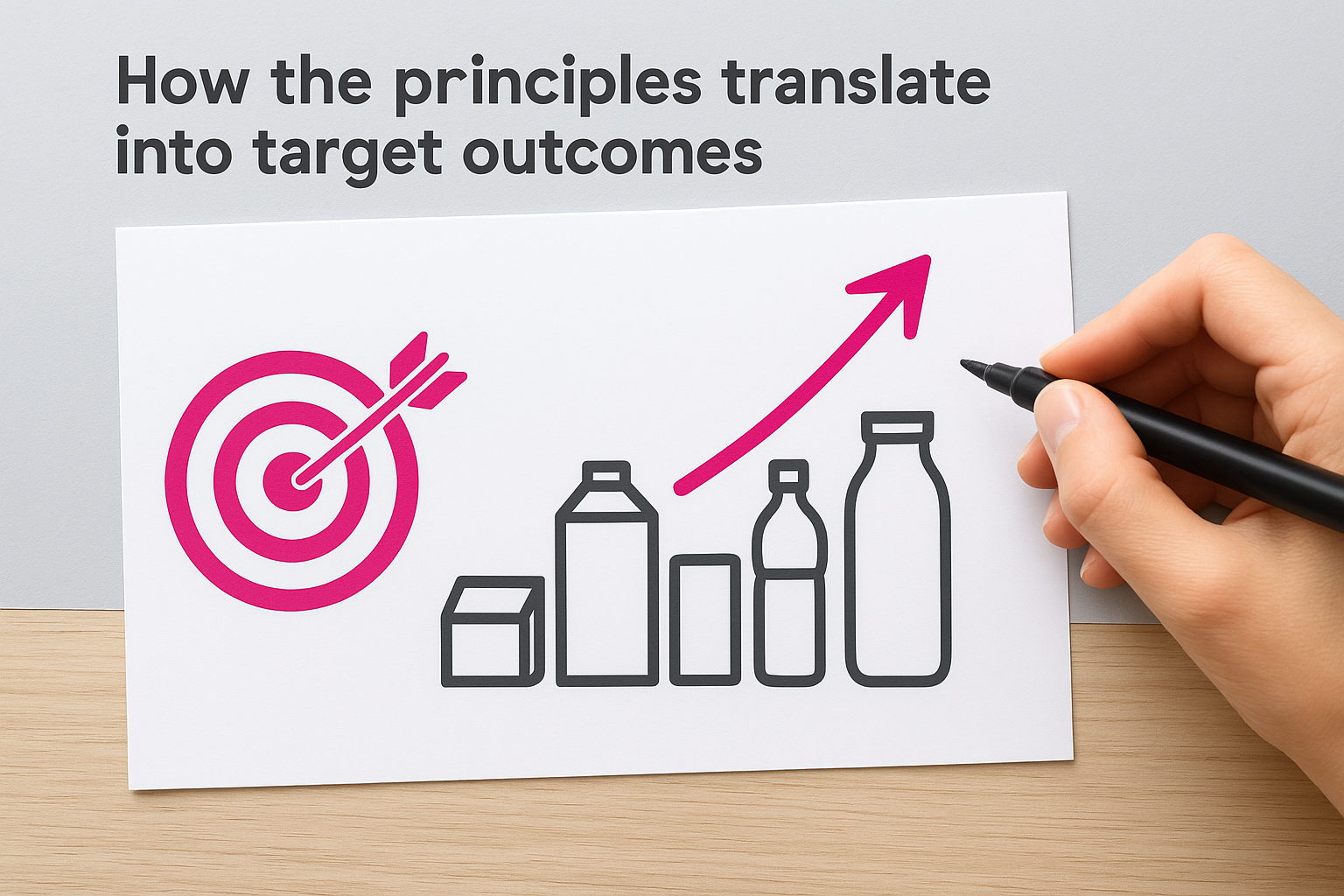
Working through the principles in order gives you a structured way to reduce packaging complexity and increase its recovery rate. Principles focused on material selection push your recycled content figures upward, while recovery-focused principles improve the percentage of your packaging that actually re-enters the supply chain after use.
Businesses that treat the guidelines as a live checklist, rather than a one-time exercise, find it far easier to demonstrate year-on-year improvement in their APCO reporting and stay ahead of tightening compliance expectations across the Australian market.
How to apply the guidelines to your packaging
Applying the APCO sustainable packaging guidelines starts with a packaging audit of everything you currently use across your range. List every material, its weight, its local recyclability status, and whether it contains restricted substances. That audit becomes the baseline you measure every future improvement against.
Starting with a documented audit means every change is trackable and reportable from day one.
Work through the principles in sequence
Taking each of the 10 principles in order stops you from skipping steps that affect your overall compliance score. Start with material elimination, asking whether each component is necessary, then move through material type and recycled content thresholds before addressing design-for-recovery and consumer communication.
- Is each packaging component essential, or can it be removed?
- Does the material meet recycled content targets for your category?
- Can the material be recovered through mainstream kerbside systems?
Test against real infrastructure
Your packaging decisions need to work within Australia's actual kerbside systems, not just in theory. Verify your materials are accepted across the majority of Australian councils before committing to any new format.
Building this check into your design process early saves you from investing in materials that look right on paper but get rejected at the collection point.
A simple way to get started today
The APCO sustainable packaging guidelines give you a ready-made framework, so you don't need to build your approach from scratch. Pick one packaging format you use regularly and run it through the 10 principles. Note where it falls short, identify the easiest material swap or design change, and make that your first commitment. Document every decision so your improvements stay trackable from day one.
Small, consistent changes compound quickly when you apply them across your full product range. Focus on the principles where your current packaging clearly fails first, then work through the rest in order. Each principle you address moves your packaging closer to full compliance with Australia's 2025 targets and reduces your exposure as reporting requirements tighten.
At Coorong Candle Co., sustainability sits at the core of every product we make. If you'd like to see what eco-conscious production looks like in practice, explore our natural soy candles and home fragrance range.