
You light a candle to unwind, not to fill your lounge room with something you'll regret breathing in. So it's fair to ask are soy wax candles toxic, especially with so much conflicting advice floating around about what actually happens when wax burns. If you've read scary claims about candle fumes or you're simply choosing between soy and paraffin for your home, you deserve a straight answer.
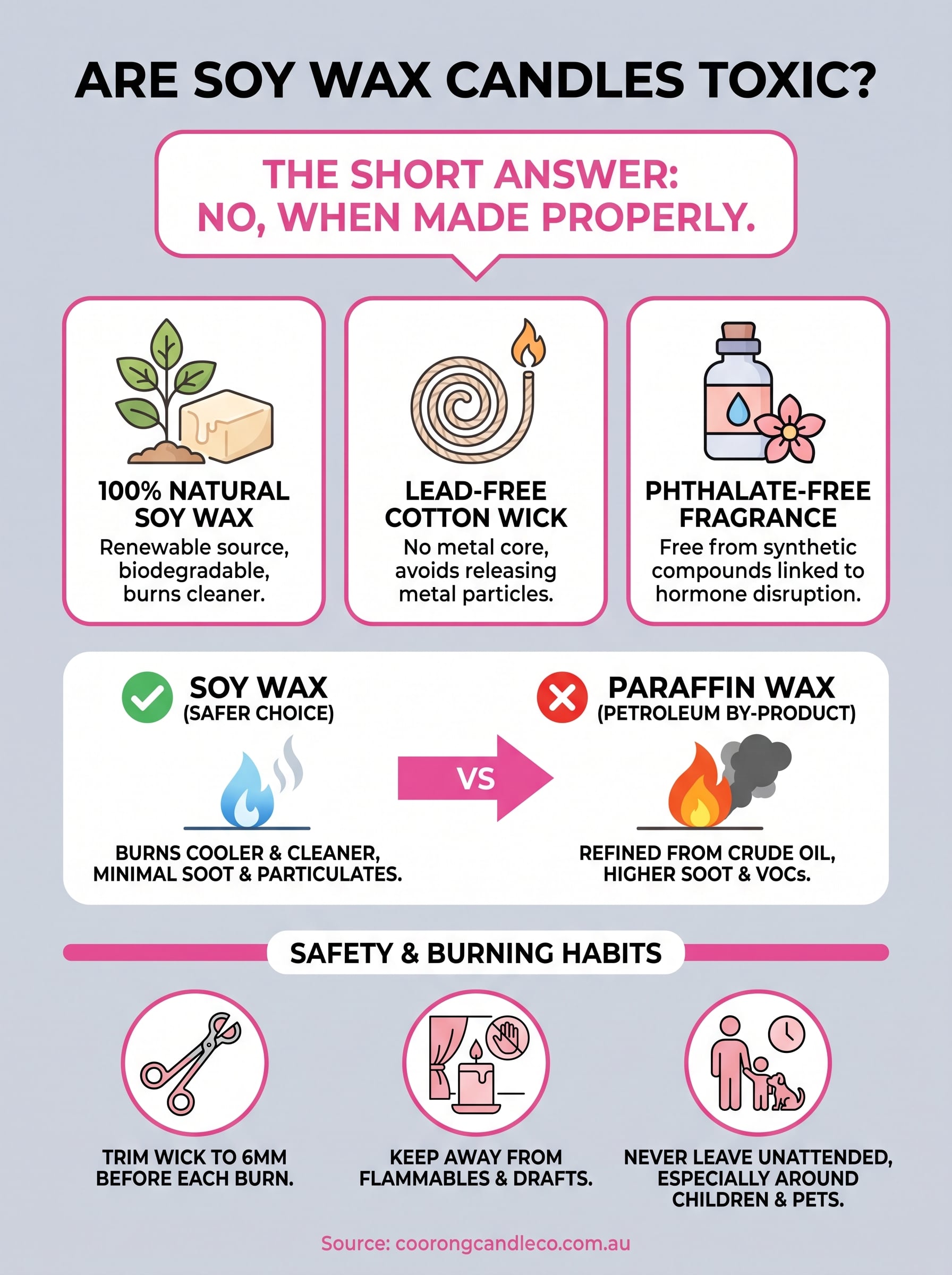
The short version: soy candles are non-toxic when they're made properly, with natural soy wax, a lead-free wick, and phthalate-free fragrance oils. That's a very different story to paraffin, which is a petroleum by-product that can release more soot and questionable compounds as it burns. Soy wax comes from soybean oil, burns cleaner, and doesn't carry the same baggage.
Below, we'll unpack what's actually in soy candles, how they compare to paraffin on health grounds, and what to check on a label before you buy, so you can burn with confidence, not just hope for the best. It's exactly why we hand-pour every Coorong Candle Co. candle with soy wax and cotton wicks in the first place.
Why soy wax candles are considered a safer choice
Soy wax starts as soybean oil, which gets hydrogenated into a solid, creamy wax you can pour into a jar or tin. There's no petroleum refining step, no crude oil derivatives, and no synthetic hardeners needed to make it hold its shape. That's the core reason soy candles are non-toxic in most independent testing: the raw material itself is a renewable, food-grade oil rather than an industrial by-product. Soybean farming does carry its own environmental footprint, but the wax that ends up in your candle is chemically simple and biodegradable.
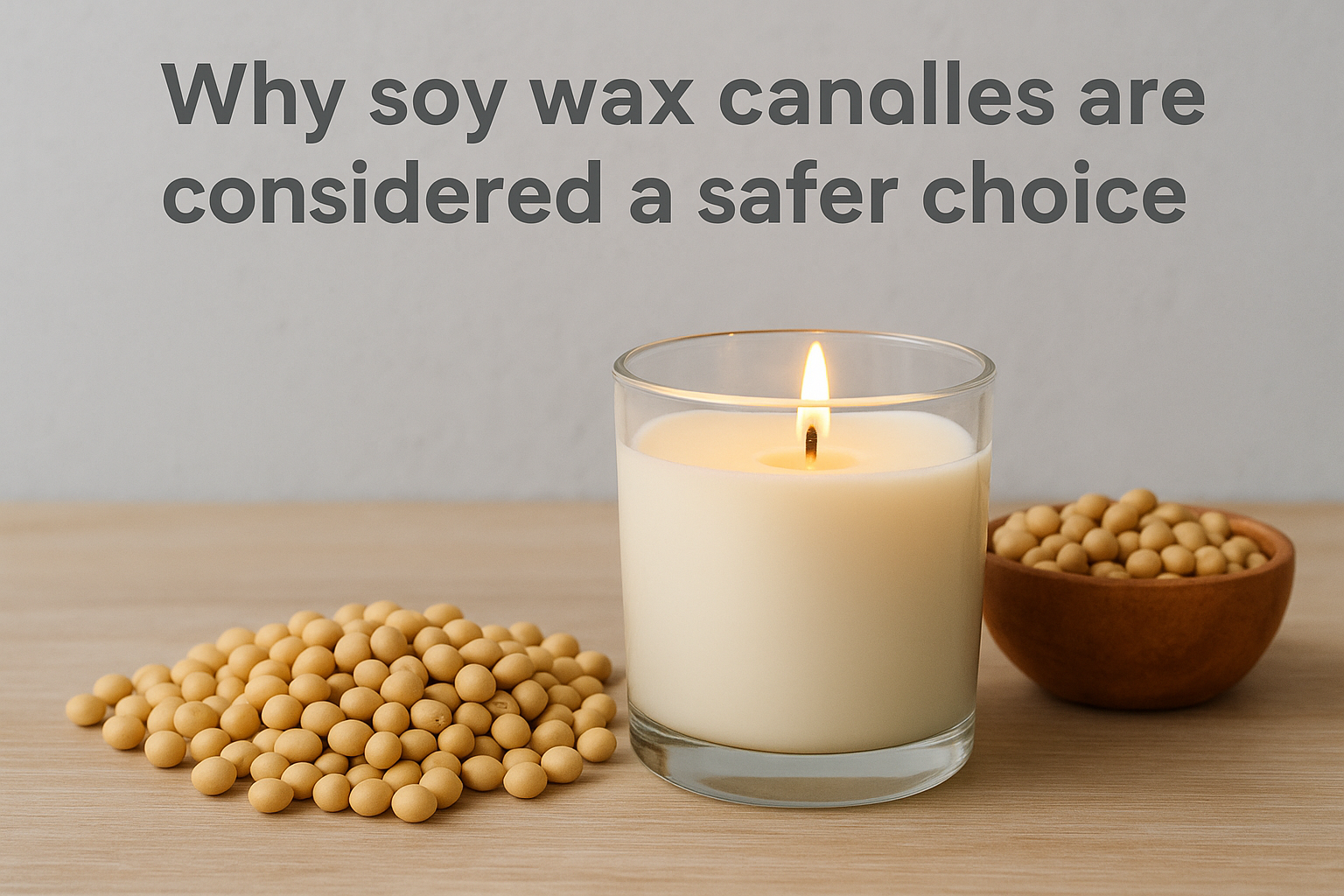
Burn quality matters just as much as the raw ingredient. Soy wax has a lower melting point than paraffin, so it burns cooler and produces far less soot. Less soot means less black residue on your walls, less airborne particulate matter, and less of that greasy candle smell that lingers in soft furnishings. Studies looking at candle emissions consistently show that soy wax candles produce cleaner smoke than paraffin equivalents, with fewer polycyclic aromatic hydrocarbons released during combustion. The US Environmental Protection Agency has published research into indoor air quality and combustion by-products more broadly, and cleaner-burning waxes consistently come out ahead on particulate output (EPA, Indoor Air Quality).
Soy wax burns cooler and cleaner, which is the simplest reason it's considered the safer candle choice for your home.
Wick choice plays a bigger role than most people realise. A cotton wick, free of lead or zinc cores, doesn't release metal particles into the air as it burns. Older candles sometimes used lead-core wicks for rigidity, a practice long phased out in reputable manufacturing, but it's still worth checking labels on cheap imports. Reputable makers, including us at Coorong Candle Co., use lead-free cotton wicks paired with soy wax specifically to avoid that risk altogether.
Fragrance oils deserve a mention too, since scent is often the biggest unknown in any candle. Phthalate-free fragrance oils are the standard for anyone serious about clean-burning candles, because phthalates are the synthetic compounds linked to hormone disruption in some studies. Combine soy wax, a cotton wick, and phthalate-free fragrance, and you've got a candle that ticks every box for are soy candles safe without needing to compromise on scent throw or burn time. It's a straightforward formula, and it's exactly why so many households have quietly switched away from paraffin without noticing any drop in quality.
How soy wax compares with paraffin and other waxes
Putting soy, paraffin, and blended waxes side by side makes the differences obvious rather than theoretical. Paraffin wax is a petroleum by-product, refined from crude oil, and it burns hotter and produces noticeably more soot than soy. Palm wax sits somewhere in the middle: it's plant-derived like soy, but large-scale palm farming raises its own deforestation concerns, so it's not the eco win it sounds like on paper. Beeswax burns clean too, but it's pricier and not vegan, which rules it out for a lot of shoppers who want an accessible, ethical option.
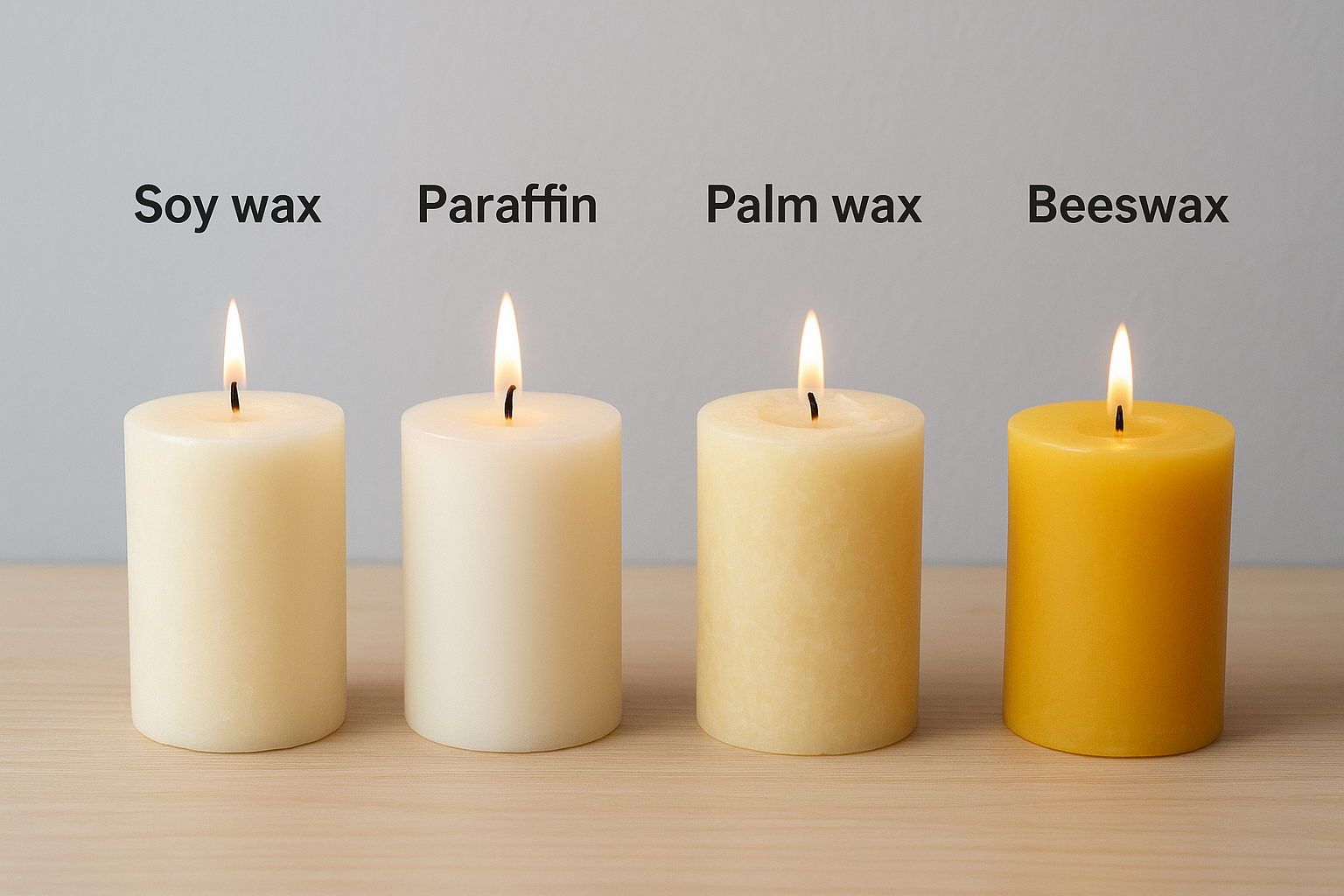
| Wax type | Source | Soot output | Burn temperature | Common concerns |
|---|---|---|---|---|
| Soy wax | Soybean oil | Low | Cooler | Minimal, if lead-free wick used |
| Paraffin | Crude oil | High | Hotter | Soot, VOCs, petroleum by-products |
| Palm wax | Palm oil | Low-moderate | Moderate | Deforestation, sourcing ethics |
| Beeswax | Beehives | Low | Moderate | Cost, not vegan |
Answering are soy candles dangerous compared with these alternatives is straightforward once you look at the data: soy consistently scores lowest on soot and airborne particulates, which is the main health-relevant metric researchers track.
Soy wax beats paraffin on soot, beats palm on ethics, and beats beeswax on price, which is why it's become the default for households wanting soy candles better for your health without a big price jump.
Regional collections like ours lean on soy for exactly this reason. It lets us keep the eco-friendly promise intact while still delivering the strong scent throw customers expect from a candle inspired by places like Kangaroo Island or the Barossa Valley.
How to choose and burn soy candles safely
Choosing well starts before you even light the wick. Look for candles labelled 100% soy wax rather than a soy blend, since many budget candles mix in paraffin to cut costs while still marketing themselves as "soy". Checking the fine print answers are soy wax candles toxic for that specific product, because the label tells you exactly what you're burning, not just what's on the front of the jar.
What to check on the label
A few minutes reading ingredients saves you from bringing home a candle that undercuts the whole point of switching to soy.
- 100% soy wax, not a soy-paraffin blend
- Cotton or wood wick with no lead or zinc core
- Phthalate-free fragrance oils, ideally stated outright
- Country of manufacture and a real business name, not just a marketplace listing
If the label doesn't mention lead-free wicks and phthalate-free fragrance, assume it hasn't earned either claim.
Burning habits that keep things safe
Good habits matter as much as good ingredients. Trim the wick to around 6mm before every burn, since a long wick causes flickering, extra soot, and uneven melting. Never leave a candle burning near curtains, bedding, or anything flammable, and keep burns away from open windows or fans that create drafts pulling the flame sideways. On the first burn, let the wax melt across the full surface, usually two to three hours, so you avoid tunnelling down the middle and wasting fragrance later. Extinguishing a soy candle before the wax pool reaches the glass edges also protects the container from heat stress over repeated use. Following these steps is really how you get a genuinely safe soy candle experience, rather than relying on the wax type alone to do all the work.
Are soy candles safe around children and pets
Families with toddlers or curious cats ask this question more than any other, and rightly so. Soy candles are safe around kids and animals when you follow the same basic rules that apply to any open flame: keep the candle out of reach, never leave it burning unattended, and place it somewhere a wagging tail or grabby hand can't tip it over. The wax itself isn't the risk here, it's the flame and the hot glass, so treat a soy candle with the same caution you'd give a stovetop or a heater.
Genuine soy wax also means there's no lead dust settling on the floor where a crawling baby or a low-slung dog might come into contact with it, which matters more than people realise. Pets groom themselves constantly, and cats especially pick up airborne residue on their fur, so a cleaner-burning candle genuinely reduces what they're licking off later. This is one of the clearer, practical reasons soy candles are non toxic claims hold up under scrutiny rather than just sounding good on packaging.
A soy candle burned sensibly, out of reach and never left unattended, poses no more risk to kids or pets than any other flame in your home.
Scent strength is worth a thought too. Dogs and cats have far more sensitive noses than we do, so a heavily fragranced room can overwhelm them even when the ingredients themselves are perfectly safe. Rotating between lighter and stronger scents, or cracking a window while burning, keeps things comfortable for the whole household, humans included.
Making a cleaner choice for your home
So, are soy wax candles toxic? Not when they're made the right way. Soy wax candles are non-toxic, cooler-burning, and free of the petroleum baggage that comes with paraffin, provided you're checking for 100% soy wax, lead-free cotton wicks, and phthalate-free fragrance every time you buy. That's not a marketing line, it's just chemistry, and it's the same standard we hold every candle to at Coorong Candle Co.
Getting this right isn't complicated once you know what to look for on a label, and it's a small habit that pays off every time you light one at home. Trust the ingredients, trust your nose, and burn with the same confidence you'd want for anything else you bring into your lounge room.
Ready to make the switch? Browse our range of natural soy wax candles and see what a genuinely clean burn feels like.