
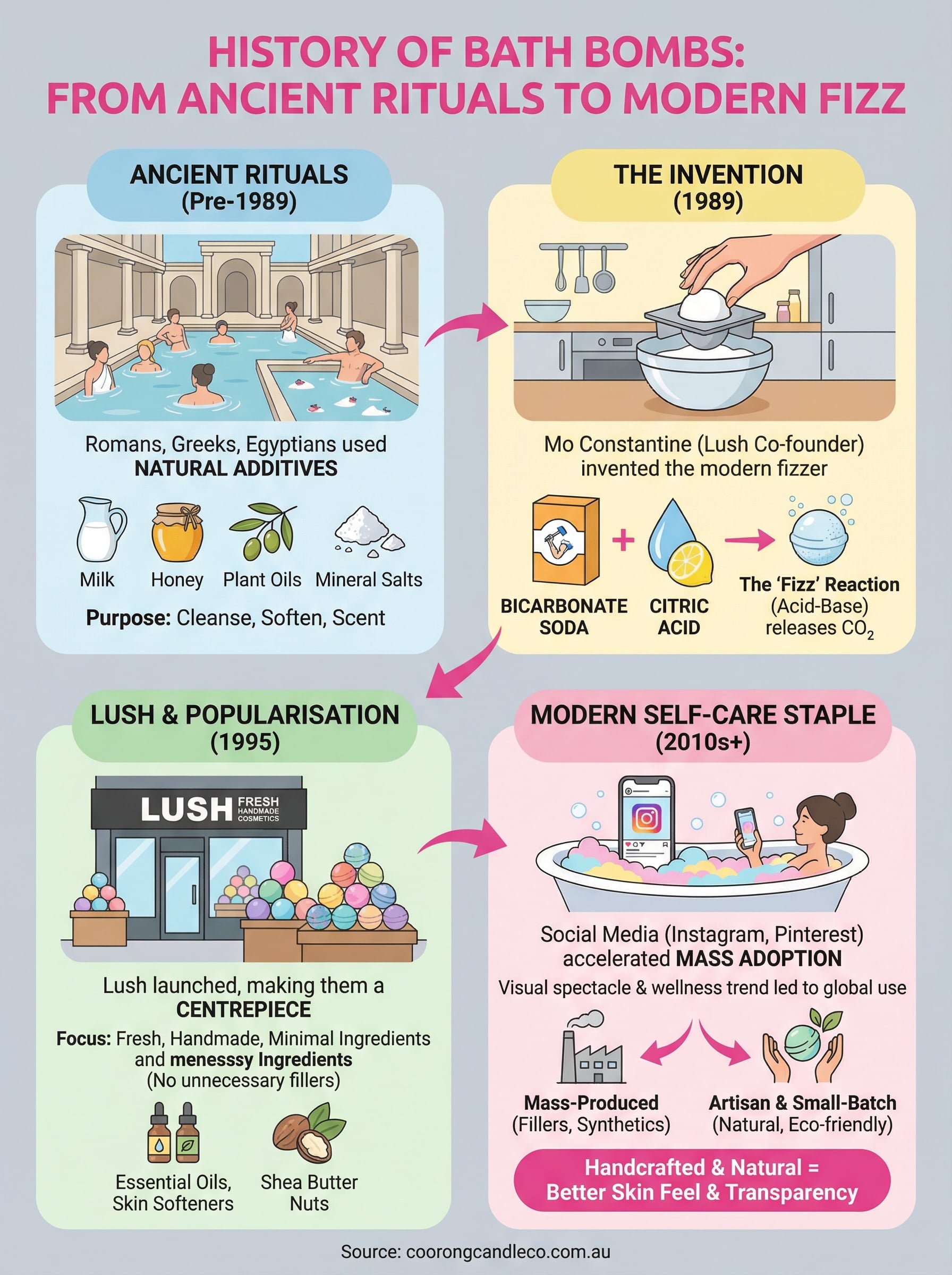
Drop a bath bomb into warm water and you get an instant burst of colour, fizz, and fragrance. It feels like a product that's always existed, but the history of bath bombs is surprisingly recent. The fizzing sphere we know today was invented in 1989 by Mo Constantine, co-founder of Lush Cosmetics, though the bathing rituals that inspired it stretch back thousands of years.
At Coorong Candle Co., we handcraft bath bombs here in South Australia as part of our commitment to small-batch, eco-friendly self-care products. Understanding where these little spheres of indulgence came from gives us a deeper appreciation for the craft, and we think it'll do the same for you. From ancient mineral soaks to modern-day fizzing formulas, the story is richer than you might expect.
This article traces the full timeline: ancient bathing traditions, the chemistry that makes the fizz possible, Mo Constantine's kitchen experiments, the Lush effect, and how bath bombs became a global self-care staple. Whether you're a long-time fan or simply curious, here's everything worth knowing about how a simple ball of bicarbonate soda and citric acid changed the way we bathe.
Why the history of bath bombs matters
Most people grab a bath bomb off the shelf without giving much thought to what's inside it or where the idea came from. But knowing the history of bath bombs helps you make better choices about what goes into your bathwater, what ingredients to trust, and why handcrafted, small-batch products differ so significantly from mass-produced alternatives.
Understanding what a product is made of, and why it was formulated that way, is the first step to making a purchase you'll actually feel good about.
It connects ingredients to purpose
Every ingredient in a bath bomb has a reason for being there. Bicarbonate of soda and citric acid create the fizz through a simple acid-base reaction when they meet water. Essential oils and fragrance compounds deliver scent. Skin-softening agents like shea butter or coconut oil provide that smooth, nourished feel after you step out of the bath. When you understand the origins of these formulas, you start to see why ingredient quality matters and how a poorly made bath bomb can irritate sensitive skin rather than soothe it.
It gives you a framework to spot quality
The bath bomb market has grown rapidly since its 1989 origins, and not all products are created equal. Cheap fillers, synthetic dyes, and artificial fragrances now dominate many supermarket shelves. Knowing that the original formula was designed around simple, skin-friendly ingredients gives you a clear benchmark. You can ask better questions: Is this scented with real essential oils? Does it use natural colourants? Is it made in small batches where someone actually pays attention to the ratios?
Tracing the roots of any product reveals what it was originally designed to do before commercial pressure diluted it. For bath bombs, that original purpose was straightforward: a luxurious, skin-nourishing soak that felt genuinely special without being complicated.
Ancient bath rituals and early bath additives
The history of bath bombs begins long before 1989, though the fizzing sphere itself is modern. Ancient civilisations understood that adding substances to bathwater changed the experience entirely. Romans, Greeks, and Egyptians all used natural additives to cleanse, soften, and scent their baths, establishing rituals that laid the groundwork for what Mo Constantine would later formalise into a product.
Mineral soaks and natural ingredients
Ancient bathers added milk, honey, and plant oils to their water for skin-softening benefits. Cleopatra's famous milk baths were not mythology but a practical use of lactic acid as a gentle exfoliant. Romans built elaborate bathhouses and used salts sourced from natural mineral springs to soothe tired muscles. These weren't luxuries for everyone, but they showed a clear understanding that water alone wasn't enough.
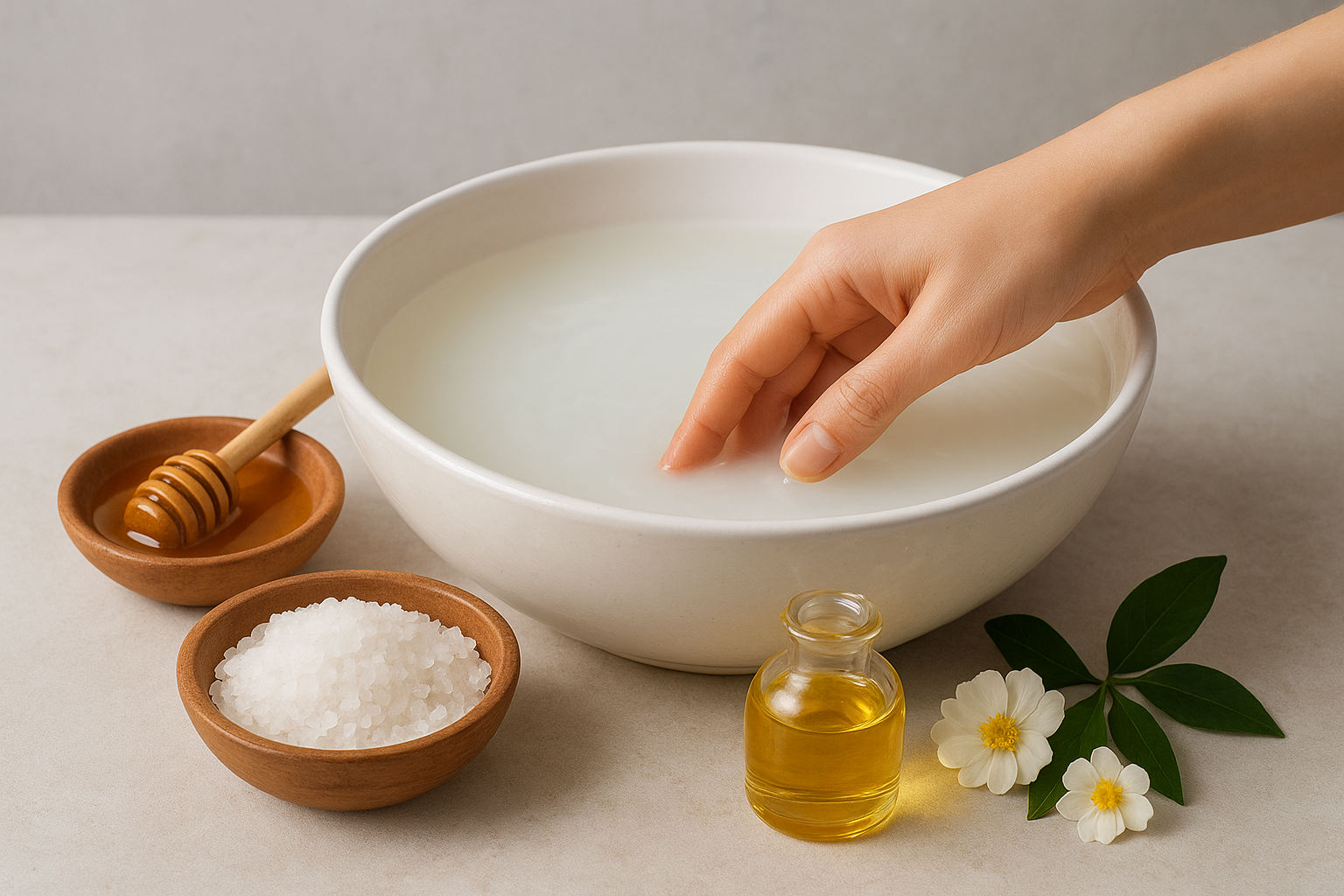
The desire to enhance a simple bath with skin-nourishing ingredients has driven bathing culture for thousands of years.
Natural mineral-rich waters from hot springs drew people across Europe and the Middle East for their therapeutic properties. You can trace a direct line from those ancient mineral soaks to the bicarbonate-and-citric-acid formula sitting in your bath today. The impulse to turn a simple soak into something restorative is as old as civilisation itself.
The 1989 invention and Lush's role
The specific moment in the history of bath bombs that changed everything happened in Mo Constantine's kitchen in 1989. Mo, who later co-founded Lush Cosmetics with her husband Mark, was experimenting with bicarbonate of soda and citric acid when she pressed them together into a solid, mouldable form. The result was a product that fizzes on contact with water, releasing fragrance and skin-conditioning agents all at once.
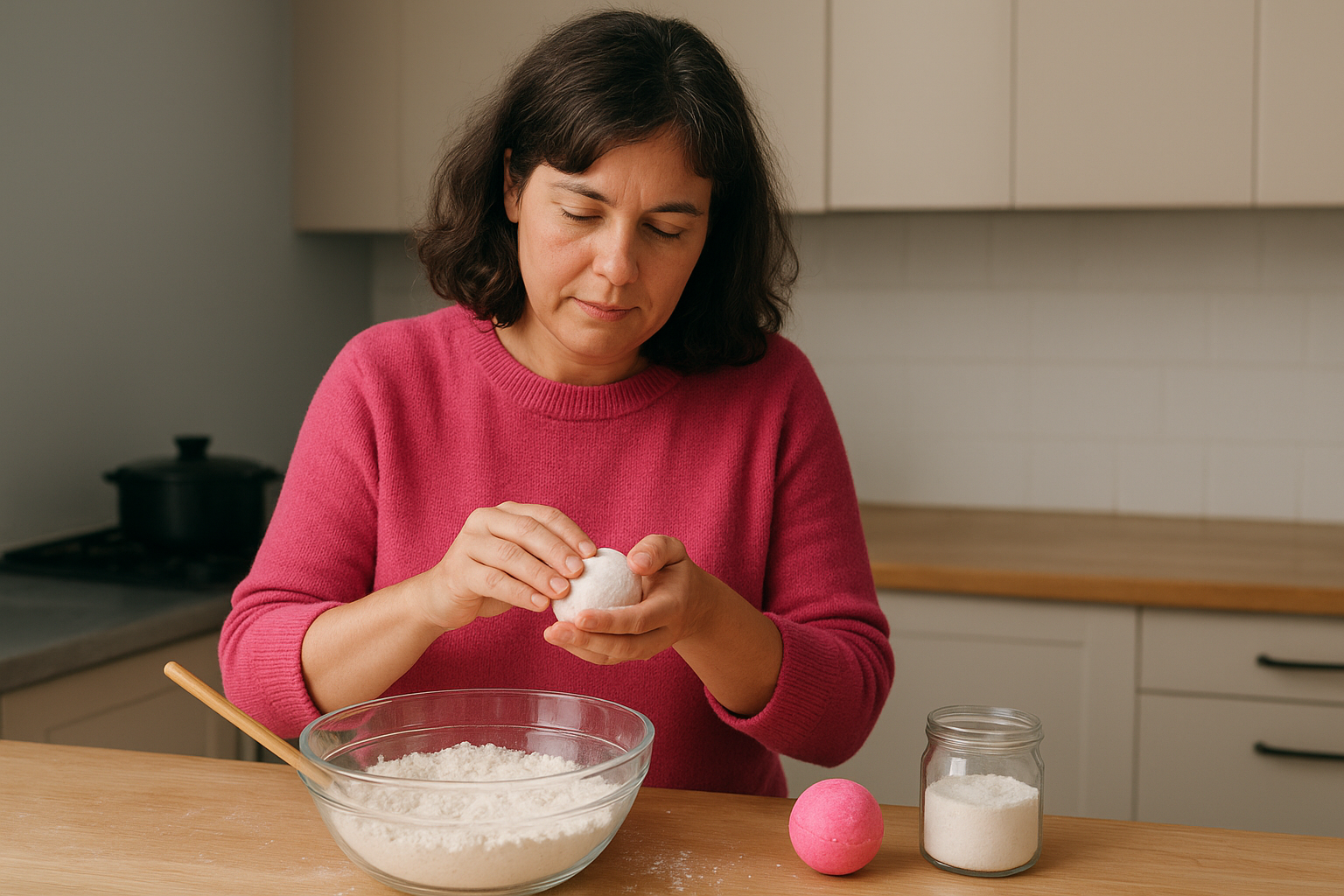
A single kitchen experiment produced one of the most recognisable self-care products in modern bathing history.
How Lush turned one idea into a global product
Lush launched as a retail brand in 1995, and bath bombs became a centrepiece of the range almost immediately. Mo's original formula kept things deliberate and minimal: bicarbonate of soda, citric acid, essential oils, and a binding agent. No unnecessary fillers, no synthetic dyes that stain your tub. The focus was squarely on sensory experience and how your skin felt after.
That commitment to handmade, small-batch production gave bath bombs credibility as a genuine craft product rather than a novelty item. It shaped what consumers came to expect: ingredient transparency, artisan attention to detail, and a clear reason for every ingredient included. That standard remains the benchmark for quality producers today.
How bath bombs work: fizz, fragrance and skin feel
The science behind a bath bomb is straightforward, which is part of what makes them so reliable when made well. Two key ingredients drive everything: bicarbonate of soda and citric acid. Kept dry, they sit dormant. Drop them into water and the reaction starts instantly, releasing carbon dioxide gas as the fizz you see and hear.
The acid-base reaction
When water triggers the acid-base reaction, carbon dioxide bubbles form rapidly and push through the surface of the bomb. This is the same basic chemistry used in baking, applied here for sensory effect. Understanding this part of the history of bath bombs explains why keeping them dry before use matters so much.
A bath bomb that has absorbed moisture before use will fizz weakly or not at all, because the reaction has already partially started.
Fragrance and skin-nourishing ingredients
The fizz does more than entertain. As the bomb breaks apart, it disperses essential oils and fragrance compounds evenly through your bathwater, surrounding you in scent. Skin-conditioning agents like shea butter or sweet almond oil ride along with the reaction and coat your skin during the soak, leaving it noticeably softer once you dry off.
How bath bombs became a modern self-care staple
After Lush popularised the format in the 1990s, the history of bath bombs took a sharp turn toward mass adoption. Social media platforms like Instagram and Pinterest accelerated this significantly in the 2010s, turning the visual spectacle of a fizzing, colour-releasing bomb into shareable content that reached millions of people who had never tried one.
The moment bath time became worth photographing, bath bombs became worth buying.
From niche product to bathroom essential
Independent makers and small artisan businesses picked up where Lush left off, producing handcrafted bath bombs in small batches with natural ingredients. This gave consumers more choice and pushed the broader market toward higher quality standards. The wellness movement reinforced this shift, with more people investing in home rituals as a genuine form of stress management rather than simple indulgence.
Today, bath bombs sit alongside candles and diffusers as core home self-care products, used regularly rather than saved for special occasions. Their appeal is straightforward: they transform an ordinary bath into something that engages your senses, softens your skin, and gives you a genuine moment to decompress.
Final thoughts
The history of bath bombs covers more ground than most people expect. From ancient mineral soaks and therapeutic spring waters to Mo Constantine's kitchen experiment in 1989, the through-line is consistent: people have always looked for ways to make a simple bath feel genuinely restorative. What Lush formalised into a retail product, small-batch artisan makers have continued to refine, keeping ingredient quality and skin benefit at the centre.
Understanding where bath bombs came from helps you choose them better. You now know what drives the fizz, why ingredient ratios matter, and how commercial shortcuts can turn a skin-nourishing soak into an irritating one. That knowledge is worth carrying into every purchase you make.
If you want to experience handcrafted bath bombs made in small batches with naturally sourced ingredients, explore the full range at Coorong Candle Co.'s bath bomb collection and find the scent that suits your next soak.