
You've probably noticed a reed diffuser sitting elegantly on a shelf, quietly releasing fragrance without flames, batteries, or fuss. But how do reed diffusers work, exactly? The answer lies in a simple but clever bit of science that keeps your space smelling beautiful without any effort on your part.
At Coorong Candle Co., we craft our luxury reed diffusers to bring the essence of South Australia's natural landscapes into your home. Understanding the mechanics behind these devices helps you get the most from them, and appreciate why quality ingredients make all the difference.
This guide breaks down the science of capillary action, walks you through proper setup, and shares practical care tips to keep your diffuser performing at its best. Whether you're new to reed diffusers or looking to optimise an existing one, you'll find everything you need below.
What a reed diffuser is and what's inside
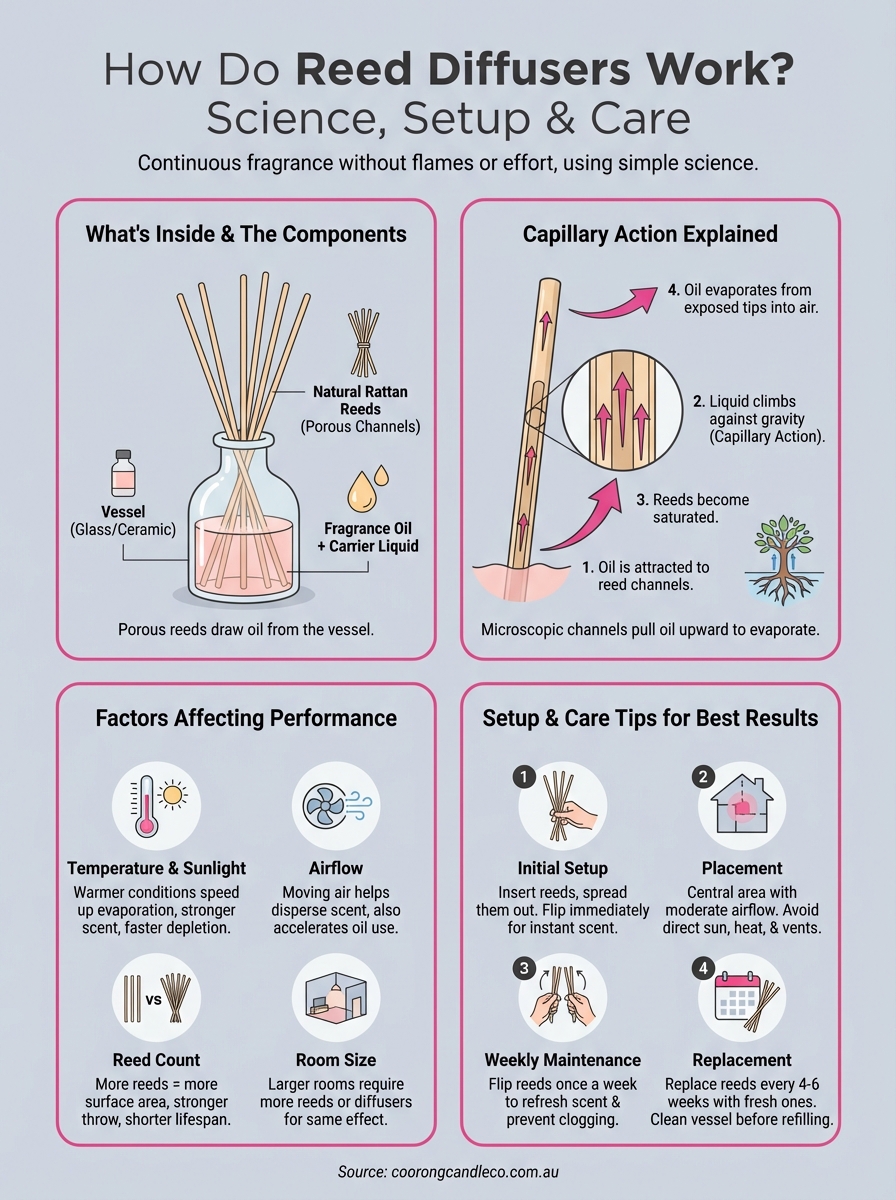
A reed diffuser is a flameless fragrance solution that releases scent continuously through natural evaporation. You place thin wooden reeds into a container of scented oil, and the reeds draw the liquid upward to disperse fragrance into your space. Understanding how do reed diffusers work starts with knowing what components make up the system.
The vessel and fragrance oil
The container holds fragrance oil mixed with a carrier liquid (usually alcohol or a synthetic base) that helps the scent travel up the reeds. Your diffuser vessel can be glass, ceramic, or another non-porous material that won't absorb or react with the oil inside. At Coorong Candle Co., we use carefully formulated fragrance blends inspired by South Australian regions, balanced to provide optimal diffusion without overwhelming your room.
Quality fragrance oil makes the difference between a subtle, lasting scent and one that fades in days.
The carrier liquid's job is to thin the fragrance enough for it to climb the reeds efficiently. Too thick, and the oil won't travel. Too thin, and it evaporates before releasing much scent.
The reeds themselves
Reeds are natural wooden sticks with tiny channels running through them, typically made from rattan. These channels act like microscopic straws, pulling the oil upward through a process called capillary action (which we'll explore in the next section). You'll usually find between six and twelve reeds in a standard diffuser, depending on the bottle size and desired scent intensity.
Natural rattan outperforms synthetic alternatives because its porous structure creates more pathways for oil to travel. Bamboo skewers or plastic sticks simply don't work as effectively, since they lack the internal channel network that makes proper diffusion possible.
How reed diffusers work: capillary action explained
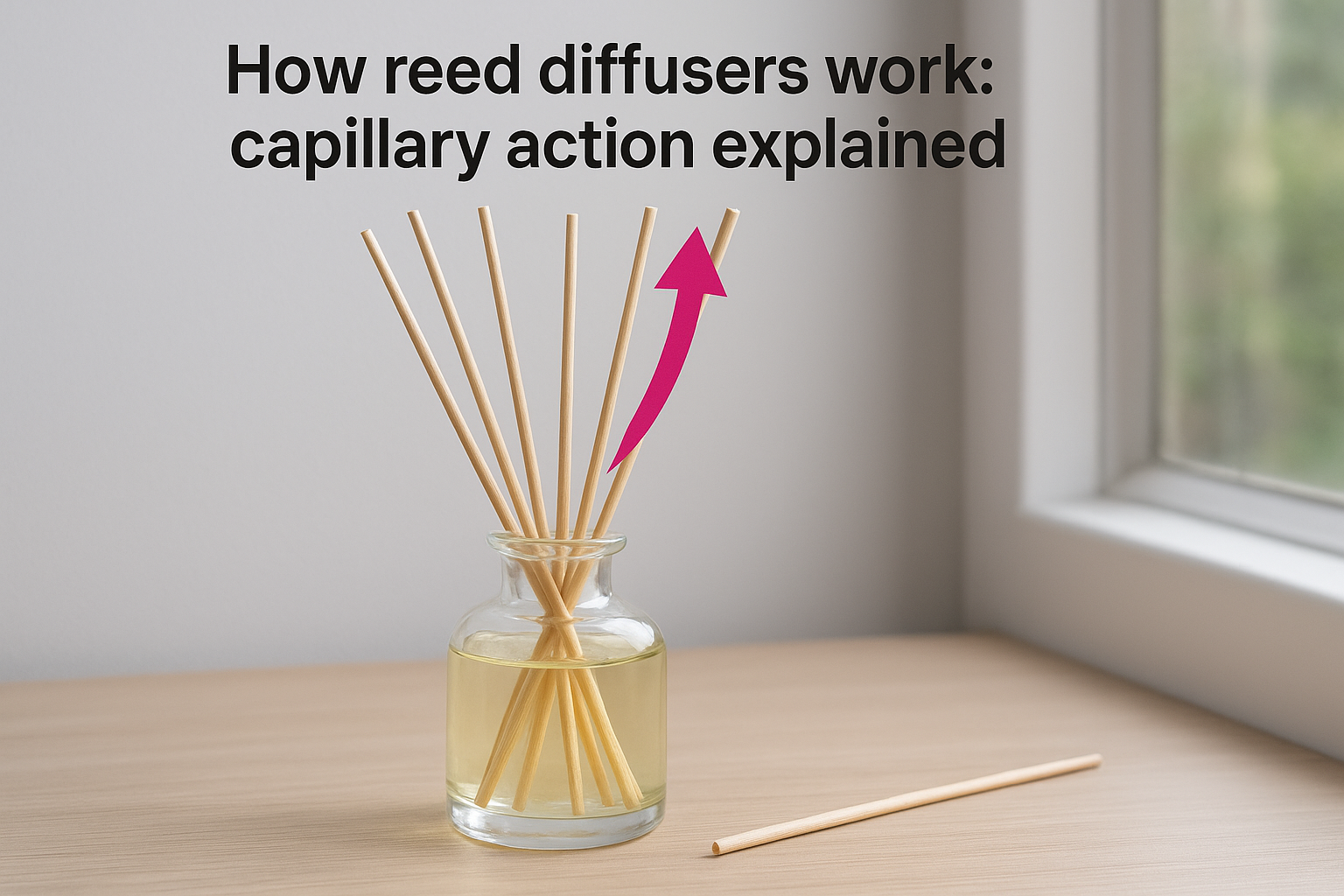
The science behind how do reed diffusers work centres on capillary action, the same principle that helps trees pull water from their roots to their leaves. When you insert reeds into fragrance oil, the liquid climbs upward through those microscopic channels inside the wood, defying gravity without any external pump or power source. This happens because liquid molecules are attracted to the reed's internal surfaces more strongly than they're attracted to each other.
The journey from oil to air
As the fragrance oil travels up each reed, it reaches the exposed tip at the top, where it meets room air. The carrier liquid (usually alcohol-based) evaporates quickly, leaving fragrance molecules to disperse into your space. This process continues non-stop as long as oil remains in the vessel, creating a steady, gentle scent throw that doesn't require flames or electricity.
The narrower the channels in your reeds, the faster capillary action pulls oil upward.
Think of it like a paper towel absorbing spilled water. Your reeds work the same way, except they're drawing scented oil upward instead of soaking it in from the side. The porous rattan structure creates hundreds of tiny pathways, each one acting as a miniature delivery system for fragrance.
Why your diffuser strength and lifespan vary
Several factors determine how strongly your diffuser throws scent and how long it lasts. Understanding how do reed diffusers work means recognizing that no two setups perform identically, even with the same product. Your room conditions, reed count, and oil quality all influence both fragrance intensity and longevity.
Environmental factors that affect performance
Temperature and airflow accelerate evaporation, which means your diffuser in a warm, breezy room will release more scent but empty faster than one in a cool, still space. Direct sunlight hitting your vessel creates the same effect, speeding up the entire diffusion process. You'll notice stronger fragrance near heating vents or windows, but you'll also need to refill more frequently.
Doubling the number of reeds doubles fragrance throw but halves lifespan.
Room size matters too. A small bathroom needs fewer reeds than an open-plan living area to achieve the same scent level. Your diffuser works harder (and depletes quicker) when it's trying to fragrance a larger volume of air.
Reed count and quality
Adding more reeds increases surface area for evaporation, creating stronger scent but consuming oil faster. Fresh reeds also perform better than old ones, which become clogged with residue over time. Natural rattan consistently outperforms synthetic alternatives because its porous structure maintains better capillary action throughout the diffuser's life.
How to set up and place a reed diffuser
Setting up your diffuser correctly ensures you get maximum fragrance and longevity from it. The process takes less than two minutes, but your placement choices determine how well your diffuser performs. Understanding how do reed diffusers work helps you position them strategically for optimal scent distribution throughout your space.

Initial setup steps
Start by removing the stopper or cap from your fragrance vessel and inserting your reeds into the oil. Spread them apart gently to create space between each stick, which allows better air circulation around the exposed tips. You'll notice fragrance starting to release within 20 minutes to an hour as the oil climbs upward.
Flip your reeds weekly to refresh the scent intensity and prevent clogging.
For stronger initial throw, flip the reeds immediately after inserting them so the oil-soaked ends sit at the top. This gives you instant fragrance while the dry portions continue drawing oil upward from below.
Choosing the right location
Place your diffuser in a central area with moderate airflow (not directly under air vents or fans). Avoid windowsills where direct sunlight accelerates evaporation, and skip bathrooms where humidity interferes with proper diffusion. Hallways, living rooms, and bedrooms work well because they allow natural air movement to carry scent without causing rapid oil depletion.
Care, safety and troubleshooting common issues
Regular maintenance keeps your diffuser performing well and extends its lifespan. Knowing how do reed diffusers work helps you identify problems quickly and fix them before they affect your fragrance experience. Most issues stem from clogged reeds or poor placement, both of which you can resolve with simple adjustments.
Maintaining your diffuser for best results
Flip your reeds once weekly to refresh scent intensity and prevent the exposed ends from becoming saturated with dust. Replace reeds entirely every four to six weeks, as they gradually clog with fragrance residue and lose their ability to draw oil effectively. When refilling your vessel, always use fresh reeds rather than reusing old ones, which won't diffuse properly in new oil.
Never leave diffusers within reach of children or pets, and avoid placing them near open flames.
Clean your vessel between refills using warm soapy water and let it dry completely before adding new oil. This prevents old fragrance from mixing with your new scent.
Solving weak scent and other issues
Weak fragrance usually means your reeds need flipping or replacing. Add more reeds if your room is large, or move your diffuser to a more central location with better airflow. Oil that looks cloudy or separated needs stirring (cap the vessel and shake gently) before inserting reeds. Spills wipe away easily with rubbing alcohol, which dissolves fragrance oil without damaging most surfaces.
Key takeaways
Understanding how do reed diffusers work comes down to capillary action, the natural process that pulls fragrance oil up through porous rattan reeds and releases it into your space. You don't need flames, electricity, or constant attention to enjoy continuous, gentle fragrance that lasts for weeks or months depending on your setup and environment.
Your diffuser's performance depends on reed quality, oil formulation, and placement choices. Fresh reeds in a well-ventilated room deliver stronger scent, while too much direct heat or sunlight depletes your oil faster than necessary. Flip your reeds weekly and replace them completely every four to six weeks for consistent results that match the first day you opened them.
Quality matters when choosing your diffuser. Our luxury reed diffusers at Coorong Candle Co. use carefully blended fragrances inspired by South Australian landscapes, giving you premium scent throw without compromise. Each diffuser arrives with natural rattan reeds and enough oil to fragrance your home beautifully for months.