
Blowing out a candle sounds harmless enough, but if you've ever ended up with wax splatter on your side table or a plume of smoky soot drifting through your lounge room, you already know the problem. Searching for a candle snuffer australia usually means you're past the point of tolerating scattered wax and want a proper fix, not another workaround. It's a small tool, but it changes how you finish every candle session.
A candle snuffer is simply a small bell-shaped tool on a long handle that smothers the flame by cutting off its oxygen supply, rather than blasting air across the wax pool. That means no soot marks on your walls or diffuser bottles, no wax spitting onto timber furniture, and a longer wick life because you're not bending it sideways with your breath.
In this article, we'll walk through exactly what a snuffer does, why it matters more than people expect once they own a few soy candles, and how to choose one that suits your home and your collection. If you're building a proper candle ritual around pieces like ours, this small addition rounds it out properly.
Why a candle snuffer improves your candle ritual
The hidden damage of blowing out a candle
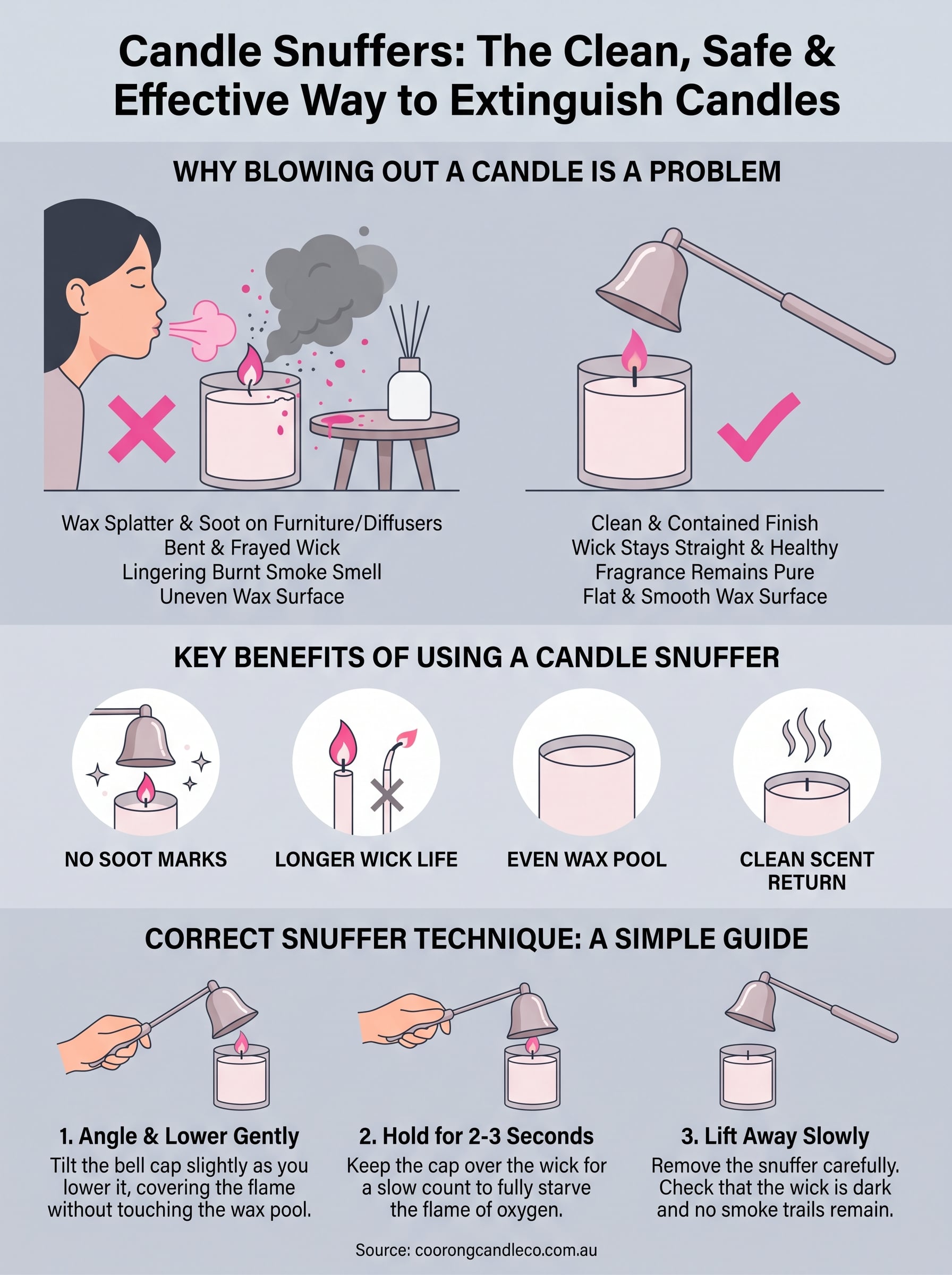
Every puff of air you send across a candle flame does more than put out the light. It pushes melted wax sideways, which is why you sometimes find tiny wax freckles on the rim of the jar or splattered across your side table. It also forces smoke back down into the wax pool, which is where that lingering burnt smell comes from. Soot particles settle on the wick, the wax surface, and anything nearby, including reed diffuser bottles and pale furniture. None of this happens with a snuffer, because the bell cap simply removes oxygen instead of scattering wax and ash.
A snuffer stops the flame the way it started, quietly, instead of blasting it into a mess of smoke and wax.
Keeping soy wax candles burning cleanly
Soy wax candles, like the ones we hand-pour in 350g jars and 165g travel tins, are softer and more heat-sensitive than paraffin blends. Blowing across a soy wax pool disturbs the surface while it's still liquid, which can lead to an uneven finish the next time you light it, sometimes called tunnelling. Snuffing avoids this disturbance entirely, letting the wax set flat and clean. Repeated blowing also bends the cotton wick, curling it to one side, which shortens burn life and makes the next lighting less reliable.
What changes when you switch to a snuffer
| Action | Blowing out | Using a candle snuffer |
|---|---|---|
| Wax surface | Often splattered or uneven | Stays flat and smooth |
| Smoke and soot | Released into the room | Minimal, contained near wick |
| Wick shape | Bent, frayed over time | Stays straight, trims evenly |
| Scent throw next burn | Can smell like smoke | Clean fragrance return |
| Furniture and diffusers nearby | Risk of wax spots | No spatter risk |
The ritual side of finishing a candle properly
Owning a candle snuffer isn't only about protecting your furniture, it's part of treating the whole candle experience as a proper wind-down rather than an afterthought. Lighting a candle in the evening, letting it burn through a chapter of a book or a bath, then closing it out with a slow, deliberate motion rather than a puff of breath, keeps the ritual calm from start to finish. Many Australians searching for a candle snuffer near me are really looking for that finishing touch to match candles they've already invested in, whether that's a Barossa Valley scent on the mantle or a travel tin by the bath. Using the right tool completes the sensory experience instead of interrupting it with smoke and mess.
How to use a candle snuffer correctly
Using a candle snuffer feels obvious the first time you see one, but there's a proper technique that gets the best result. Lower the bell cap over the flame at a slight angle rather than straight down, and hold it there for two to three seconds so the wick is fully starved of oxygen. Rushing the motion is the most common mistake, and it usually means the flame flickers back to life the moment you lift the cap away.
A simple step-by-step
Getting the motion right takes one or two tries, then it becomes automatic. Follow this sequence:
- Hold the snuffer handle firmly, keeping your wrist relaxed.
- Tilt the bell cap slightly as you lower it toward the flame, rather than dropping it flat.
- Rest the cap gently over the wick without pressing into the wax pool.
- Count to three before lifting away, giving the flame time to fully die.
- Check the wick tip; if it's still glowing, repeat the motion once more.
Hold the snuffer over the wick a moment longer than feels necessary, that's the whole trick.
Positioning matters more than people expect
Most people place the snuffer too high above the flame, which lets air sneak in underneath the bell and prolongs the whole process. Keep the cap close to the wax surface without touching it, since contact can drag melted wax up the inside of the snuffer and make a mess of the tool itself. If you're working with a wide candle, like our standard 350g jars, angle the snuffer so the cap covers the entire wick rather than just brushing one edge of the flame.
Adjusting for different candle types
Narrow travel tins need a lighter touch than wide jars, since the flame sits closer to the rim and a heavy-handed approach can knock wax onto the tin's edge. Reed diffusers don't need snuffing at all, obviously, but if you're managing a shelf with several candles burning together, work through them one at a time rather than rushing between jars. Doing this slowly is really what a candle snuffer is for in the first place: giving you a controlled, unhurried way to end a burn instead of guessing how hard to blow.
What a soot-free finish actually looks like
Once the flame is out, the wick should show a small dark tip with no lingering smoke trail curling upward. If you still see a thin ribbon of smoke, the flame wasn't fully smothered, so lower the cap again for another few seconds. A properly snuffed candle leaves the wax surface undisturbed and the room free of that burnt-match smell that blowing out a flame so often creates.
Choosing the right candle snuffer for your candles
Not every snuffer suits every candle, and picking the wrong one can leave you frustrated with a tool that never quite fits the job. Handle length matters more than most buyers expect, especially if you're managing a mantel of pillar candles or a cluster of travel tins where a short handle means hovering your hand uncomfortably close to the flame. Weight matters too. A snuffer that feels flimsy tends to wobble as you lower it, which makes the whole motion less controlled than it should be.
Material and finish
Brass and stainless steel are the two materials you'll see most often across Australian stockists, and each has a different feel in daily use. Brass develops a soft patina over time and suits a warmer, more traditional look, while stainless steel stays brighter and resists tarnishing near bathroom humidity. Whichever you choose, check that the bell cap has a rolled or smooth edge, since a rough-cut rim can catch on wax and leave marks on your candle vessel.
| Feature | Brass snuffer | Stainless steel snuffer |
|---|---|---|
| Look | Warm, ages with patina | Bright, stays consistent |
| Best for | Living areas, gift displays | Bathrooms, humid spaces |
| Maintenance | Occasional polishing | Wipe clean, low upkeep |
| Weight | Slightly heavier | Lighter, easier control |
Matching the snuffer to your candle collection
If your shelf holds a mix of standard 350g jars and 165g travel tins, look for a snuffer with a mid-sized bell, roughly 3 to 4 centimetres across, since it covers a jar's wick without being so large it can't tuck into a narrow tin. Wide bell caps work brilliantly on statement candles but become clumsy on smaller vessels, so buying one snuffer to suit your whole regional or lifestyle set is usually the smarter move rather than owning several mismatched sizes.
The right snuffer fits the candle in front of you, not the other way around.
What to look for when buying online
Many people searching to buy a candle snuffer online in Australia skip past the practical details and focus only on price, which often means a wobbly hinge or a handle that bends after a few weeks of use. Look instead for a solid one-piece construction, a handle long enough to keep your hand well clear of heat, and a seller who can tell you the exact metal used. A well-made snuffer should last years, not months, so it's worth treating as a small investment rather than a throwaway extra tucked into your cart at checkout.
Candle snuffer versus other ways to put out a flame
Extinguishing a candle isn't limited to blowing or snuffing, and it helps to know how the alternatives stack up before you settle on one method for your whole collection. Wick dippers, cloches, and even a splash of water all get the job done, but each comes with its own trade-off in mess, safety, or wear on the candle itself. Weighing these against a candle snuffer makes it obvious why so many Australian candle owners eventually switch over.
Wick dippers and cloches compared
Wick dippers work by pushing the lit wick down into the melted wax pool, then pulling it back up coated and ready for the next burn. It's a clever method, but dunking the wick repeatedly can shorten it faster than snuffing, and it's fiddly on narrow travel tins where there's barely room to manoeuvre. Cloches, the glass or metal domes that sit over a whole candle, work well for pillar candles left burning for hours, though they're impractical for a shelf of smaller jars since you'd need one dome per candle. Neither tool matches the simplicity of lowering a bell cap over the flame for a few seconds.
Blowing, water, and other shortcuts
Blowing remains the default for most households simply because it's free and requires no extra tool, but as covered earlier, it scatters wax, bends wicks, and leaves soot behind. Water might seem like an obvious fix for a stubborn flame, but pouring liquid into hot wax can crack a glass jar or cause a small splash-back of hot wax, which is a genuine burn risk. Pinching the wick with wet fingers works in a pinch, literally, but it's messy and not something most people want to do to a scented jar candle sitting on a coffee table.
| Method | Mess risk | Wick condition | Best suited to |
|---|---|---|---|
| Blowing | High, wax spatter | Bent over time | Quick, casual use |
| Wick dipper | Low | Shortens faster | Single pillar candles |
| Cloche | Low | Unaffected | Long-burning pillars |
| Water | Moderate to high | Can damage wick | Not recommended |
| Candle snuffer | Minimal | Stays straight | Everyday use, all sizes |
Every alternative asks you to trade something, mess, safety, or wick life, while a snuffer asks for nothing but a few seconds of patience.
Comparing the options side by side makes the case for a snuffer fairly clear cut. It's the only method that protects the wick, avoids splatter, and works consistently whether you're finishing a wide 350g jar or a slim 165g travel tin, without introducing water, glass domes, or extra dipping tools into the routine.
Bringing better candle care into your home
Getting a candle snuffer right isn't complicated, but it does change the way your candles perform over time. A clean extinguish protects the wick, keeps the wax surface flat, and stops soot from settling on nearby furniture or diffuser bottles. Once you've felt the difference, blowing out a flame starts to feel like the workaround it always was.
Think of it as the last small step in a proper ritual, not an afterthought tacked onto the end of a burn. If you're building out that ritual properly, a soy wax candle with clean-burning cotton wicks gives the snuffer something worth protecting in the first place. Have a look through our range of hand-poured soy candles and pair your next purchase with a snuffer that actually does the job.