
We hand-pour every candle at Coorong Candle Co. with one expectation: that you'll enjoy it safely. And one of the most common safety questions we hear is, "can you leave a candle burning unattended?" The short answer is no, and it's not just a suggestion. It's a fire safety rule backed by every major fire authority in Australia.
Whether you've ducked out to grab the mail or drifted off on the couch with a soy candle flickering nearby, an unattended flame is an unpredictable one. Even in a quality vessel with a lead-free cotton wick, a candle still produces a live flame, and that demands your attention.
This guide breaks down exactly why unattended candles are dangerous, what "unattended" actually means in practice, and the practical safety habits that let you enjoy your candles with confidence.
Why leaving a candle unattended is risky
A lit candle produces a real, open flame that can reach temperatures of around 1,000°C at its core. That flame doesn't know you've stepped out of the room. It continues to burn, and if anything shifts, falls, or comes within range, the risk escalates within seconds. This is exactly why every fire safety authority, including Fire and Rescue NSW and Country Fire Service South Australia, advises you to never leave a candle burning unattended.
How fast things can go wrong
Candle fires don't build slowly. A curtain catching the flame, a draught disturbing the wick, or even a pet brushing past a candle stand can trigger a fire in moments. Research from fire safety organisations consistently shows that candles are among the leading causes of residential fires in Australia, with the majority of incidents linked to inattention rather than defective products.
Leaving a candle unattended for even a few minutes creates an unpredictable risk that no quality of wax, wick, or vessel can eliminate.
The compounding effect of household hazards
Your home contains multiple fire accelerants you probably don't think about during a relaxed evening: bookshelves, soft furnishings, curtains, tissue boxes, and dried flowers. When a candle burns without your supervision, any one of these can become a fuel source if the flame spreads.
Even a well-made soy candle in a glass vessel carries real risk if left burning on an unstable surface or near a draught. The question of whether can you leave a candle burning unattended becomes straightforward when you understand how quickly household materials ignite once an open flame reaches them, and how little time you have to respond.
What counts as unattended and what does not
There's a practical line worth understanding here. "Unattended" doesn't only mean you've left the house. It means a lit candle is burning without someone in the same room who can see it and react if anything changes. That definition covers more everyday situations than most people realise.
Situations that count as leaving a candle unattended
Any time you break your direct line of sight with a lit flame, that candle is unsupervised. This applies to common moments that feel low-risk in the moment:
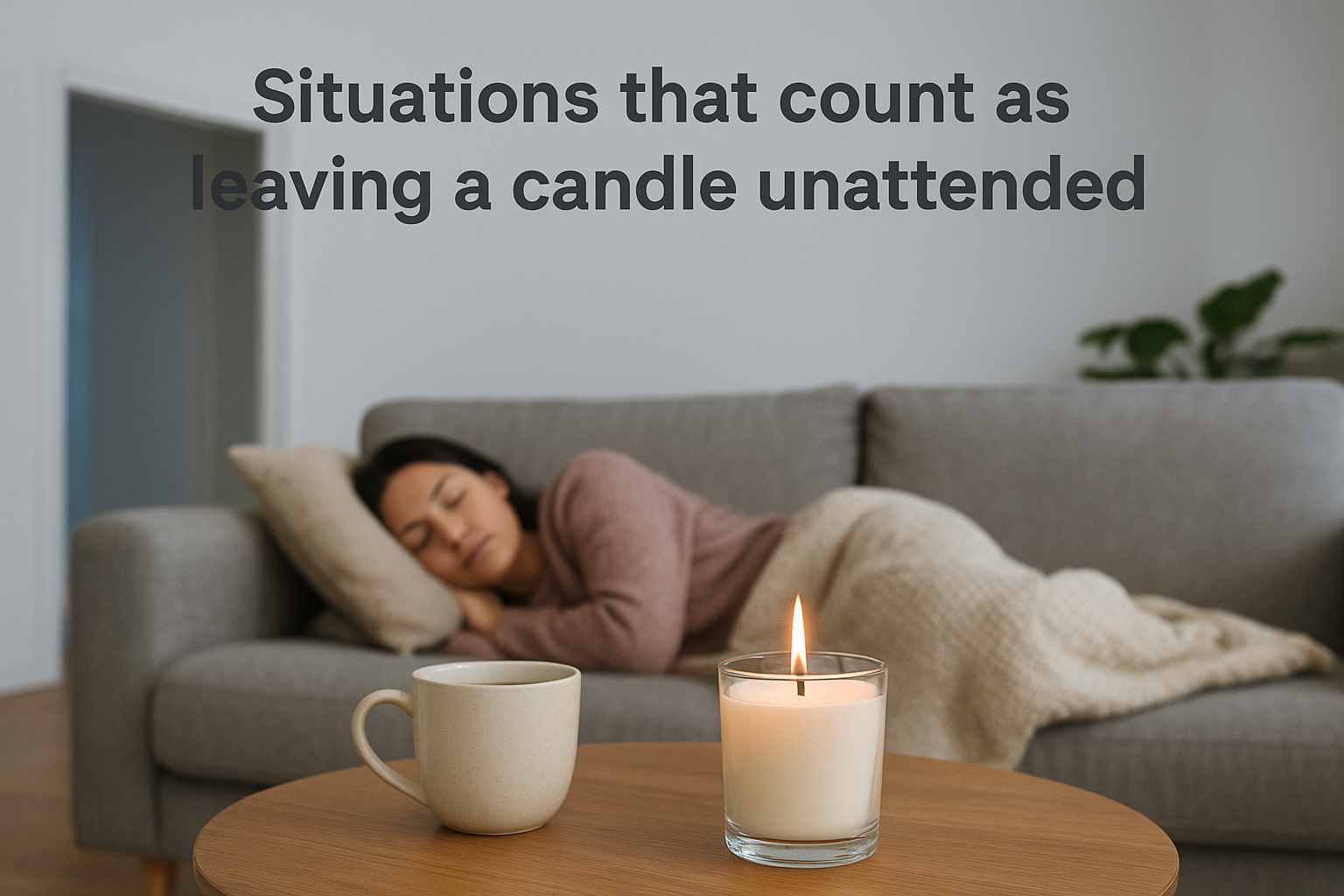
- Stepping into another room to make tea or answer a call
- Falling asleep on the couch while a candle burns nearby
- Answering the front door for several minutes
- Stepping outside briefly to bring in the post or bins
If you cannot see the flame and respond to it within seconds, the candle is unattended, no matter how brief the absence.
You are only considered present when you stay in the same room with a clear sightline to the candle. Moving to the far side of an open-plan space where you can still see and reach the flame quickly also counts as supervised, provided nothing obstructs your view or your ability to act immediately.
Candle safety rules to follow every time
Following a consistent routine each time you light a candle is the most reliable way to reduce risk. These rules apply whether you burn your candle for five minutes or two hours, and they work alongside the core answer to can you leave a candle burning unattended: you simply do not.
A few simple habits repeated every single time are far more effective than any single safety product.
Keep your candle in a safe position
Always place your candle on a stable, heat-resistant surface away from flammable materials. Keep the flame well away from curtains, books, and soft furnishings, and never position it near an open window where a draught can push the flame sideways or carry embers.
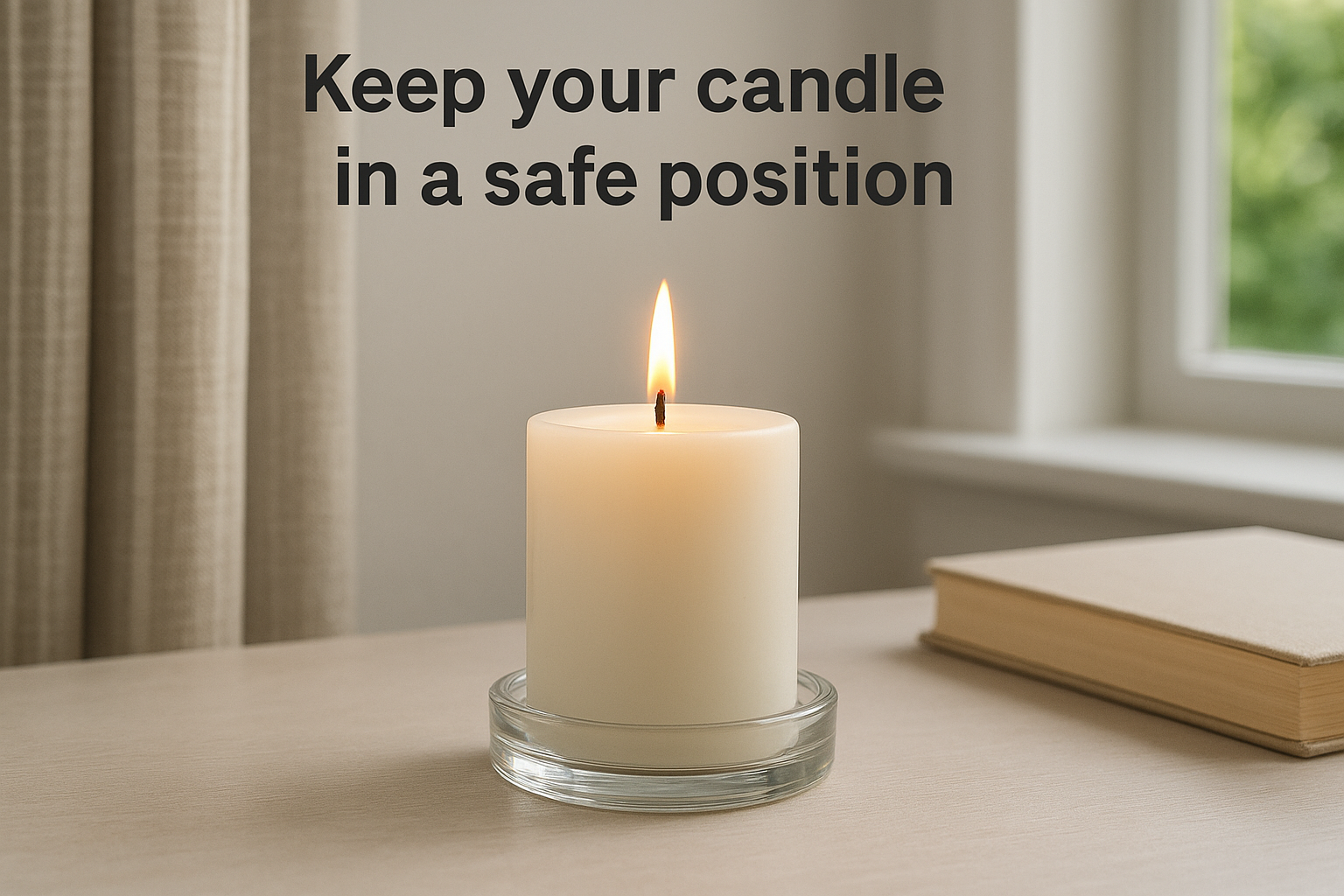
- Place it on a ceramic, glass, or metal holder
- Maintain at least 30cm of clear space around the flame
- Never burn a candle near an air vent or fan
Trim the wick and watch the burn time
Trim your wick to around 6mm before each burn to prevent a large, unstable flame that produces excess soot and flickers unpredictably. Avoid burning a candle for more than four hours in one sitting, as an extended burn raises the vessel temperature and increases the risk of cracking or uneven wax pooling. Let the wax cool fully before you relight.
What to do if you must leave the room
The safest answer to can you leave a candle burning unattended is to extinguish it before you go. Putting the flame out takes only a few seconds and eliminates the risk completely. Use a candle snuffer rather than blowing the wick, which can scatter hot wax and send embers onto nearby surfaces.
Extinguishing the candle before you leave the room is the only method that removes all risk, every time.
Extinguish before you go
Treating this as a non-negotiable habit makes it automatic over time. Put out the flame every single time you leave the room, even for a quick trip to the kitchen. A well-made soy candle with a trimmed wick relights cleanly, so there is no real inconvenience to stepping back in and relighting it when you return.
- Use a candle snuffer to avoid scattering hot wax
- Confirm the flame is fully out before you walk away
- Wait a moment to ensure the wick stops glowing completely
If you forget and come back
Mistakes happen to everyone. If you realise you've left a candle burning while you were out of the room, return promptly and extinguish it immediately. Before you settle back in, check the surfaces around the candle for any signs of heat damage or scorching to confirm nothing has been compromised.
If you left a candle unattended, what to do next
If you realise you left a candle burning without supervision, act quickly. Return to the room and extinguish the flame immediately using a candle snuffer. Avoid rushing past the candle or creating airflow that could disturb the flame before you reach it.
The most important step after any lapse is a thorough check of everything around the flame.
Check for damage immediately
Once the flame is out, inspect the surrounding area carefully. Look for scorch marks, melted surfaces, or any materials that absorbed heat near the candle. Check that the glass vessel has not cracked from an extended burn, and allow the wax to cool fully before you move or relight it.
- Look for discolouration on nearby surfaces
- Check the wick has stopped glowing completely
- Confirm no fabric or paper has been affected
Reset your habits going forward
One lapse does not mean the answer to can you leave a candle burning unattended has changed. It simply means your routine needs reinforcement. Treat your next burn as a reset point and commit to extinguishing the flame before you leave the room, every single time.
From your next burn, use a visible cue, like placing your snuffer beside the candle, to make extinguishing the flame a consistent habit rather than an afterthought.
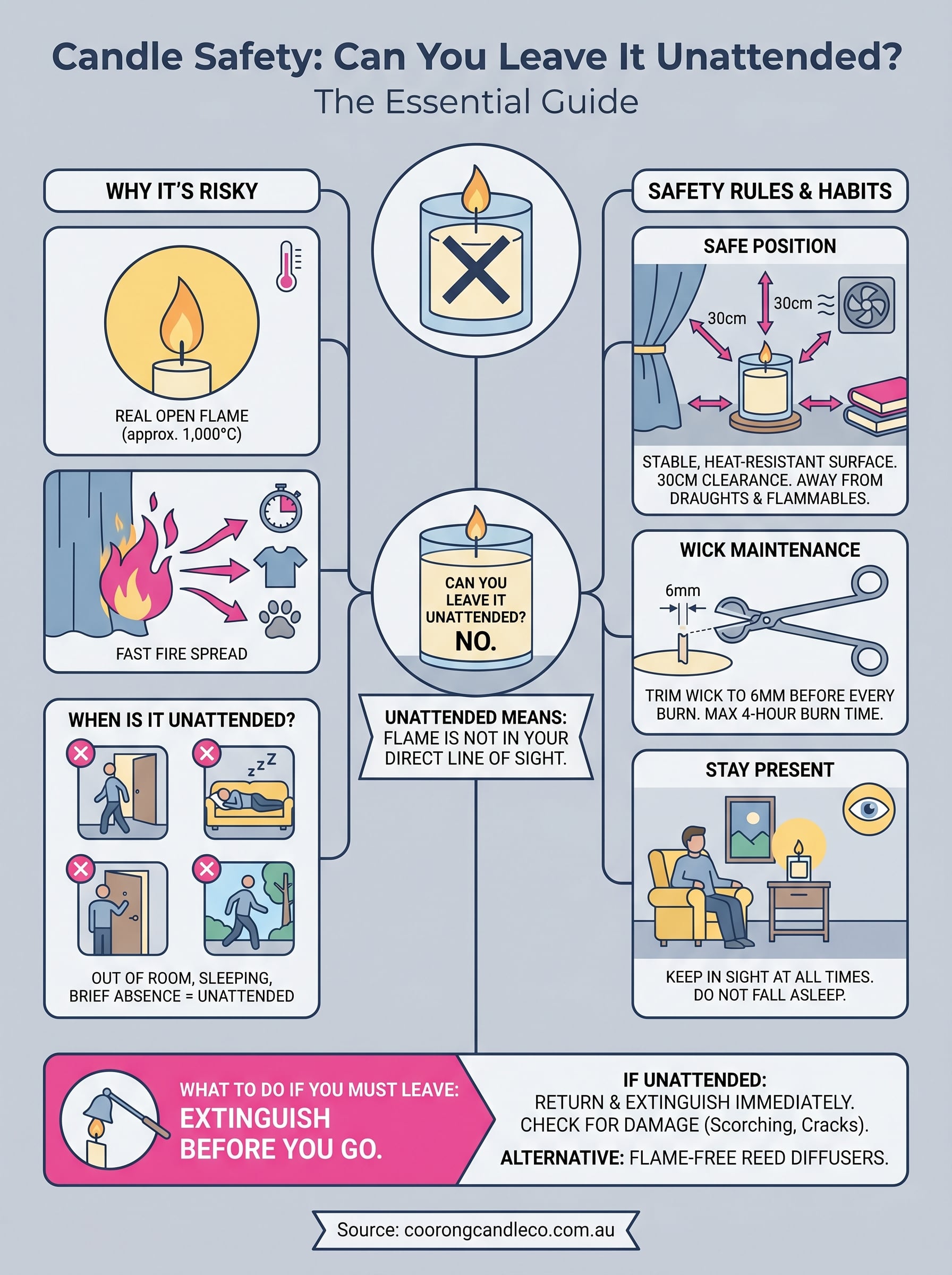
A simple way to stay safe at home
The answer to can you leave a candle burning unattended has never changed: no, you cannot, and no candle type or quality level makes it safe to do so. The good news is that safe candle habits are straightforward to build. Extinguish before you leave the room, trim your wick before each burn, place your candle on a stable heat-resistant surface, and stay present while it burns. Those four steps address the vast majority of candle fire risks in the home.
If you want fragrance without managing a live flame, a reed diffuser delivers continuous scent with no supervision required at all. But when you do light a candle, commit to these habits every single time, and they become second nature quickly. Browse our natural soy candles and flame-free reed diffusers to find the right option for your home and your routine.