
Every soy candle starts with a decision most buyers never think about: which grade of soy candles wax actually goes into the pour. Get it wrong and you end up with poor scent throw, sinkholes, or a candle that burns unevenly no matter how good the fragrance oil is. If you're sourcing wax to make your own candles, or just trying to understand what separates a cheap tin candle from one that fills a whole room, the grade of wax is where it all begins.
This article answers exactly that: what soy candle wax is made from, how container blends differ from pillar blends, and which melting points and additive levels suit Australian conditions. We'll walk through what to look for when comparing suppliers and quantities, so you're not guessing between a 4.5kg bag and a bulk carton.
We write this from the bench, not the boardroom. At Coorong Candle Co., every batch of candles with soy wax we hand-pour in South Australia has taught us something about grade selection, and we're sharing that experience here so you can choose with confidence, whether you're a home hobbyist or comparing candles soy wax options for your next order.
Why soy wax is the top pick for candle makers
Soy wax has become the default choice for anyone serious about candle making in Australia, and it's not just a marketing angle. Soybean oil is hydrogenated into a solid wax that behaves in ways paraffin simply can't match, from how it holds scent to how it looks once it's set in the jar. Understanding why so many makers switch to it helps explain what you're actually paying for when you buy a bag of soy candles wax rather than a cheaper petroleum blend.
A renewable resource that burns cleaner
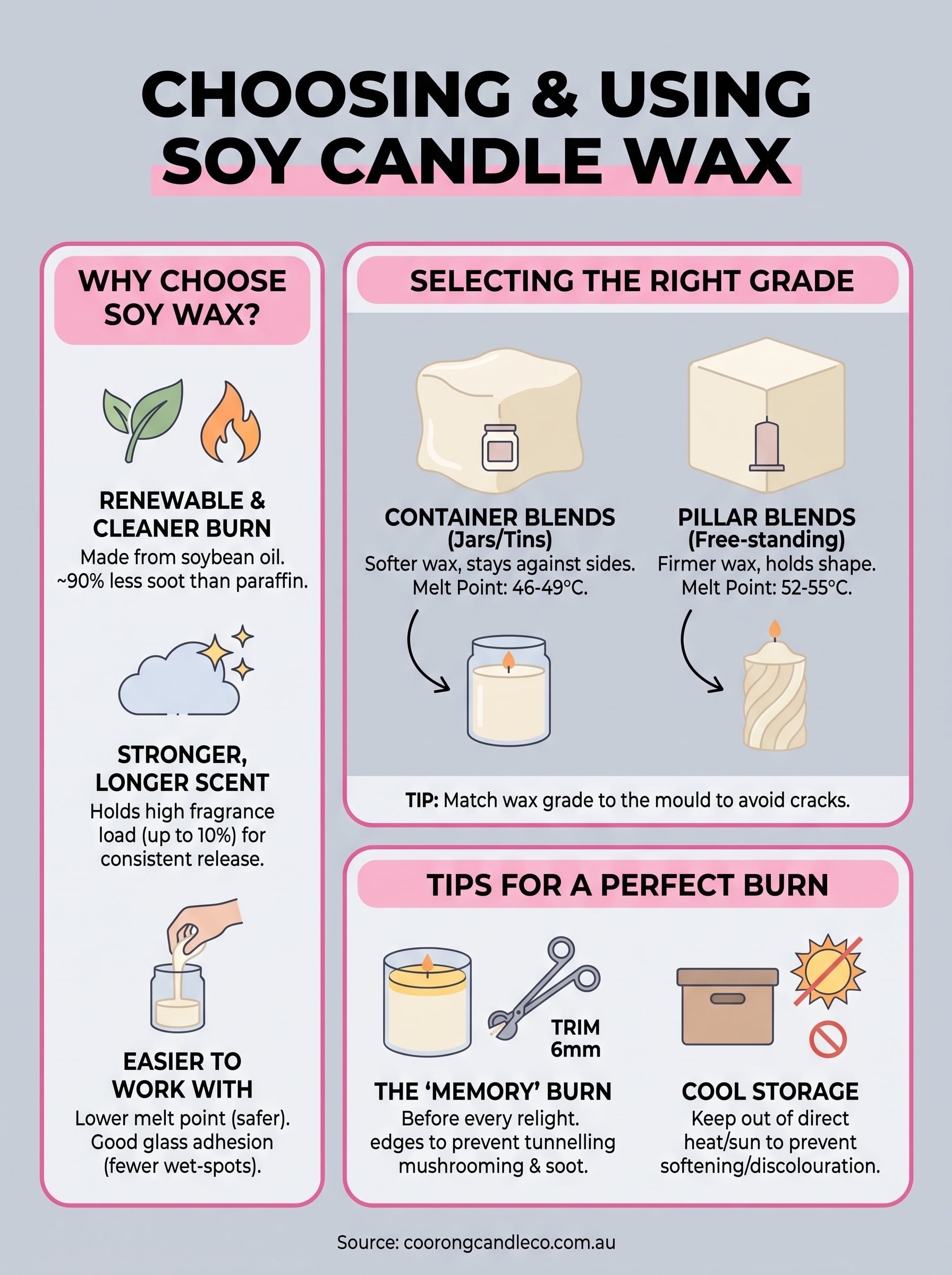
Because it comes from a renewable crop rather than crude oil, soy wax fits naturally with the eco-conscious mindset that drives most of our customers at Coorong Candle Co. Growing soybeans doesn't deplete a finite resource the way petroleum extraction does, and the wax itself is biodegradable, so spills and leftover wax don't linger in the environment the way paraffin residue can. Combustion is cleaner too. Soy wax produces roughly 90% less soot than paraffin, according to research cited by the US Department of Agriculture, which matters if you're burning candles in a closed-up living room or bedroom over a long Australian summer.
Soy wax burns cooler and slower than paraffin, which means your fragrance lasts through the whole candle, not just the first hour.
Stronger, longer-lasting scent throw
Candle makers obsess over scent throw for good reason, and this is where soy wax's structure gives it a real edge. Its slightly porous, crystalline makeup holds more fragrance oil per gram than paraffin without seizing or sweating, so a well-formulated soy candle keeps releasing fragrance evenly from the first light to the last pool of wax. Fragrance oils blend into soy wax at a higher load rate, typically up to 10% by weight in a container blend, compared with the lower thresholds many paraffin waxes tolerate before they start weeping oil back out onto the surface.
Easier to work with, even for beginners
Soy wax is forgiving for anyone learning to pour candles at home, which is part of why it dominates the hobbyist market as well as commercial production. It has a lower melting point than most paraffin blends, so you're working with cooler pours that are safer around kids or a kitchen bench, and it adheres well to glass without the frosting or shrinkage that trips up first-time paraffin users.
- Lower melt point (usually 46-52°C) means safer handling during pouring
- Good glass adhesion reduces the wet-spots and air gaps common with paraffin
- Higher fragrance load capacity gives stronger, more consistent scent throw
- Slower burn rate stretches candle life without sacrificing throw
All of this is why our own range of natural soy candles is built entirely on soy wax, hand-poured in small batches rather than mass-produced from paraffin blends. It's the difference between a candle that smells strong in the shop and one that still fills the room three weeks into burning it.
How to choose the right soy wax grade
Not all soy wax is created equal, and picking the wrong grade is the fastest way to waste a batch of fragrance oil on a candle that won't set properly. Suppliers usually split their soy candles wax into container blends and pillar blends, and mixing the two up is the most common mistake we see from hobbyists starting out.
Container blends versus pillar blends
Container blends are softer, with a lower melt point, and they're designed to stay in glass or tins without shrinking away from the sides. Pillar blends run firmer and hold their shape free-standing, which is exactly what you need if you're pouring moulded candles rather than filling jars. Grabbing a pillar blend for a jar candle, or vice versa, is where most of the sinkholes and cracking come from.
Melting point and additive percentage
Melting point tells you how the wax will behave in your climate, and it matters more in Australia than most overseas guides admit, given how warm our storage sheds and delivery vans can get. Additive percentage, usually vybar or a similar polymer, affects how much fragrance oil the wax can hold before it starts sweating.
| Grade type | Typical melt point | Additive level | Best for |
|---|---|---|---|
| Container blend | 46-49°C | Low-medium | Jars, tins, gift candles |
| Pillar blend | 52-55°C | Medium-high | Free-standing shapes |
| Wholesale bulk soy | 48-52°C | Varies by batch | Larger production runs |
Match the wax grade to the mould before you match the fragrance to the wax, or you'll be fixing problems you didn't need to create.
Buying the right quantity from the right supplier
Quantity matters just as much as grade. Home hobbyists rarely need more than a 4.5kg bag to test a fragrance line, while small commercial producers often move straight to bulk cartons to keep costs down per candle. Reliable suppliers will list melt point, additive type, and recommended fragrance load on the packaging or spec sheet, and if they don't, that's a sign to look elsewhere. If sourcing and testing your own wax feels like more trial and error than you want, our regional gift sets show what a properly graded soy blend can do once it's dialled in.
Soy wax versus paraffin and other candle waxes
Once you understand grades, the next question buyers ask is how soy actually stacks up against the other waxes on the market. Paraffin, beeswax, and coconut wax all have loyal followings, but each comes with trade-offs that matter once you factor in Australian conditions, cost, and how the candle actually performs after a few burns.
Paraffin: cheaper, but at what cost
Paraffin is still the cheapest wax to buy in bulk, and it holds certain novelty dyes and additives better than soy does. That's about where its advantages end. It's derived from crude oil, produces noticeably more soot, and tends to burn hotter and faster, which shortens candle life and can overpower a small room with fragrance rather than filling it evenly. For a brand built around eco-friendly ingredients, paraffin was never a serious contender for us at Coorong Candle Co.
Beeswax and coconut wax as alternatives
Beeswax burns beautifully and has a natural honey scent, but it's expensive, has a low fragrance load capacity, and doesn't take fragrance oils as cleanly as soy. Coconut wax throws scent well and burns cleanly too, but it's pricier again and harder to source consistently in Australian quantities. Most commercial coconut wax candles are actually coconut-soy blends rather than pure coconut, precisely because pure coconut wax is soft and expensive to work with alone.
| Wax type | Renewable | Soot level | Fragrance load | Relative cost |
|---|---|---|---|---|
| Soy wax | Yes | Low | High (up to 10%) | Moderate |
| Paraffin | No | High | Low-moderate | Low |
| Beeswax | Yes | Low | Low | High |
| Coconut wax | Yes | Low | High | High |
If you want a candle that's clean-burning, generously scented, and still affordable to produce, soy wax sits closer to the sweet spot than any of its rivals.
Why soy wins for most home fragrance products
Blending isn't unusual either, and some suppliers sell soy-paraffin or soy-coconut hybrids to chase a firmer set or a glossier finish. We've tested these blends and keep coming back to pure or near-pure soy candles wax, because it gives us the fragrance strength and clean burn our customers expect without leaning on petroleum byproducts to get there.
Tips for a clean, long-lasting burn
Buying good-grade soy candles wax only gets you halfway to a candle that performs well. How you burn it at home matters just as much, and most of the complaints we hear about tunnelling or weak scent throw trace back to burning habits rather than the wax itself.
Give the first burn time to set the memory ring
Getting the first burn right sets up every burn after it. Soy wax has a memory effect, meaning it tends to melt to whatever diameter it reached the first time you lit it, so if you blow it out after twenty minutes, you've locked in a shallow melt pool that will tunnel down the middle for the rest of the candle's life. Let a new candle burn until the wax pool reaches the edges of the jar, usually one to two hours depending on the size, before you put it out.
A rushed first burn is the single biggest reason a good soy candle underperforms.
Trim the wick before every relight
Here's a habit worth building: trim the wick to about 6mm before each burn. A wick left too long will mushroom, drawing up more fuel than it can burn cleanly and producing soot on the jar's inside wall, which looks like a paraffin problem even though the wax underneath is pure soy.
- Trim to 6mm using proper wick trimmers, not scissors, for a cleaner cut
- Keep burns to 3-4 hours at a time so the wax doesn't overheat the container
- Avoid draughty spots, since airflow pulls the flame sideways and causes uneven melting
- Store unlit candles somewhere cool and out of direct sun, since soy wax softens and discolours faster than paraffin in heat
Storage matters more in Australian conditions
Summer storage catches a lot of people out. Soy wax's lower melt point, the same trait that makes it easier to pour, also means it softens faster in a hot car boot or a sunny windowsill than paraffin would. Keeping candles in a drawer or cupboard until you're ready to burn them protects both the scent and the finish, which is exactly how we store our own range before it ships from South Australia.
Choosing wax that suits your craft
Getting soy candle wax right comes down to matching grade, melt point, and quantity to what you're actually making, not grabbing whatever bag is cheapest at the craft shop. A container blend suits jars and tins, a pillar blend suits free-standing shapes, and your climate and storage habits decide how forgiving that wax will be once it leaves the shelf. Knowing this turns candle making from guesswork into a repeatable craft, whether you're pouring your first batch or refining a recipe you've run a dozen times.
Sourcing is only half the job. If you'd rather skip the trial and error and see what properly graded soy candles wax looks like once it's fragranced, set, and burning cleanly, browse our natural soy candle range and see the difference the right grade makes in your own home.