
Candle warmer lamps have surged in popularity, promising a flameless way to enjoy your favourite candles while making them last longer. But are candle warmer lamps worth it, or are they just another gadget that ends up collecting dust? It's a fair question, especially when you've invested in quality handmade candles and want to get the most from every pour.
At Coorong Candle Co., we hand-pour every soy candle in small batches here in South Australia, so we care deeply about how our customers experience them. Whether you light a wick or place a jar under a halogen bulb, the way you melt your candle affects scent throw, burn time, and safety, three things worth understanding before you spend $40 to $150 on a warmer lamp.
This article breaks down the real pros and cons of candle warmer lamps, covering cost-effectiveness, safety compared to open flames, and how well they actually distribute fragrance. We'll also look at how they perform with natural soy wax specifically, so you can decide whether a warmer lamp deserves a spot in your home sanctuary, or whether a match still does the job better.
Why candle warmer lamps have become popular
Candle warmer lamps didn't appear out of nowhere. They've been building momentum for several years as home fragrance has moved from a niche interest to something people actively design their living spaces around. If you've noticed them appearing on wishlists and in home styling content, there's a clear set of reasons behind that shift, and most of them come down to lifestyle, aesthetics, and practical convenience rather than any single trend.
The shift toward treating home as a sanctuary
The years Australians spent at home through the pandemic pushed many people to invest more intentionally in their living spaces, and that habit has stayed. Home has become a place of active restoration for a lot of people, not just somewhere to sleep and store things. Scent plays a direct role in that shift, with a growing body of research linking ambient fragrance to mood regulation and reduced stress responses. Candle warmer lamps fit cleanly into this mindset because they offer a continuous, low-effort way to fragrance a room without needing to monitor an open flame or follow a burning schedule.
Scent is one of the fastest ways the brain signals a shift in mood, which is why ambient fragrance has become a genuine part of daily wellness routines rather than just a decorative habit.
For many households, warmer lamps are more practical for everyday use in rooms where you wouldn't leave a burning candle unattended, such as a home office, a study, or a room shared with young children. The lamp sits on a shelf and works quietly in the background without asking anything of you.
The aesthetic appeal that drives purchase decisions
Candle warmer lamps carry a visual quality that standard wax melters simply don't match. Many designs function as stand-alone decorative objects, using shaped shades in materials like matte ceramic, rattan, or vintage-style metal that cast warm, diffused light into a room even when you're not actively warming a candle beneath them. That dual function as lamp and fragrance source makes them attractive to anyone who thinks carefully about what sits on their surfaces.
Platforms like Pinterest have amplified this considerably. Styled interiors regularly feature warmer lamps as part of a considered, curated home aesthetic, which has introduced them to audiences who would never have searched for them directly. If you've spotted one in a home tour or a gift guide and thought it looked genuinely appealing, you're responding to that visual quality, not just marketing.
The practical reasons people make the switch
Beyond looks, a few specific practical factors have driven real conversion from wick burning to warmer lamps. The most consistently cited is candle longevity: when you melt wax using gentle heat from above rather than a direct flame, the wax melts more slowly and evenly, which extends the life of your candle significantly. For someone who has spent $40 or more on a quality handmade candle, that's a compelling reason to reconsider how they use it.
Renters and people in shared accommodation have also found warmer lamps useful because some lease agreements and body corporate rules restrict open flames inside units or apartments. A warmer lamp sidesteps that restriction entirely while still letting you enjoy the scents you've chosen for your space. Add in the absence of soot, dripping wax, or the risk of a forgotten flame, and the practical argument builds quickly and convincingly.
How a candle warmer lamp works and what to expect
A candle warmer lamp uses a heat source, typically a halogen bulb positioned above the wax, to gently melt the surface of your candle from the top down. No wick is involved, and no flame touches the wax at any point, which is the fundamental difference between this method and traditional burning.
The mechanics behind the heat
Most warmer lamps house a 25W to 40W halogen bulb inside a decorative shade that sits over the top of a candle jar. The bulb generates enough radiant heat to slowly liquefy the top layer of wax, releasing fragrance molecules into the air without combustion. The temperature stays well below what an open flame produces, which affects how fragrance oils evaporate and how gradually your candle diminishes over time.
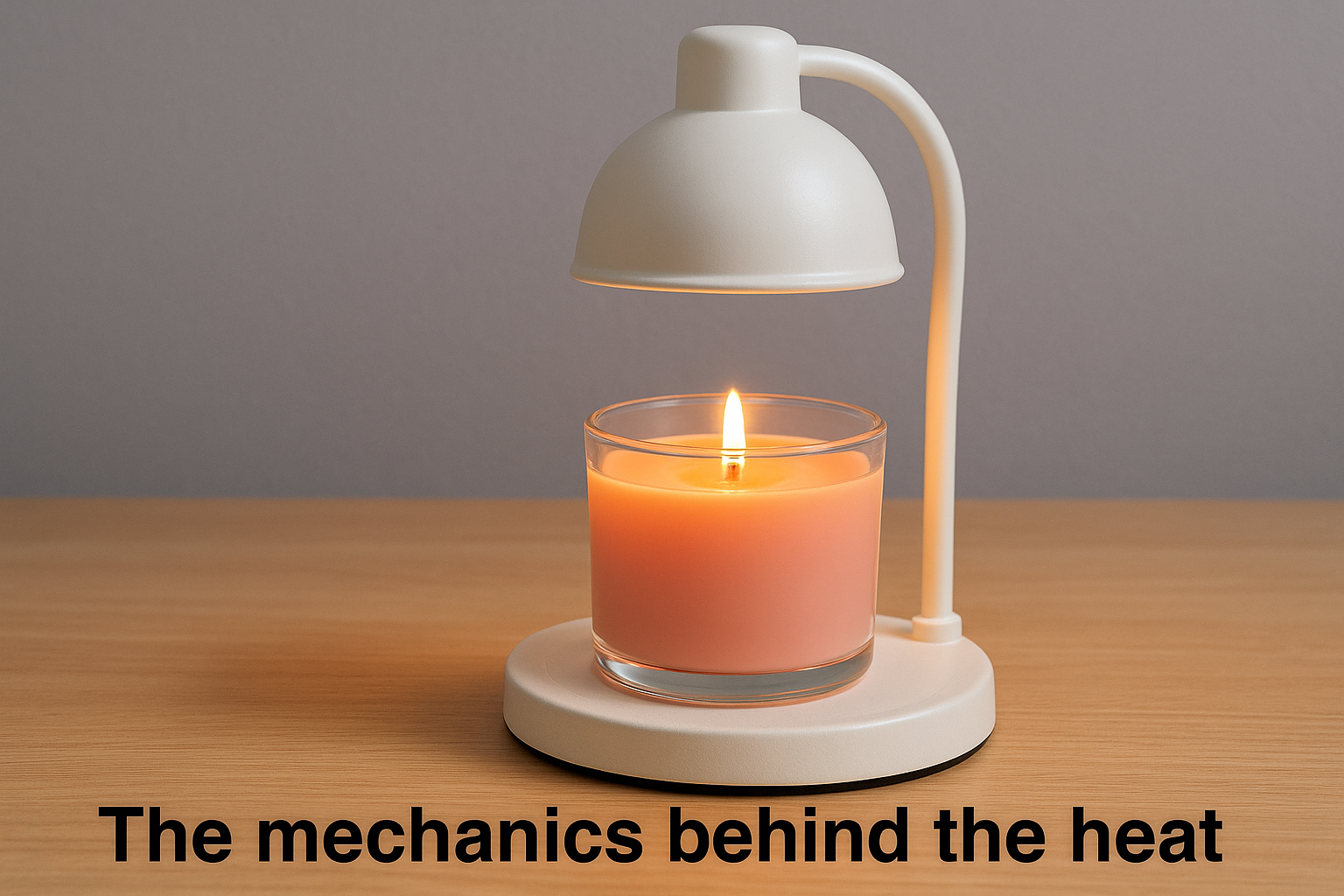
Because the heat is gentler and more controlled, soy wax candles tend to respond particularly well to warmer lamps, releasing scent steadily rather than in a single sharp burst.
Some models include adjustable dimmer switches that let you control bulb intensity directly, giving you influence over how strong the scent throw is in your space. This feature is worth comparing when shopping, as a fixed-wattage lamp may not suit every candle size or room volume equally well.
What to expect from scent throw and wax life
When you switch from burning to warming, two things change noticeably: scent intensity and the rate at which your candle disappears. Warmer lamps typically produce a softer, more ambient fragrance rather than the sharper throw you get from an open flame. Whether that suits you depends on whether you want background scent or a stronger sensory presence in the room.
Your candle will also last considerably longer under a lamp than it would with a lit wick. The slower melt rate means you're not burning through wax at the same speed, which is one of the most common reasons people ask are candle warmer lamps worth it in the first place. Many users report getting 30 to 50 percent more use from the same candle, though the actual figure varies based on lamp wattage, room temperature, and the diameter of your candle jar.
Safety and air quality vs burning candles
One of the most straightforward reasons people ask are candle warmer lamps worth it comes down to safety and what enters the air in their home. Open flames carry real risks that warmer lamps eliminate entirely, and the difference in air quality between the two methods is worth understanding clearly before you decide which suits your space.
Fire risk and household safety
With a warmer lamp, there is no open flame at any point, which removes the primary fire hazard associated with traditional candle use. Forgotten burning candles cause a significant number of residential fires in Australia each year, and warmer lamps sidestep that risk completely. The lamp stays warm rather than hot, and while you should avoid leaving any electrical appliance running indefinitely, the risk profile is considerably lower than a lit wick sitting near soft furnishings or timber surfaces.
A warmer lamp is particularly worth considering for households with young children or pets, where an unattended flame creates a genuine everyday hazard.
What burning releases into your air
When a candle wick burns, combustion produces byproducts including soot particles, carbon dioxide, and trace amounts of volatile organic compounds, even with a quality soy candle. The candle itself matters here: natural soy wax with a cotton wick produces far less soot than paraffin alternatives, but some particulate matter is unavoidable whenever you have a flame. For people with asthma, allergies, or respiratory sensitivities, that distinction can genuinely affect comfort at home. Broadly, candle choice affects what goes into your air:
- Soy wax with cotton wick: minimal soot, lower particulates, no lead
- Paraffin with synthetic wick: higher soot output, more chemical byproducts
Air quality with a warmer lamp
A warmer lamp releases fragrance through gentle evaporation rather than combustion, so you avoid soot and most of the particulate matter associated with burning. Fragrance oils still disperse into the air, so adequate ventilation remains sensible regardless of which method you use. If you're sensitive to strong scents, the adjustable dimmer feature available on some lamp models gives you direct control over how much fragrance enters your space at any one time, which a lit candle simply cannot offer.
Cost and running costs in Australia
The upfront price of a candle warmer lamp in Australia generally falls between $40 and $150, depending on build quality, shade material, and whether the lamp includes features like a dimmer switch. Budget options sit around the $40 to $60 mark and typically use fixed-wattage bulbs with simpler shades, while mid-range and premium designs in ceramic or rattan run from $80 upward and hold up considerably better with regular use. That initial outlay is the primary cost to weigh, but it's only one part of the full financial picture.
What you spend on electricity
Running a 25W to 40W halogen bulb for a few hours daily adds very little to your power bill. At current Australian residential electricity rates, a 25W lamp running for four hours each day costs roughly $0.50 to $0.70 per week, which works out to around $26 to $36 per year. For most households, that's a negligible ongoing expense, particularly when you factor in the reduced rate at which your candles diminish under gentle radiant heat compared to an open flame burning through the wax directly.
If you compare that electricity cost against buying replacement candles more frequently through wick burning, a warmer lamp recovers its purchase price within a reasonable timeframe for any regular candle user.
Candle savings over time
This is where the financial case becomes most compelling, and it's what makes are candle warmer lamps worth it such a practical question rather than a purely aesthetic one. Candle longevity is the central argument: a quality soy candle priced at $40 to $55 that provides around 50 hours of wick burn time can stretch to 70 hours or more under a warmer lamp, depending on the lamp wattage and the diameter of the jar.
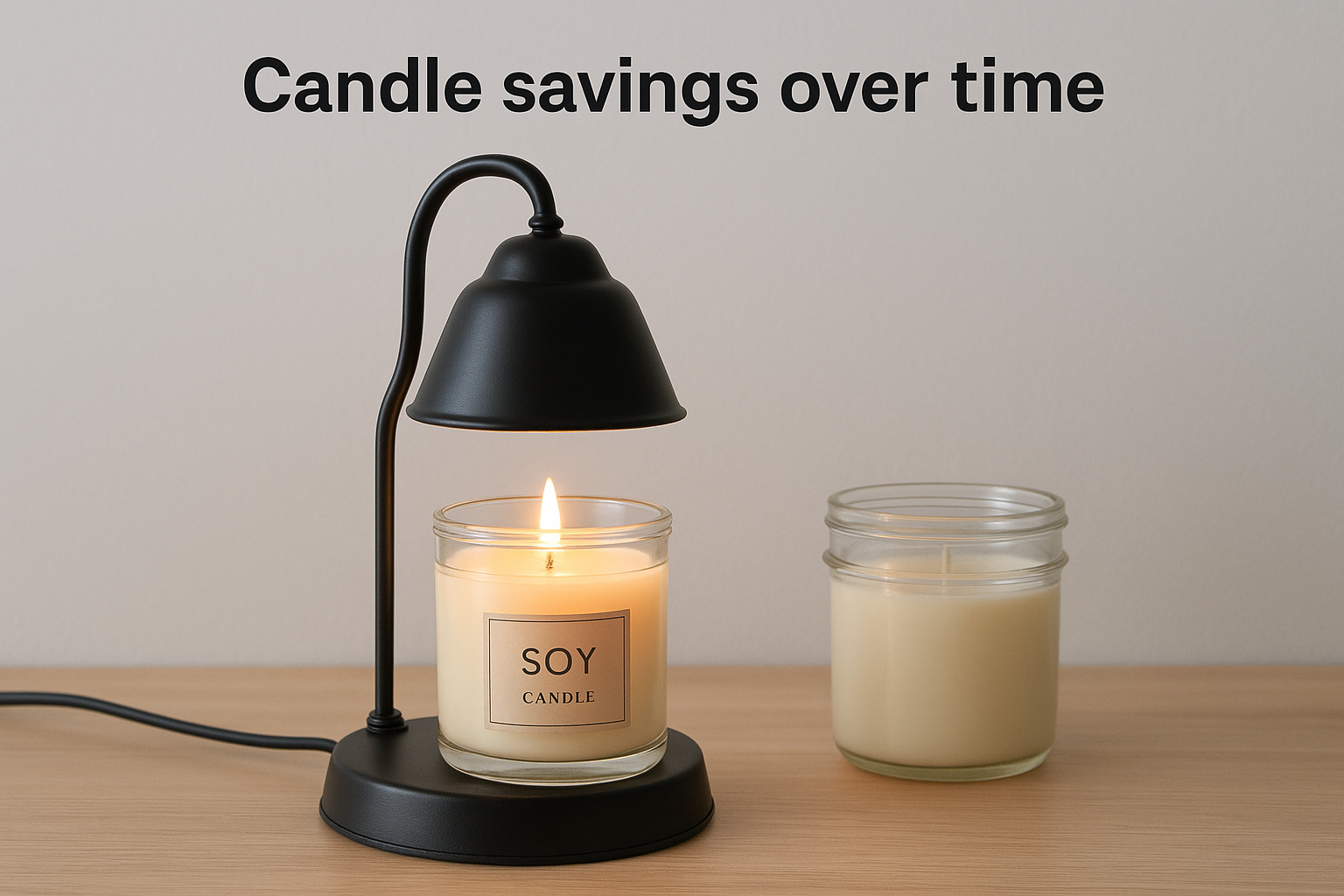
For someone burning candles consistently across the year, that extension adds up to real savings. The upfront lamp cost effectively pays for itself through reduced candle replacement, often within the first few months of regular use. These savings become more pronounced the more you invest in quality handmade candles, since choosing the lamp over lighting the wick each time protects a higher-value product and draws more from every gram of wax you've already paid for.
How to choose one and use it well
Once you've worked through whether are candle warmer lamps worth it for your home, the next step is choosing the right one and using it properly from the start. Build quality and wattage matter more than aesthetics alone, and a poorly matched lamp will underdeliver regardless of how good your candle is. Taking a few minutes to match lamp specifications to your candle collection before purchasing saves you from an underwhelming result.
Match the lamp to your candle size
Jar diameter is the most important factor to check before buying a warmer lamp. A shade that's too narrow will trap heat unevenly, while one that's too wide won't concentrate warmth effectively over the wax surface. Most standard 350g candle jars sit between 80mm and 90mm in diameter, so look for lamp shades designed to accommodate that range comfortably before committing to a purchase.
Wattage matters here too. A 25W bulb suits smaller jars and rooms where you want subtle background scent, while a 40W bulb works better for larger jars or open-plan living areas where fragrance needs to travel further. If you find a lamp with an adjustable dimmer switch, that flexibility removes the guesswork and lets you control scent intensity based on the room, the time of day, and the strength of the fragrance oil in your specific candle.
Getting the most from every session
Run your warmer lamp for two to four hours at a time rather than leaving it on continuously. Wax fragrance has a saturation point, and your nose adjusts to ambient scent quickly, so shorter sessions deliver more noticeable impact each time you switch the lamp on. Rotating between two or three different candle scents across the week also helps, since your brain responds more strongly to a fragrance it hasn't encountered for several hours.
Clean the inside of your lamp shade occasionally with a dry cloth to prevent dust settling on the bulb, which reduces heat output and shortens bulb life over time.
Allow the wax to cool and solidify fully between sessions before moving the jar or switching candles. Liquid wax that gets jostled mid-session pools unevenly and affects both fragrance release and how cleanly the candle finishes across its full lifespan.
Final take
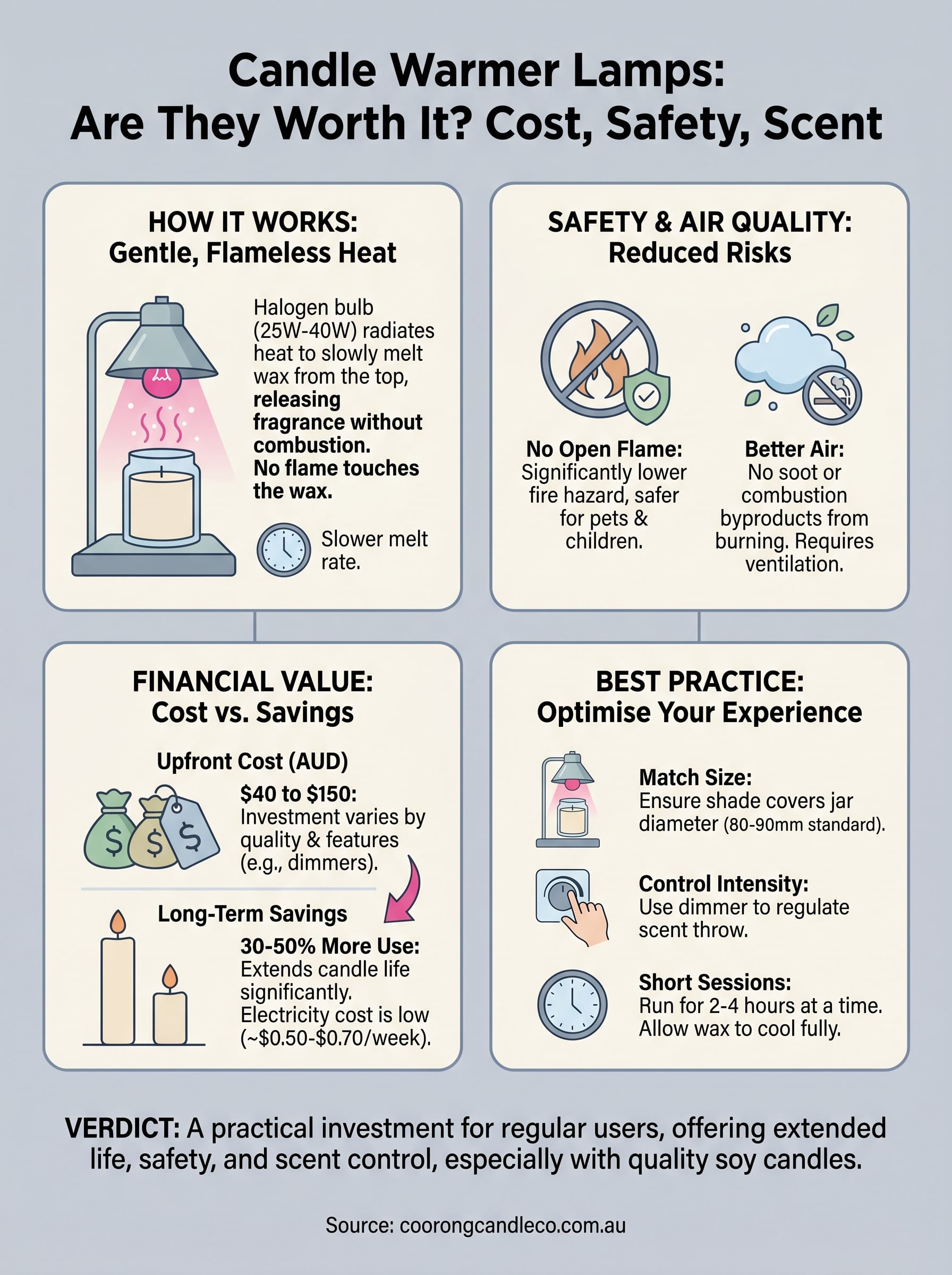
So, are candle warmer lamps worth it? For most regular candle users, yes. They extend candle life, reduce fire risk, and give you genuine control over scent intensity in a way that open-flame burning simply cannot. The financial case is straightforward: the upfront cost recovers through slower wax consumption, especially if you regularly buy quality handmade candles. The safety and air quality benefits make them a sensible choice for any household where a lit wick feels impractical or risky.
That said, a warmer lamp works best when the candle underneath it is worth the effort. Natural soy wax with quality fragrance oils responds particularly well to gentle radiant heat, releasing scent cleanly and consistently across every session. If you want a collection worth warming, explore our handmade soy candles and home fragrance range, hand-poured in small batches from South Australia, and built to deliver exactly that.