
You've mixed up a batch of DIY room spray, given it a good shake, spritzed it around the house, and twenty minutes later, the scent has completely vanished. Sound familiar? The problem usually isn't your technique. It's the fragrance oils for room spray you're using and how you're combining them with the rest of your ingredients.
At Coorong Candle Co., we work with fragrance oils daily to create our hand-poured soy candles and reed diffusers here in South Australia. That hands-on experience has taught us exactly what makes a scent stick around in a room versus fade into nothing. The same principles apply whether you're pouring a candle or bottling a room spray.
This guide walks you through choosing the right fragrance oils, mixing a room spray that actually lasts, and a few proven tricks to extend scent throw well beyond that first spritz. We'll also cover common mistakes that silently kill your spray's longevity, so you can stop wasting good oil on a formula that underperforms.
What makes room sprays fade fast
Room spray scent fades for a handful of specific, fixable reasons, and once you know them, you can address each one directly. Most DIY recipes circulating online cut corners on two or three critical points, which explains why your spray smells incredible in the bottle but disappears the moment it hits the air.
The alcohol you choose matters
The most common culprit is using the wrong carrier alcohol. Many recipes suggest cheap vodka or isopropyl alcohol from the chemist, but these don't disperse fragrance oils evenly and they evaporate so fast they take your scent with them. You need a high-proof ethanol (ideally 190-proof or pharmaceutical grade) to properly carry and release fragrance over time. It costs a little more, but the difference in staying power is immediate.
The grade of alcohol you use determines how long your fragrance oils for room spray actually stay airborne after each spritz.
Your fragrance concentration is too low
Most beginner recipes use somewhere between 1% and 3% fragrance oil, which is not enough to make an impression on a room. A well-performing room spray sits between 15% and 20% fragrance concentration by volume. Anything below 10% will feel flat and short-lived, regardless of how good the fragrance oil smells straight from the bottle.
The missing ingredient most DIYers skip
Solubiliser (sometimes listed as polysorbate 20) is the binding agent that keeps your fragrance oil properly mixed into the water portion of your spray. Without it, the oil simply floats on top of the liquid, the bottle looks cloudy, and each spritz delivers an inconsistent hit of scent. Adding the correct ratio of solubiliser, typically one part solubiliser to every one part fragrance oil, is the single change that fixes most fading problems immediately.
Ingredients and equipment you need
Getting your ingredients right before you start saves time and prevents you from reformulating halfway through a batch. You only need four core ingredients and a small set of basic equipment to produce a room spray that actually performs.
The four ingredients
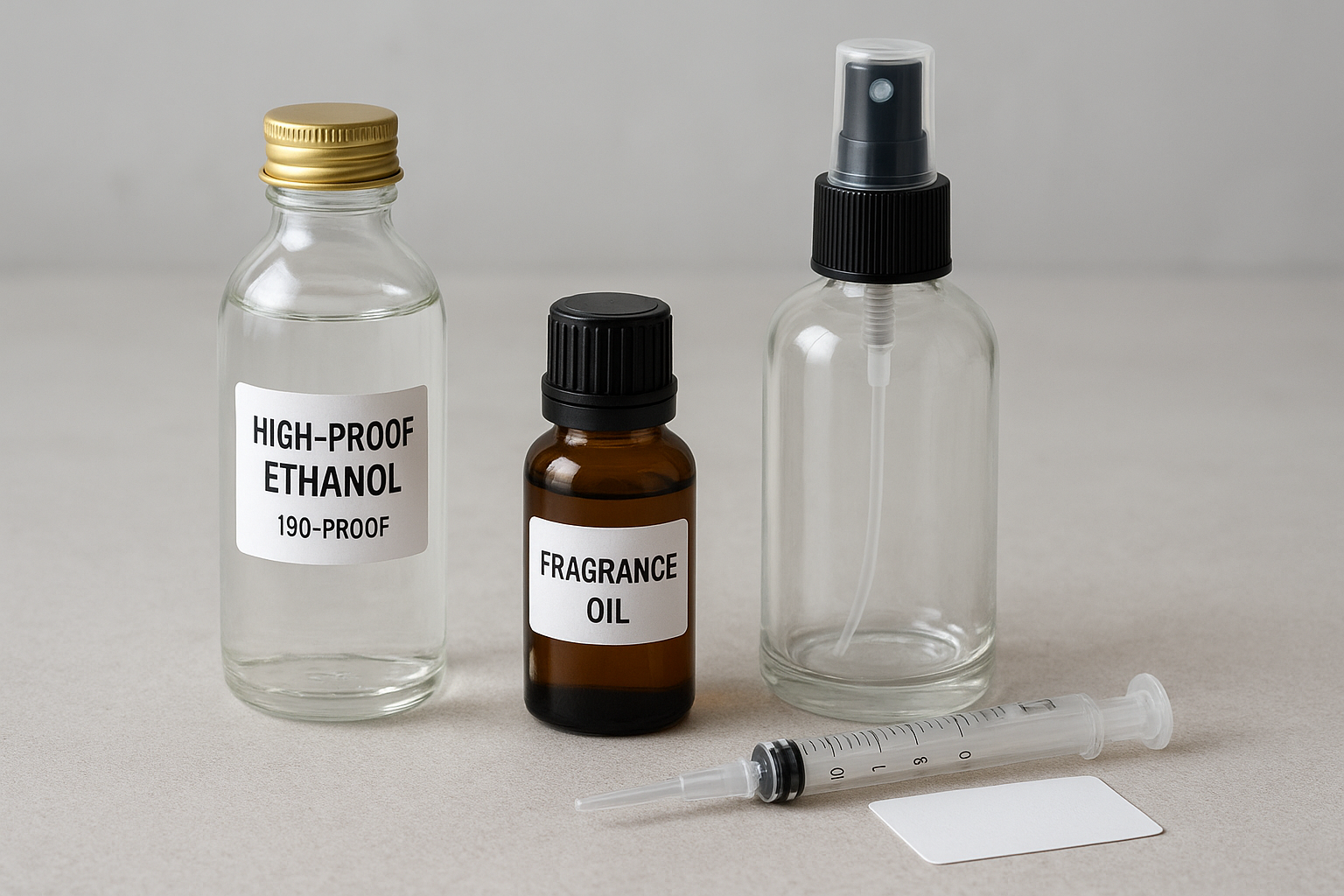
Here is exactly what to gather for a standard 100ml batch:
| Ingredient | Purpose | Amount for 100ml batch |
|---|---|---|
| High-proof ethanol (190-proof) | Carrier and dispersant | 70ml |
| Fragrance oil | Scent source | 15-20ml |
| Polysorbate 20 (solubiliser) | Binds oil to water | Equal volume to fragrance oil |
| Distilled water | Dilutes the spray | Top up to 100ml |
Equipment you need
You don't need specialist tools to get started. A 100ml glass spray bottle, a small measuring syringe, and a set of labels are enough to run your first batch. Glass is the better choice over plastic because many fragrance oils for room spray will degrade plastic bottles over time, affecting both the container and the scent quality.
Always use distilled water rather than tap water; minerals in tap water can cloud your spray and alter how your fragrance oil performs once diluted.
Step 1. Make a stable fragrance oil concentrate
Before you add any water or alcohol, combine your fragrance oil with solubiliser first. This pre-mixing step is what most DIY guides skip, and it is why so many sprays turn cloudy or inconsistent. Doing it in the right order gives you a clear, stable concentrate that blends cleanly into the rest of your formula.
Combine the oil and solubiliser
Measure your fragrance oil and polysorbate 20 in equal volumes directly into a small glass beaker or measuring cup. For a 100ml batch, use one of these ratios depending on how strong you want your spray:
- 15ml fragrance oil + 15ml polysorbate 20 for a standard room spray
- 20ml fragrance oil + 20ml polysorbate 20 for a stronger, longer-lasting result
Stir gently for 30 seconds until the mixture looks completely clear with no separation visible.
This pre-mix stage is critical when working with fragrance oils for room spray because it determines whether your final spray disperses evenly or pools inconsistently with every spritz.
Check your concentrate is ready
Your concentrate is ready when it flows freely and looks transparent throughout. If you spot any oily rings or haziness, add one or two more drops of solubiliser and stir again before moving to the next step.
Step 2. Dilute, bottle, and label your spray
Once your concentrate is clear and stable, you can move on to diluting it and getting it into the bottle. This step is straightforward, but the order you add each ingredient matters more than most people expect.
Add the alcohol and water in the right order
Pour your 70ml of high-proof ethanol into the glass spray bottle first, then add your fragrance oil and polysorbate 20 concentrate directly into the alcohol. Stir or swirl gently for about 20 seconds. Adding the concentrate to alcohol rather than water first keeps everything evenly dispersed and prevents cloudiness before you introduce the water.
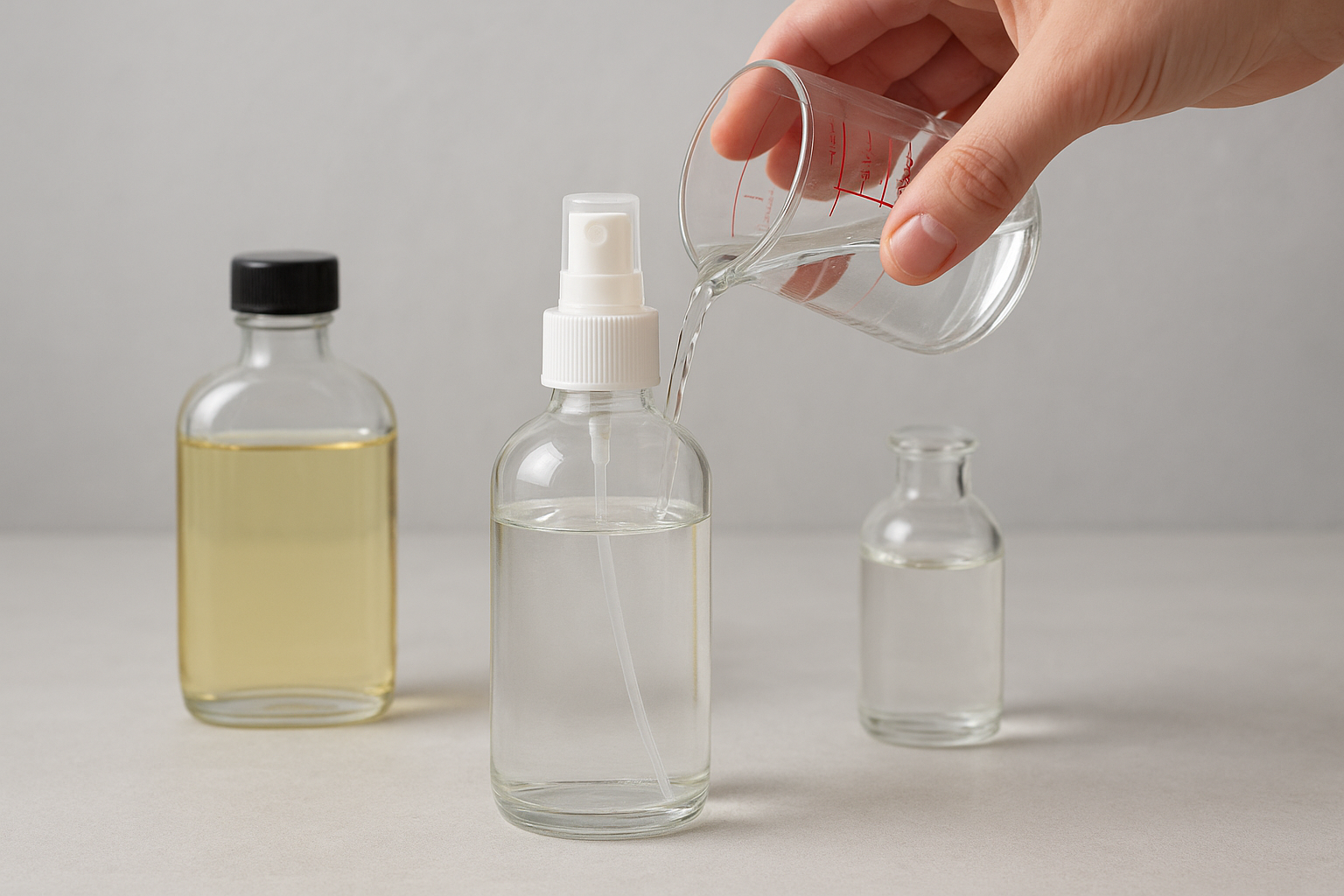
Always add the water last when working with fragrance oils for room spray; water added too early causes the formula to emulsify unevenly.
Top up to 100ml with distilled water, screw on the spray nozzle, and give the bottle a gentle shake for 10 seconds. Your spray should look completely clear.
Label your bottle with the essentials
Unlabelled bottles create confusion and wasted effort, especially if you make multiple scent variations at once. At minimum, your label should include:
- Fragrance name and batch date
- Concentration (e.g., 15% or 20%)
- Key ingredients for safety reference
A clearly labelled bottle also helps you replicate a formula you love without guesswork.
Step 3. Make the scent last longer in your home
Having a well-made spray is only part of the equation. Where and how you spritz makes a significant difference to how long the scent lingers. A few targeted habits will extend the life of your fragrance oils for room spray well beyond what the formula alone can deliver.
Spray fabric and soft surfaces, not just air
Fabric holds scent far longer than open air. Aim your spray at cushions, curtains, and upholstery rather than misting it into the centre of the room. Soft furnishings act like a slow-release surface, gradually releasing the fragrance as the room warms throughout the day.
Spraying directly onto fabric can multiply how long your room spray scent lasts compared to misting into open air alone.
Control the room conditions
Humidity and airflow both affect how quickly a scent disperses. In well-ventilated rooms, fragrance evaporates faster. Closing doors and windows for 10 to 15 minutes after spraying gives the scent time to settle before air circulation dilutes it.
A slightly warmer room also helps fragrance molecules stay airborne longer. Spritzing just before you turn on a heater or after a warm shower are two situations where the same amount of spray will perform noticeably better than in a cool, draughty space.
Quick recap and what to try next
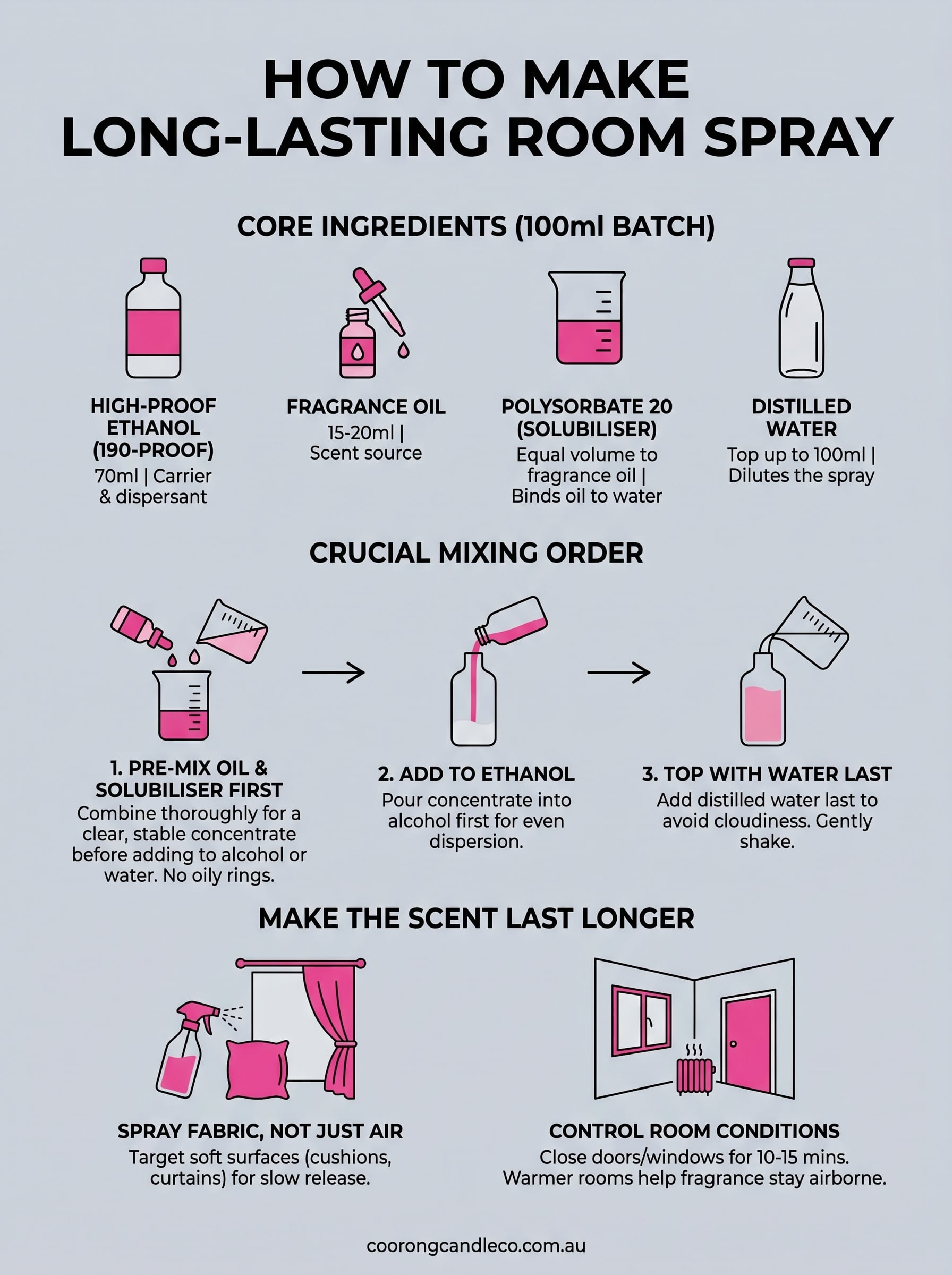
Making a room spray that actually holds its scent comes down to four decisions: using high-proof ethanol, hitting a fragrance concentration between 15% and 20%, adding polysorbate 20 as your solubiliser, and spraying onto fabric and soft surfaces rather than open air. Get those four things right, and your formula will outperform most commercial sprays you can buy off the shelf.
The order of mixing matters just as much as the ingredients themselves. Combine your fragrance oil with solubiliser first, add it to alcohol second, and top up with distilled water last. That sequence keeps your fragrance oils for room spray stable, clear, and consistent with every spritz you make.
Ready to see what a well-crafted room spray can do without the DIY work? Browse the Coorong Candle Co. room spray collection for premium, ready-made scents inspired by South Australian landscapes.