
Walk into most gift shops and you'll find a wall of reed diffusers promising rose, jasmine or gardenia, yet half of them smell more like air freshener than an actual flower. Choosing good floral reed diffusers means knowing what separates a true botanical scent from a synthetic one, and how to pick a fragrance that actually suits the room you're placing it in.
If you're browsing for reed diffusers with flowers as a gift or a way to freshen your living room, the short answer is this: look at the oil quality, the reed material, and whether the florals are balanced with base notes so the scent doesn't turn cloying after a week. Strength matters too, since a diffuser in a hallway needs more punch than one on a bedside table.
This guide walks you through everything worth checking before you buy, from reading ingredient lists to matching a reed diffuser flowers blend with your home's style, plus how to keep the scent throwing strong for months rather than fading after a fortnight.
What to know before choosing a floral reed diffuser
Before you add anything to your cart, it helps to understand why so many floral diffusers disappoint. Most mass-produced versions rely on synthetic fragrance oils that mimic a flower's scent using a handful of aroma chemicals, and it helps to understand how essential oils and fragrance oils differ before you compare bottles. They smell strong on day one, then flatten out into something sharp and one-note by week two. A genuinely good floral diffuser uses a fragrance blend built on real botanical notes, layered with wood or musk bases so the scent doesn't just evaporate, it matures.
Quality also shows up in how the scent behaves in your home rather than in a shop. Cheap oils often smell fine in a small sample vial but turn overpowering or artificial once the reeds have been sitting in a warm room for a few days. That's the real test of a floral reed diffuser: does it still smell like a flower after two weeks, or has it turned into something closer to cleaning product?
A floral diffuser is only as good as how it smells on day fourteen, not day one.
Natural versus synthetic floral blends
Here's a quick way to compare what you're likely to find on shelves versus what a small-batch maker like Coorong Candle Co. uses in its reed diffusers:
| Feature | Synthetic mass-market blend | Natural botanical blend |
|---|---|---|
| Scent longevity | Strong at first, fades or turns sharp within 1-2 weeks | Consistent, softens gradually over 6-8 weeks |
| Ingredients | Fragrance oil, mineral oil carrier | Essential oils, natural carrier oils, cotton reeds |
| Room feel | Can smell chemical or heavy | Reads as fresh, closer to a real bloom |
| Price point | Lower upfront cost | Higher upfront cost, better cost-per-week |
Once you've settled on that distinction, the next question is which floral note actually suits your space, since jasmine in a small bathroom behaves very differently to jasmine in an open living area.
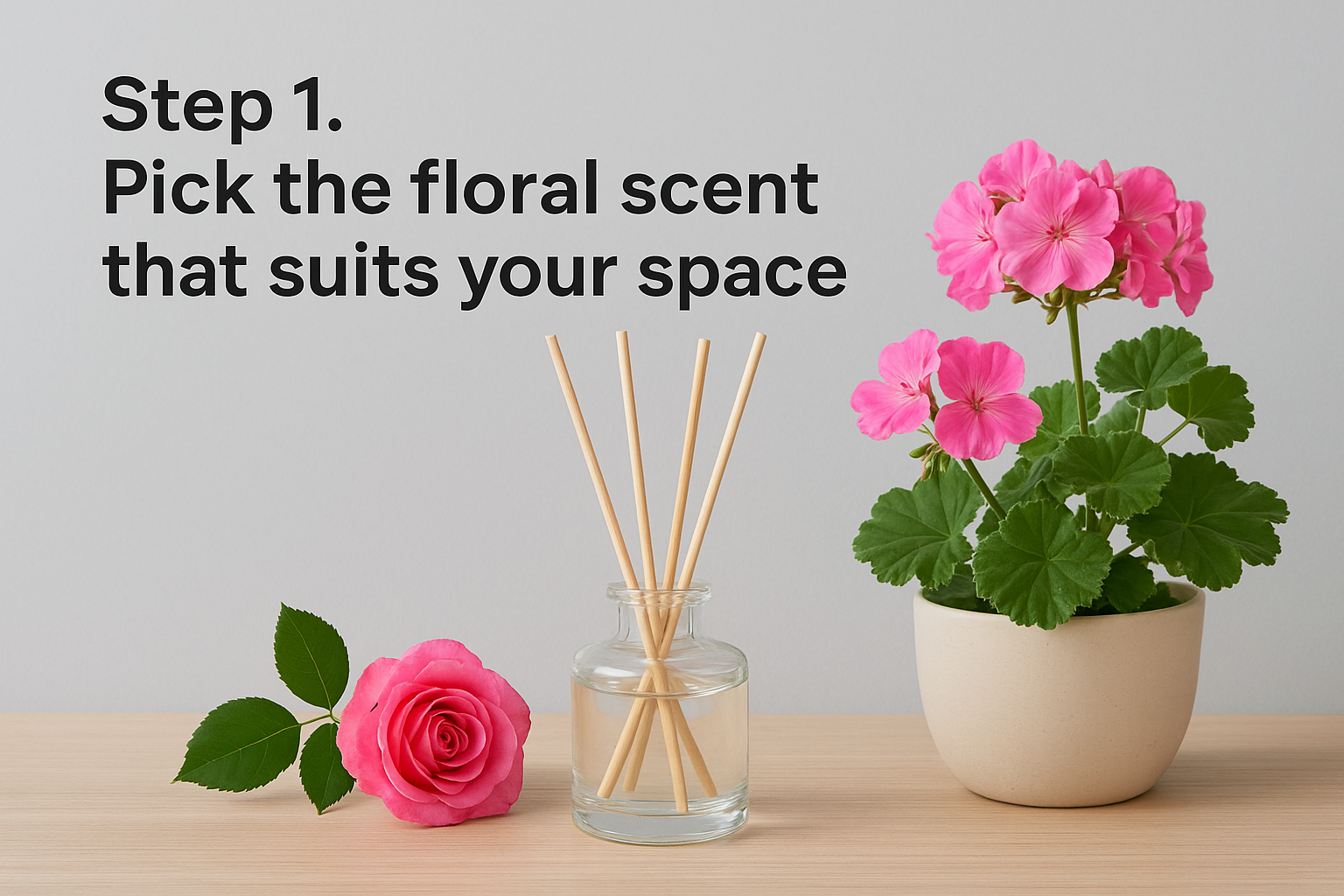
Step 1. Pick the floral scent that suits your space
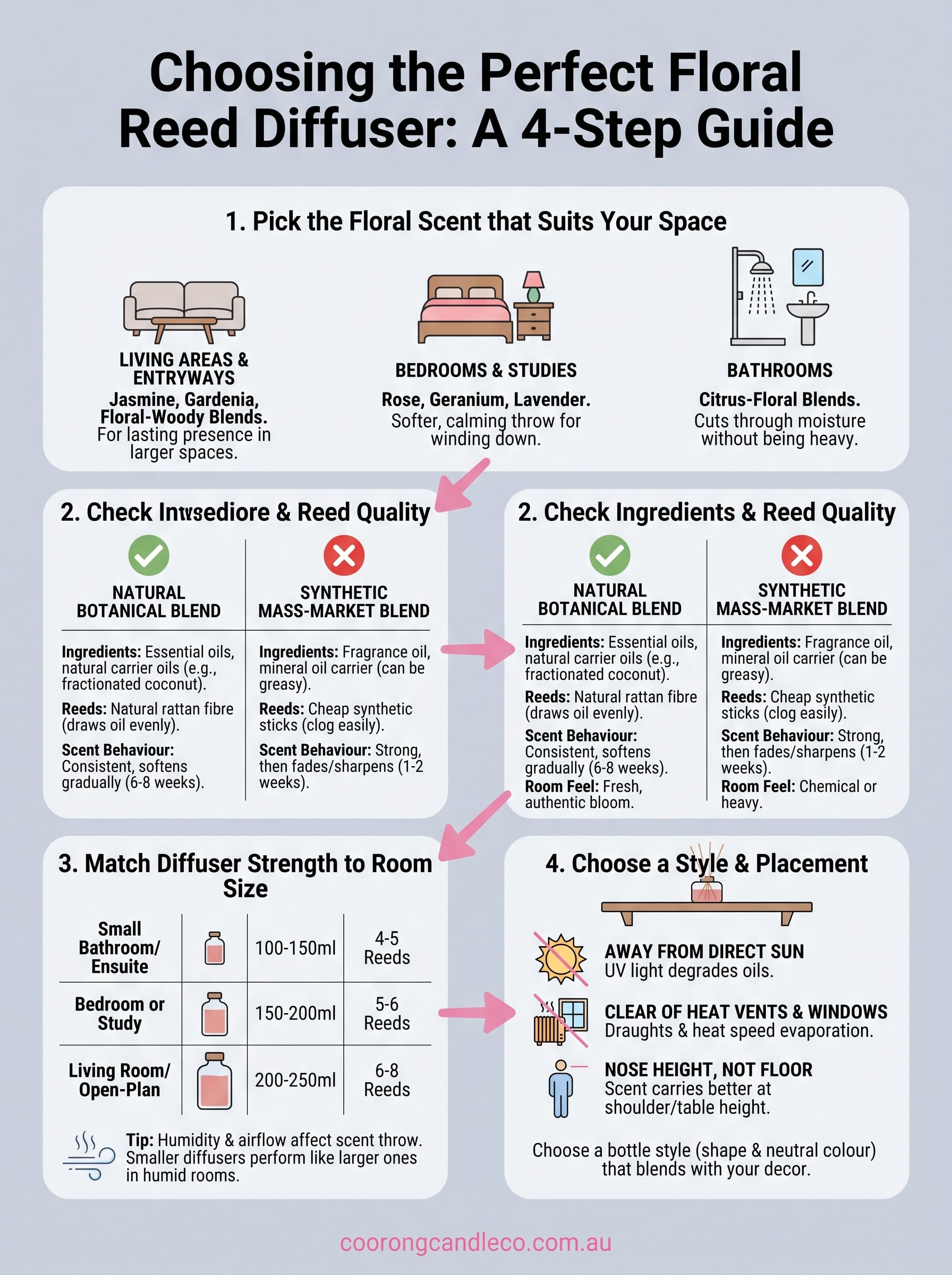
Start by thinking about how you use the room, not just what flower you like on paper. Jasmine and gardenia carry an intense, almost creamy sweetness that suits an entryway or living room where the scent has space to spread, but they can feel overwhelming in a small ensuite. Rose and geranium sit lighter and softer, making them a safer pick for bedrooms or anywhere you sit close to the diffuser for hours at a time. Lavender and chamomile blends lean calming rather than sweet, which is why they turn up so often among the essential oils people choose for reed diffusers on a bedside table to help them wind down.
Regional and native florals are worth considering too, especially if you want something that doesn't smell like every other diffuser on the market. Coorong Candle Co.'s Regional Collections pair florals with native Australian botanicals, so a Kangaroo Island blend might mix wildflower with coastal eucalyptus rather than a straight, generic rose.
Match the flower to the room's mood, not just to your favourite scent.
Quick scent-to-room guide
- Living areas: jasmine, gardenia, or a floral-woody blend for lasting presence
- Bedrooms: rose, geranium, or lavender for a softer, calming throw
- Bathrooms: citrus-floral blends that cut through moisture without turning heavy
- Entryways: stronger florals with a musk or wood base to greet guests
Once you've narrowed the scent family, the next thing to check is what's actually inside the bottle.
Step 2. Check the ingredients and reed quality
Turn the bottle around before you buy, because the ingredient list tells you more than any marketing copy on the front. Look for essential oils or natural fragrance blends listed ahead of synthetic fragrance oil, and check whether the carrier is one of the best oils for reed diffusers rather than mineral oil, which can leave a greasy film on surfaces and fade the scent faster. A short, plain-language ingredient list is usually a good sign. A long string of unpronounceable chemical names, even if it's technically compliant, tells you the floral note is being built entirely from synthetics.
Reeds matter just as much as what's inside the bottle. Natural fibre reeds, usually rattan reeds, draw oil upward through capillary action far more evenly than the cheap synthetic sticks bundled with some supermarket sets. Synthetic reeds tend to clog, throw scent unevenly, and need replacing within a few weeks.
Good reeds are half the fragrance, not just a decoration in the bottle.
What to check on the label
- Fragrance type: essential oil or natural blend, not just "fragrance oil"
- Carrier oil: natural oil (like fractionated coconut) rather than mineral oil
- Reed material: natural rattan, ideally 6-8 reeds for a 200-250ml bottle
- Bottle size: larger bottles generally last longer without needing constant refills
- Country of production: small-batch, locally made blends often use higher-grade oils than mass imports
Once you know the ingredients stack up, the next step is working out how much diffuser you actually need for the room you're placing it in.
Step 3. Match diffuser strength to your room size
Sizing a diffuser wrong is one of the most common mistakes people make, and it has nothing to do with fragrance quality. A 200ml bottle with 6 reeds might smell perfect on a bathroom shelf but disappear entirely in an open-plan living space, which is why diffusers made for large rooms are worth a look. Larger rooms need either a bigger bottle, more reeds, or a stronger floral concentration to actually notice the scent once you're a few metres away.
Humidity and airflow change things too. Bathrooms and kitchens tend to carry scent further because of steam and warmth, so a smaller 200ml diffuser often performs like a much larger one would in a dry, air-conditioned bedroom. Rooms with constant airflow, like near an open window or a ceiling fan, will burn through oil faster and need topping up sooner.
Size the diffuser to the room, not the other way around.
Room size guide
| Room type | Suggested bottle size | Reed count |
|---|---|---|
| Small bathroom or ensuite | 100-150ml | 4-5 reeds |
| Bedroom or study | 150-200ml | 5-6 reeds |
| Living room or open-plan area | 200-250ml | 6-8 reeds |
| Entryway or hallway | 250ml+ | 8 reeds |
Coorong Candle Co.'s reed diffuser range ships in a standard bottle size that suits most bedrooms and living areas, so if you're placing one in a larger open space, consider running two smaller diffusers rather than relying on a single bottle to fill the whole room. Once the strength is sorted, it's worth thinking about how the diffuser actually looks sitting on your shelf.
Step 4. Choose a style and placement that suits your home
Once you've settled on scent and strength, the bottle itself becomes part of your decor, not just a fragrance vessel. Glass bottle shape matters more than people expect: a tall, slim bottle suits a narrow bathroom shelf, while a squat, rounded vessel sits better on a coffee table or console where it needs to hold its own visually. Neutral glass in amber, clear or frosted tones tends to blend into most interiors, whereas coloured ceramic vessels can clash if your room already has a strong palette.
Placement affects performance as much as looks. Keep your floral reed diffusers away from direct sunlight and heating vents, both of which break down the oil faster and shorten how long the scent lasts. A shelf at nose height, away from strong draughts, lets the fragrance settle into the room evenly rather than blowing straight past you.
Put the diffuser where you'll actually smell it, not just where it looks pretty.
Placement checklist
- Away from direct sun: UV light degrades fragrance oils over time
- Nose height, not floor level: scent carries better at shoulder or table height
- Clear of heating vents and windows: draughts and heat both speed up evaporation
- Stable, flat surface: avoids spills and lets reeds sit upright
If you're gifting one rather than keeping it, Coorong Candle Co.'s home fragrance gift sets pair a diffuser with a matching candle, which solves the styling question for you since the two are designed to sit together on the same shelf.
Bringing floral fragrance into your home
Getting a floral reed diffuser right comes down to four checks: pick a scent suited to the room, read the ingredient list before the price tag, size the bottle to the space, and place it somewhere the fragrance can actually reach you. Skip any one of these steps and you'll end up with the same disappointing result as that wall of supermarket diffusers, a scent that fades fast or never smelled like a real flower to begin with.
Once you've nailed those basics, choosing between blends becomes far easier, and you'll notice the difference within the first week rather than wondering why the jasmine you bought smells like plastic. Natural botanical blends paired with proper rattan reeds simply outlast and outperform synthetic alternatives, room after room.
If you're ready to try one, browse the Coorong natural reed diffusers and find a floral blend suited to your home.