
Walk into any home fragrance aisle and you'll spot a bundle of thin sticks sitting in a bottle of scented oil. That's a rattan reed diffuser, and it's one of the simplest ways to keep a room smelling good without a flame or a power point. But not all reeds are created equal, and the wrong ones will leave you with a lukewarm scent throw and a bottle of oil that barely moves.
If you're here to actually buy diffuser sticks, you want to know what separates a good rattan reed from a dud one, how many to use, and how often to flip them. Real rattan has a porous, fibrous structure that wicks oil upward and releases fragrance steadily, unlike synthetic fibre reeds that clog fast or flood the surface below.
In this guide, we'll cover what rattan reed diffusers are made from, how they compare to fibre reeds and flame-free alternatives, and the practical details that matter when you're choosing sticks for your own space, from reed thickness to oil compatibility.
Why rattan reeds make such a difference to your home
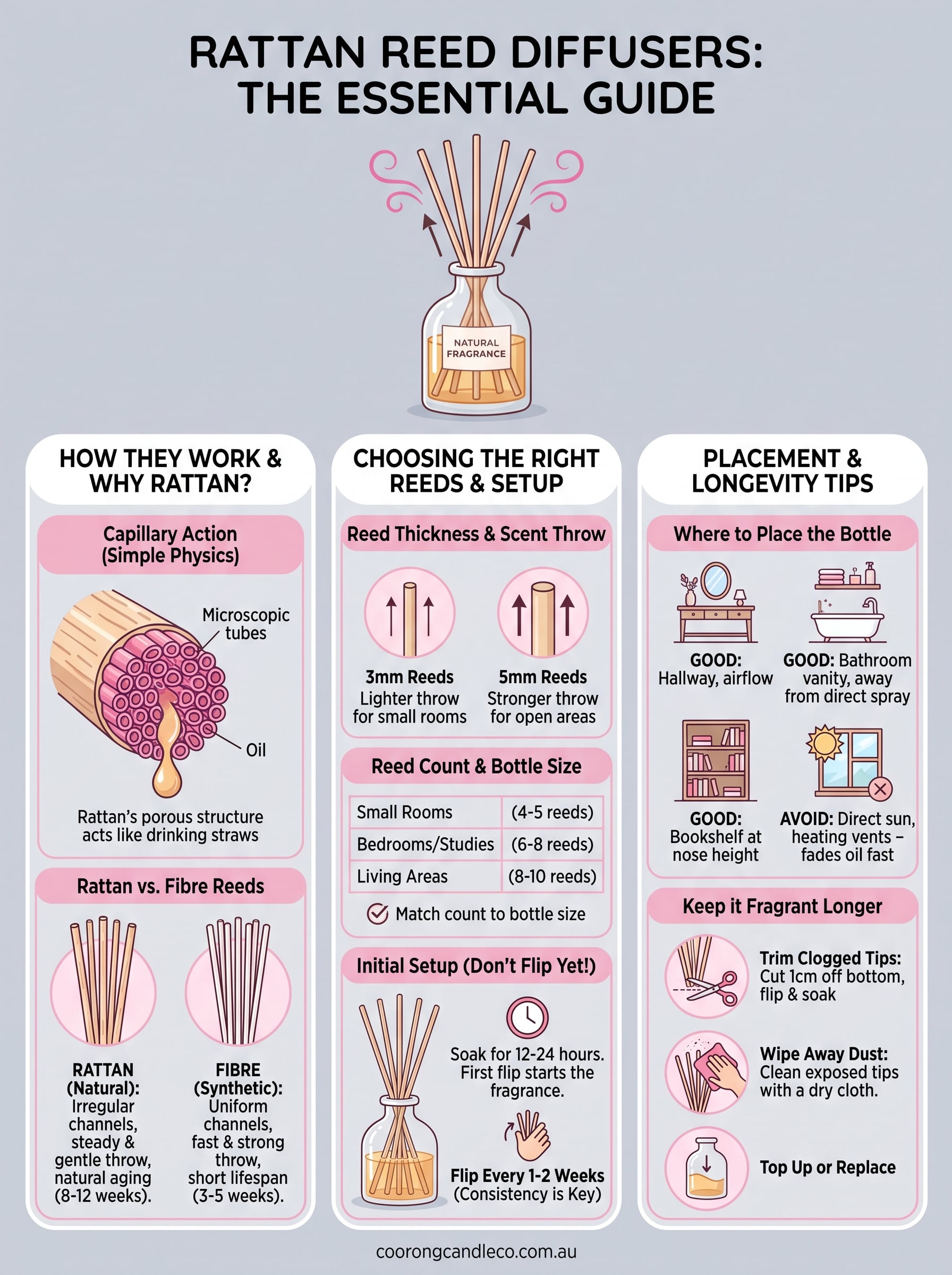
Rattan works because of a simple physics trick called capillary action. The stick's core is riddled with microscopic channels, like a bundle of drinking straws bundled into one thin rod. Dip that rod into scented oil and the liquid climbs upward against gravity, then evaporates off the exposed surface at the top. This is why a rattan reed diffuser keeps working around the clock without a flame, a power cord, or you lifting a finger. Cheaper reeds, or reeds cut from the wrong part of the plant, don't have that consistent channel structure, so the oil either stalls halfway up or floods out the top and drips down the side of the bottle.
Fragrance without fire or electricity
Compare that to a candle, which needs to be lit, watched, and eventually blown out, or an electric diffuser, which needs a power point and, in most cases, water mixed into the formula to create mist. Reed diffusers sit quietly on a shelf and do their job passively. There's no risk of an unattended flame near curtains or pets in the house, and no humming motor to listen to at 2am. For bedrooms, bathrooms, nurseries, and anywhere you want ambient scent without babysitting a device, rattan reed diffusers are the lower-maintenance choice.
A good set of rattan reeds turns a bottle of oil into a room freshener that runs itself, no flame, no power, no fuss.
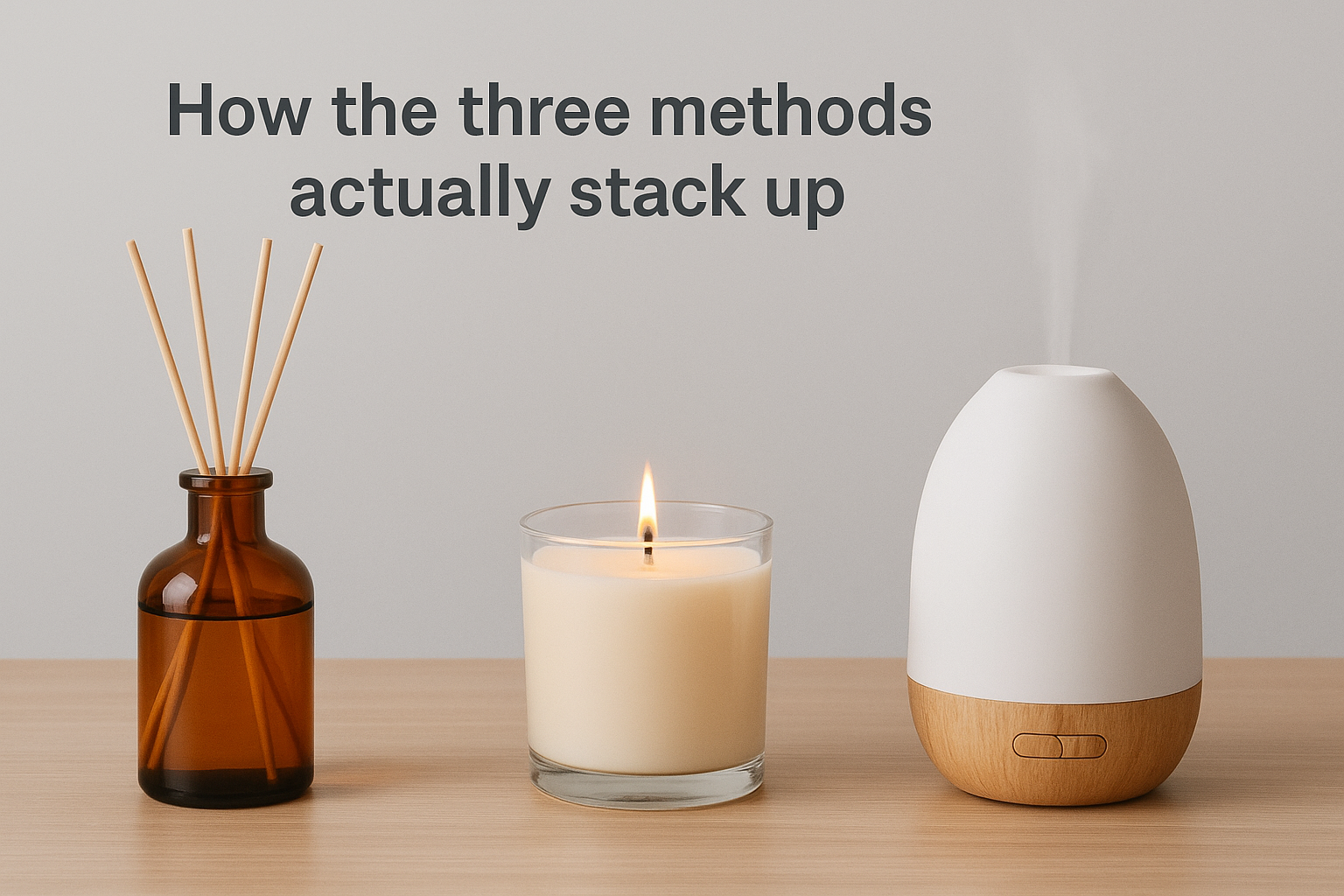
How the three methods actually stack up
It helps to see the trade-offs side by side rather than take it on faith. Here's how rattan reed diffusers compare with the two most common alternatives for everyday home fragrance:
| Method | Runs unattended | Power needed | Typical lifespan | Scent consistency |
|---|---|---|---|---|
| Rattan reed diffuser | Yes | None | 8-12 weeks per bottle | Steady, gentle throw |
| Soy candle | No, needs supervision while lit | None | Hours of burn time per session | Strong while burning, absent when out |
| Electric/ultrasonic diffuser | Yes | Mains or battery | Ongoing while plugged in | Strong bursts, can fade between refills |
Each method has its place. Plenty of our customers pair an Australian-made soy candle for evening ambience with a reed diffuser for daytime scent, so the room never sits empty of fragrance. But if you want something you can set up once and largely forget, reeds win on convenience.
The natural aesthetic factor
Beyond function, rattan brings a look that plastic or synthetic reeds can't match. The pale, slightly textured wood sits well against ceramic, glass, and stone, which is part of why interior stylists lean on diffuser bottles as small styling objects on a console table or bathroom vanity. Genuine rattan also ages gracefully, taking on a faint patina rather than looking tired or yellowed the way some synthetic reeds do after a few weeks in oil. If you're using your diffuser as part of a broader home styling choice, the material itself matters as much as the scent coming off it.
Why the plant matters for sustainability
Rattan is a climbing palm, not a tree, which means it regrows quickly after harvesting without the land clearing associated with hardwood timber. That's a meaningful point for anyone choosing home fragrance based on environmental impact, and it lines up with the same thinking behind choosing soy wax over paraffin in a candle. At Coorong Candle Co, we pair our rattan reeds with reed diffuser oils made without synthetic fillers, because the sustainability story falls apart if the stick is natural but the liquid it's sitting in isn't. If eco-credentials matter to your buying decision, check that both halves of the diffuser, the reeds and the oil, are actually doing what the label implies.
Understanding why rattan performs the way it does sets you up to make a smarter choice at the shelf. The next question is practical: how do you actually pick the right sticks for the bottle and the oil you've got.
How to choose the right rattan reed diffuser sticks
Once you understand why rattan works, picking the right sticks comes down to three practical details: thickness, length, and count. Get these wrong and even the best reed diffuser oil will underperform, sitting quietly in the bottle instead of filling the room. Most home fragrance diffusers sold in Australia use reeds between 3mm and 5mm in diameter, and that small difference changes how quickly oil travels and how strong the scent throw becomes.
Thickness changes the scent throw
Thinner reeds, around 3mm, wick oil faster and suit lighter, more delicate fragrances where you don't want an overpowering result in a small bathroom or bedroom. Thicker reeds, closer to 5mm, draw oil more slowly but release a stronger, longer-lasting throw, which works better in open living areas or hallways where scent needs to travel further. If you've ever set up a rattan reed diffuser and found the fragrance barely noticeable, there's a good chance the reeds were too thin for the space you put them in.
Match reed thickness to room size, not the other way around, and the scent throw takes care of itself.
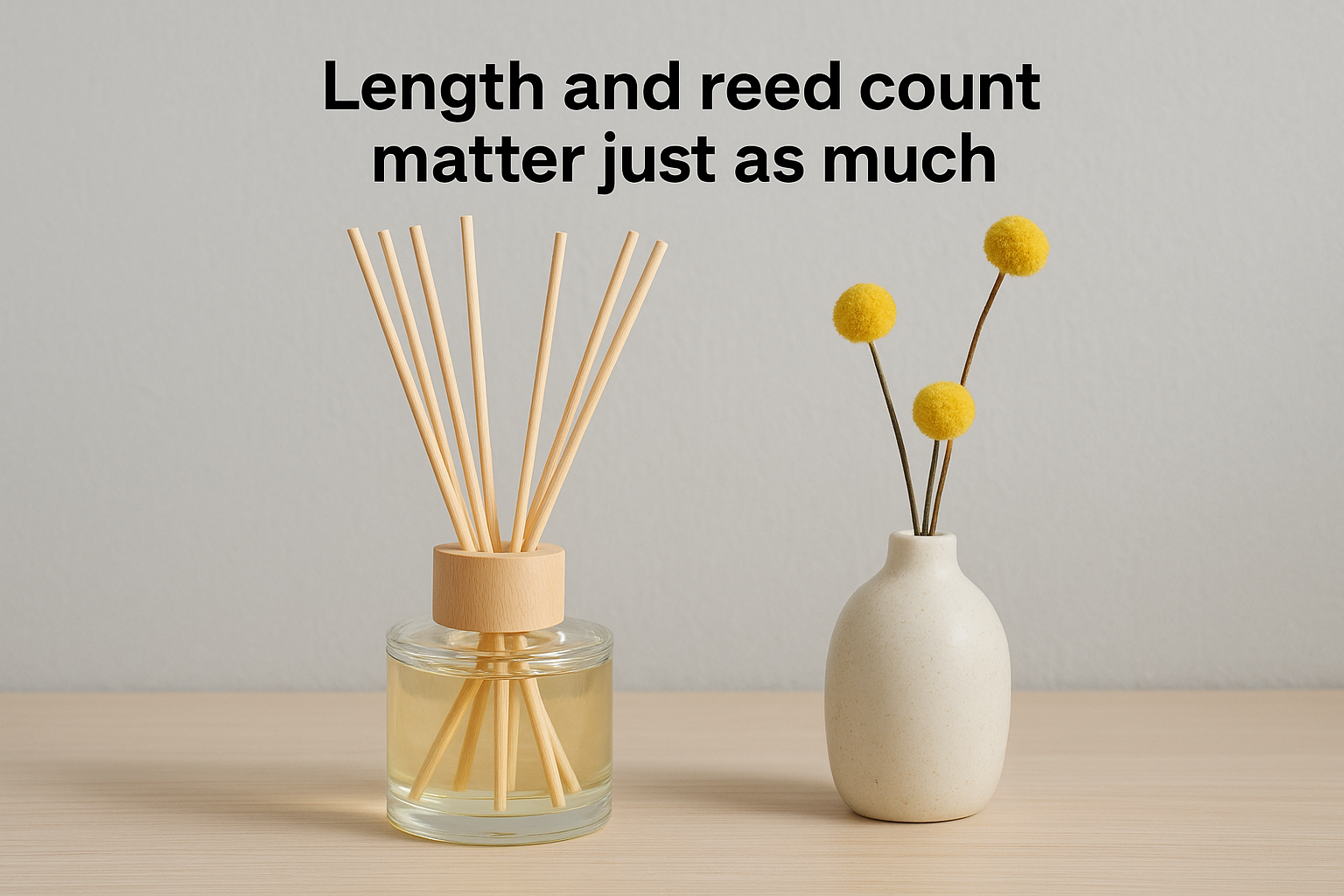
Length and reed count matter just as much
Length matters for a different reason: it controls how much surface area sits exposed to the air. Standard reeds run between 20cm and 25cm, tall enough to stand upright in most diffuser bottles without toppling, while leaving several centimetres exposed above the rim. As for how many sticks to use, the general rule is:
- Small rooms or bathrooms: 4 to 5 reeds
- Bedrooms and studies: 6 to 8 reeds
- Living areas and open-plan spaces: 8 to 10 reeds
More reeds mean more exposed surface area, which means a stronger scent throw, but there's a ceiling. Cramming ten reeds into a small 100ml bottle just drains the oil faster without meaningfully increasing fragrance, so match the count to the bottle size as well as the room.
Check the reed to oil compatibility
Compatibility between the reeds and the oil formula is the detail most people skip, and it's the one that causes the most disappointment. Reeds calibrated for a thin, low-viscosity oil will flood and drip when used with a thicker, oil-based fragrance, while reeds designed for thicker fragrance oils won't wick a watery formula efficiently at all. This is why buying reeds and oil as a matched set, rather than mixing brands, tends to give a more predictable result. It's also worth checking that the reed sticks for your diffuser are genuine rattan rather than a rattan-look synthetic, since the packaging doesn't always make this obvious and the difference only becomes apparent once the sticks are sitting in oil and not doing much.
Getting the thickness, length, and count right for your room is half the job. The other half is how you set the diffuser up once the reeds are in the bottle, which is where a lot of the scent throw either gets wasted or put to good use.
How to set up and position your reed diffuser
Setting up a rattan reed diffuser properly takes about two minutes, but most of the disappointment people report traces back to skipping one small step. Unwrap the reeds, drop them into the oil, and resist the urge to flip them straight away. Fresh rattan needs time to draw oil up through its channels before the top end has anything worth releasing, so give it a good twelve to twenty-four hours before you touch the sticks at all. Flip too early and you're just moving dry wood around.
The first flip matters most
Once that initial soak is done, turn the reeds so the saturated end points upward and the dry end sits in the oil. This is the step that actually kicks off the fragrance throw, since the oil-soaked tip is now exposed to air and starts evaporating properly. After that first flip, repeat the process every one to two weeks depending on how strong you want the scent. Flipping more often speeds up how quickly the bottle empties, so treat it as a dial rather than a fixed routine.
The first flip is what turns a bottle of oil into an actual scent, not the moment you drop the reeds in.
Where to place the bottle
Positioning affects performance almost as much as the reeds themselves. A diffuser tucked into a corner or behind furniture has nowhere for its scent to travel, no matter how good the reeds are. Aim for a spot with some air movement but out of direct sun, since UV exposure breaks down fragrance oils faster and can fade the bottle itself. Good placement options include:
- A hallway console table, where scent greets you as you walk past
- A bathroom vanity, away from direct spray from the shower
- A bookshelf or sideboard at roughly nose height, since scent needs to drift down as much as sideways
- Near, but not directly beside, a window that gets opened regularly
Avoid placing a diffuser directly next to a heating or cooling vent. Constant airflow across the reeds dries them out unevenly and can empty the bottle within weeks instead of the two to three months a well-placed diffuser should give you.
Reading how your room responds
Give any new setup three or four days before deciding it's not strong enough. Fragrance oils need time to build up in a room, especially a large open space, and judging the throw on day one usually leads to unnecessary flipping or adding extra reeds too soon. Height plays a role too: reeds standing tall in a bottle on a low coffee table won't project scent as effectively as one placed higher, since warm air naturally carries fragrance upward and outward. If a room still feels under-scented after a week of proper flipping, the fix usually isn't more reeds, it's moving the bottle somewhere with better airflow or swapping to reeds a millimetre thicker for that space.
Once placement and flipping become routine, the next decision is what the reeds themselves are actually made from, and whether rattan is genuinely the better choice for every room in your home.
Rattan versus fibre reeds: which suits your space
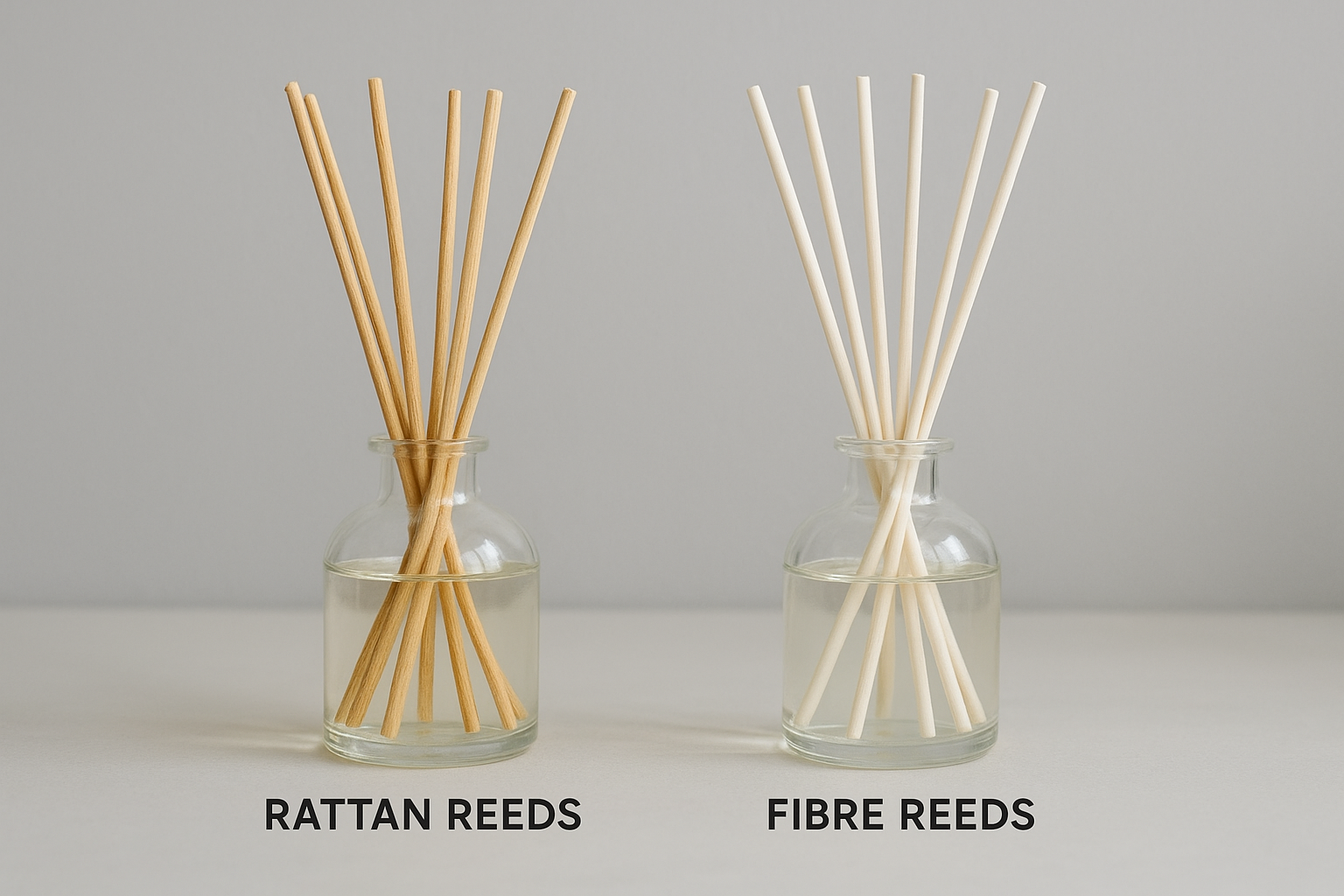
Fibre reeds turn up in a lot of cheaper diffuser kits, and at a glance they look almost identical to rattan. They're not. Fibre reeds are manufactured from synthetic or wood-pulp fibres pressed into a stick shape, designed to mimic the look of rattan without the natural plant structure underneath. That structural difference is the whole story: fibre reeds wick oil faster and more evenly because their channels are uniform and man-made, which sounds like an advantage until you realise it also means a much stronger, faster scent throw that burns through a bottle of oil in weeks rather than months.
Why the structure changes the outcome
Rattan's irregular, organic channels wick oil more slowly and unevenly along the stick, which is exactly why the scent throw feels gentler and more sustained over time. Fibre reeds don't have that variation, so they release fragrance in a stronger burst early on, then taper off as the fibres saturate and lose efficiency. For anyone using a reed diffuser as background scent rather than an air freshener, that steady rattan release matters more than an initial hit of fragrance that fades within a month.
Fibre reeds throw scent harder and faster, rattan throws it longer, and the right choice depends on how patient you want the fragrance to be.
Comparing the two side by side
Seeing the practical differences laid out makes the decision easier than guessing from packaging alone:
| Factor | Rattan reeds | Fibre reeds |
|---|---|---|
| Scent throw | Gentle, steady | Strong, fast |
| Bottle lifespan | 8-12 weeks | 3-5 weeks |
| Appearance over time | Ages naturally, slight patina | Can yellow or fray quickly |
| Sustainability | Renewable, fast-regrowing plant | Often synthetic, non-biodegradable |
| Best suited to | Bedrooms, bathrooms, everyday use | Small spaces needing a quick, strong burst |
Giving this table a quick scan before you buy saves you from picking sticks that don't match how you actually want a room to smell.
Matching the reed to the room and the goal
Hallways, entryways, or bathrooms that only get used briefly can benefit from fibre reeds, since a fast, punchy scent throw makes more sense in a space you're only in for a few minutes at a time. Living rooms, bedrooms, and studies, on the other hand, suit rattan far better, because you want a fragrance that sits quietly in the background for hours rather than announcing itself the moment you walk in. Genuine rattan also holds up visually for longer, which matters if the diffuser bottle is sitting somewhere on display rather than tucked out of sight. If sustainability and a natural aesthetic are part of why you're buying a rattan reed diffuser in the first place, fibre reeds undercut that intention even if they look similar on the shelf, so it's worth checking the product description rather than assuming every bundle of thin sticks is the real thing.
How to keep your diffuser fragrant for longer
A reed diffuser isn't a set-and-forget purchase in the way people expect, and a bit of ongoing care is what separates a bottle that lasts twelve weeks from one that fades out after four. Regular flipping does most of the heavy lifting here, but there are a handful of other habits that keep the scent throw consistent right up until the oil runs out, rather than tapering off halfway through the bottle's life.
Keep the flipping schedule consistent
Sticking to a routine matters more than the exact interval you choose. Flip the reeds every one to two weeks, and pick a day you'll actually remember, like the first of the fortnight or bin night. Skipping flips for a month and then doing several in a row doesn't catch you up, it just wastes oil on saturated tips that have already released most of what they had. If you want a stronger throw for a dinner party or a weekend at home, flip early rather than adding extra reeds, since more sticks in the same bottle just accelerates how fast the oil disappears.
Consistency in flipping beats intensity, a reed flipped on schedule outperforms one flipped twice as often but at random.
Rotate reeds instead of replacing the whole set too soon
Over time, the exposed tips of your reeds can become clogged with dust or a slight build-up of dried oil, which blunts the scent throw even when there's plenty of liquid left in the bottle. Before assuming the reeds are spent, try this simple check:
- Pull all the reeds out and wipe any visible dust from the top few centimetres with a dry cloth.
- Trim about 1cm off the saturated end with scissors, exposing fresh, unclogged fibre.
- Return the reeds with the freshly cut end downward, into the oil.
- Give it 24 hours before judging whether the throw has improved.
This trick can add another few weeks of decent scent throw to a set of reeds that were starting to feel tired, and it's far cheaper than buying a full pack of diffuser reed refills every time the fragrance dips.
Watch the environment around the bottle
Temperature and airflow affect how fast oil evaporates just as much as the reeds do. A diffuser bottle sitting in a warm, sunny spot will run through oil noticeably faster than one in a cooler, shaded corner, so if you're chasing longevity over intensity, keep it out of direct sun and away from heating vents. Humid bathrooms can also slow evaporation, which is worth knowing if you've placed a diffuser there expecting the same lifespan as one in a drier living room. Once the oil level drops close to the bottom of the bottle, it's time to top up with a diffuser oil refill or replace it entirely, since reeds sitting mostly in air rather than oil won't wick anything no matter how well you've cared for them.
Finding the right reeds for your home
Good rattan reed diffuser sticks come down to a handful of practical choices: genuine rattan over fibre, the right thickness for your room, a sensible reed count for your bottle size, and a flipping routine you'll actually stick to. Get those basics right and a single bottle will scent a room gently for two to three months without any fuss.
You don't need to overthink the rest. Place the bottle somewhere with a bit of airflow, keep it out of direct sun, and give it time to build before judging the throw. If you're ready to put this into practice, our natural rattan reeds come pre-matched with fragrance oils blended in South Australia, so you skip the guesswork around compatibility altogether. Have a look through our natural reed diffusers and find a scent that suits the room you're setting it up in.