
Your reed diffuser has been sitting on the shelf for three weeks and the scent has all but vanished. Chances are the problem isn't the reeds or the bottle, it's the oils for reed diffusers you poured into it. Not every oil is designed to travel up a rattan reed and release fragrance evenly, and using the wrong one wastes both money and good sunlight hours spent picking a scent you loved.
So which oil actually works? The short answer is that you need the right combination of a thin carrier oil reed diffuser base with either fragrance oils or essential oils for reed diffuser blends, depending on whether you want strength or subtlety. Pre-made blends take the guesswork out, while DIY versions let you control intensity and ingredients.
In this guide, we break down the differences between essential, fragrance and carrier oils, explain which ratios give the best throw, and help you decide whether to buy ready-made or mix your own scented oil for reed diffusers at home, drawing on what we've learned crafting our own South Australian-inspired diffuser range.
1. Coorong Candle Co reed diffuser oils
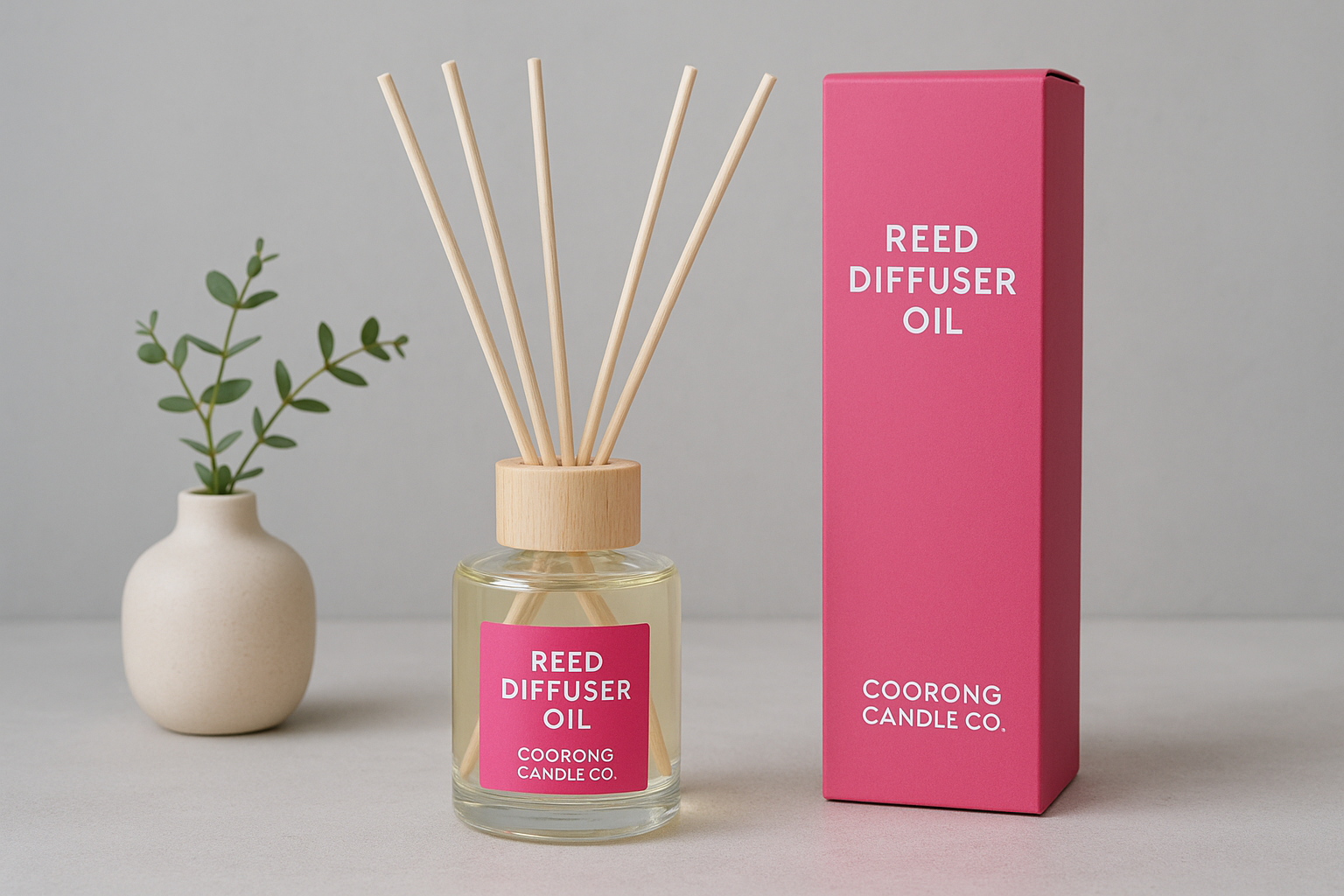
We start with our own range because it solves the exact problem most people land on this page for: oils for reed diffusers that actually throw scent for months, not weeks. Every bottle we blend uses a pre-balanced mix of fragrance oil and a light carrier base, tested against our own reed setups before it ever reaches a customer. You skip the trial and error of working out ratios yourself, and you get scents tied to real South Australian places, from the salt-air notes of our Coorong-inspired blends to the dusty grape and eucalyptus of our regional collections.
How it works
Our reed diffuser oils use a dipropylene glycol and fine fragrance oil blend, formulated to sit at the right viscosity for standard rattan reeds. Too thick and the reeds clog; too thin and the scent burns off in days. We calibrate ours so the oil climbs steadily and releases fragrance for eight to twelve weeks with five reeds in a 200ml bottle, longer if you flip the reeds fortnightly, which is roughly how long a reed diffuser lasts in a typical Aussie home.
The right diffuser oil isn't the strongest one, it's the one balanced to travel slowly and last.
Who it's best for
This option suits anyone who wants a set-and-forget fragrance without measuring, mixing or sourcing separate carrier and scent oils. If you're buying a gift, furnishing a new home, or simply don't have time for DIY, a ready-blended oil removes the guesswork entirely. It's also the safer choice for households with pets or kids, since our formulations avoid the harsher solvents found in some budget blends.
Price guide
| Product | Volume | Approx. price (AUD) |
|---|---|---|
| Single scent reed diffuser | 200ml | $34–$40 |
| Regional collection diffuser | 200ml | $36–$42 |
| Gift set with candle and diffuser | Varies | $60–$85 |
Prices sit above supermarket alternatives, but you're paying for small-batch quality, longer scent life, and ingredients that won't leave a greasy residue around the bottle neck.
2. Essential oils
Essential oils appeal to buyers who want a natural scent story to go with their fragrance, and pure lavender or eucalyptus, two of the best essential oils for reed diffusers, does smell more authentic than a synthetic copy. Using essential oils for reed diffuser setups means you're working with plant extracts rather than lab-blended compounds, which matters if you're avoiding synthetic fragrance altogether.
How it works
Because essential oils are thinner and less viscous than fragrance oils, they need a carrier base to slow their climb up the reeds and stretch out the scent life. Mixed at roughly 15 to 20 percent essential oil to 80 to 85 percent carrier, the ratio we use when making essential oil reed diffusers at home, they'll throw a soft, natural fragrance rather than a strong room-filling one. Reeds also need flipping more often, since essential oil blends tend to evaporate faster than synthetic ones.
Essential oils give you an honest, natural scent, but expect a shorter, quieter throw than fragrance oil blends.
Who it's best for
This choice suits people who prefer natural ingredients over synthetics and don't mind topping up more regularly. It's not ideal for large rooms or anyone chasing a strong, long-lasting throw, since pure oils simply can't compete with engineered fragrance oils on projection.
Price guide
| Product | Volume | Approx. price (AUD) |
|---|---|---|
| Single essential oil | 10–15ml | $10–$25 |
| Blended essential oil set | 3–6 bottles | $30–$60 |
Sourcing pure, undiluted oils from reputable suppliers keeps quality consistent, though costs add up if you're blending several scents.
3. Carrier oils
Carrier oils are the unsung workhorse of any diffuser blend, the base that carries a scent up the reeds without evaporating too fast or clogging the fibres. On its own a carrier oil reed diffuser produces almost no fragrance, which is why it's always paired with essential or fragrance oil rather than used solo. Fractionated coconut oil, light mineral oil and dipropylene glycol are the three most common bases, chosen for their thin viscosity and neutral scent, and it helps to understand what carrier oils are before you buy one.
How it works
Mixed at 80 to 85 percent of the total blend, the reed diffuser base slows the wicking rate so your chosen scent releases gradually instead of burning off in a week. Too heavy a carrier, like a thick vegetable oil, will sit in the bottle and barely climb the reeds at all.
A carrier oil doesn't add fragrance, it decides how long your fragrance actually lasts.
Who it's best for
DIY blenders who already have essential or fragrance oils on hand and just need a base to stretch them further will get the most from this option. It's less useful if you want a finished product ready to pour, since you'll still need to source and measure a second scent ingredient separately.
Price guide
| Product | Volume | Approx. price (AUD) |
|---|---|---|
| Fractionated coconut oil | 500ml–1L | $15–$30 |
| Dipropylene glycol (DPG) | 500ml | $20–$35 |
Buying in bulk brings the per-blend cost down considerably if you're making diffusers regularly.
4. Fragrance oils
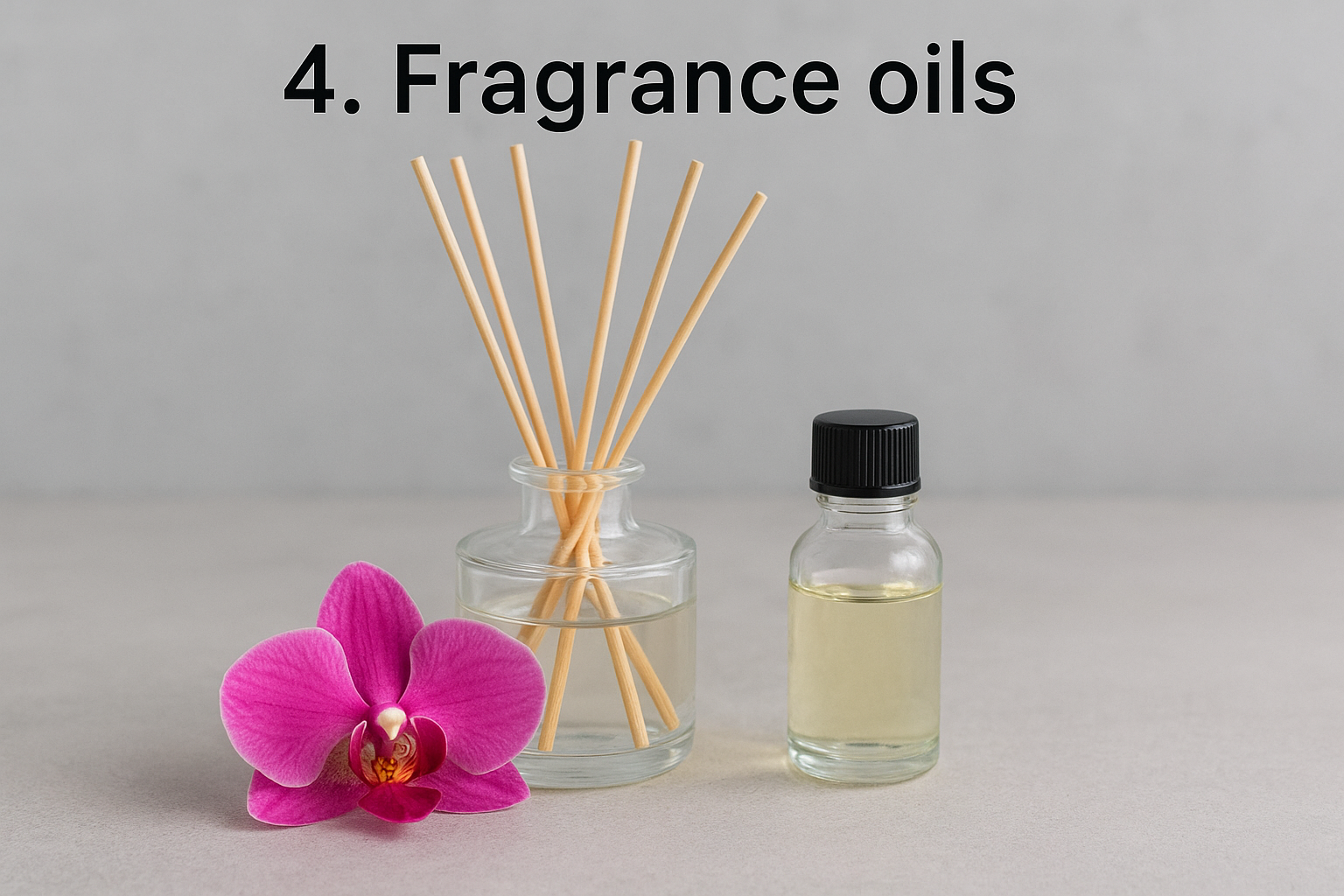
Fragrance oils are lab-crafted scent compounds designed specifically for strong, consistent throw, and they're the backbone of most fragrance oils for reed diffusers you'll find on the market. Unlike essential oils, they can replicate complex scents that don't exist in nature, like fresh linen, sea salt, or a bakery-fresh vanilla, giving blenders far more creative range.
How it works
Governed by their thicker, more stable chemistry, fragrance oils climb reeds at a steadier rate and resist evaporating as quickly as plant-based alternatives. Most blenders mix them at 20 to 30 percent fragrance oil to 70 to 80 percent carrier, giving a stronger, longer-lasting scent than an essential oil blend at the same ratio. A quality fragrance oil for reed diffusers should also be phthalate free and diffuser-grade, not the candle-specific type, since candle fragrance oils often behave differently in a liquid reed setup.
Fragrance oils trade some of the natural story for reliability, strength, and a scent that actually lasts the distance.
Who it's best for
Households wanting a noticeable, room-filling scent, or anyone gifting a diffuser and wanting it to perform well without fuss, should lean toward fragrance oils over essential oils.
Price guide
| Product | Volume | Approx. price (AUD) |
|---|---|---|
| Single fragrance oil | 30–50ml | $8–$18 |
| Diffuser-grade fragrance oil (premium) | 50–100ml | $15–$30 |
Quality varies wildly between suppliers, so stick to ones labelled specifically for reed diffusers.
5. Alcohol-based solvents
Alcohol-based solvents, usually denatured or isopropyl alcohol, thin out a fragrance oil blend so it climbs reeds faster and throws scent almost immediately. Perfumers have used this trick for decades, and it works the same way in a reed diffuser as it does in a spray bottle: thin alcohol carriers push scent molecules into the air quickly rather than letting them build slowly over weeks.
How it works
Mixed at a small percentage alongside a standard carrier and fragrance oil, alcohol evaporates fast and pulls the scent up with it, giving you a strong burst in the first few days that tapers off quicker than a pure carrier blend. It's a shortcut for instant fragrance, not longevity.
Alcohol gets you fast, strong scent upfront, but you'll be refilling the bottle sooner than with a slower carrier blend.
Who it's best for
Anyone hosting guests soon, or wanting to freshen a room before an inspection or open house, benefits from the quick payoff alcohol-based blends deliver. Skip it if you want a diffuser that lasts months without topping up.
Price guide
| Product | Volume | Approx. price (AUD) |
|---|---|---|
| Isopropyl alcohol (diffuser grade) | 500ml | $8–$15 |
| Denatured alcohol blend | 250ml | $10–$18 |
Cheap and widely available, but factor in more frequent top-ups when comparing true cost against a slower-release carrier oil.
6. Eco-solvent diffuser bases
Eco-solvent diffuser bases are a newer category built around plant-derived carriers, usually a blend of coconut or castor derivatives mixed with a small amount of eco-friendly alcohol. They're marketed as a greener alternative to dipropylene glycol or petroleum-based solvents, appealing to buyers who want carbon-free ingredients without sacrificing performance. If sustainability sits high on your list of priorities, this is where the market is heading.
How it works
Functionally, these bases behave like a hybrid between a standard carrier oil and an alcohol solvent, wicking at a moderate pace that avoids both the sluggishness of heavy oils and the fast burn-off of pure alcohol. Manufacturers formulate them to biodegrade more readily, which matters if you're conscious of what ends up in wastewater once you rinse a spent bottle. Most blend at a similar 75 to 85 percent ratio to fragrance or essential oil, so swapping one in for a conventional carrier is straightforward.
Going eco-friendly with your diffuser base shouldn't mean giving up scent throw, and the better formulations prove it doesn't have to.
Who it's best for
Buyers who already choose soy candles over paraffin, or who avoid petroleum products generally, will find this base aligns with the rest of their home. It suits anyone building a genuinely low-impact fragrance routine rather than just a natural-smelling one.
Price guide
| Product | Volume | Approx. price (AUD) |
|---|---|---|
| Eco-solvent base | 250ml | $18–$28 |
| Pre-blended eco diffuser oil | 200ml | $30–$40 |
Expect a modest premium over standard DPG, reflecting the cost of sourcing plant-based raw materials.
7. Oils to avoid in a reed diffuser
Not every oil sitting in your pantry belongs in a diffuser bottle, and using the wrong one can ruin reeds, stain surfaces or even pose a fire risk. Thick cooking oils, thick vegetable oils and heavy nut oils sit at the top of the avoid list, since they're too viscous to wick properly and simply go rancid inside the bottle. Undiluted essential oils poured straight in, without a proper carrier oil reed diffuser base, also cause problems, clogging reeds and evaporating unevenly, so it pays to know how to dilute essential oils safely.
How it works
Heavy oils like olive, sesame or coconut oil in solid form don't have the thin viscosity needed to climb rattan reeds, so they pool at the bottom and never release scent. Undiluted essential oils, meanwhile, are volatile enough to evaporate within days, leaving behind a sticky residue that blocks the reed's fibres for good.
If an oil is too thick to pour smoothly at room temperature, it's too thick for a reed diffuser.
Who it's best for
Honestly, nobody. These oils suit the pantry or the salad bowl, not the diffuser bottle, and reaching for them out of convenience usually means replacing reeds within a week.
Price guide
There's no real price guide here since these aren't diffuser products, but ruined reeds and stained surfaces cost more to fix than a proper bottle of scented oils for reed diffusers ever would.
Which oil is right for you?
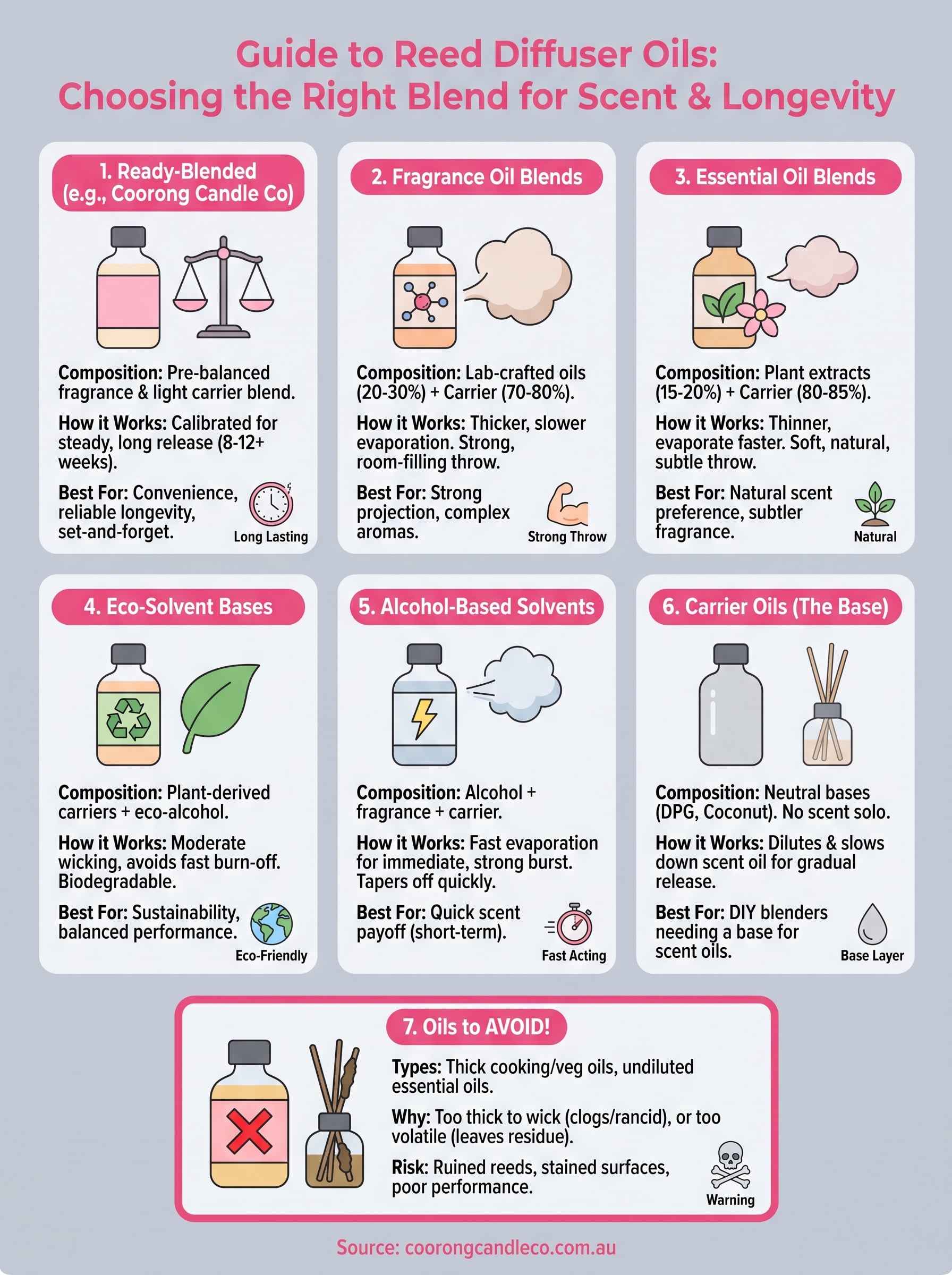
Picking the right oil for reed diffusers comes down to what you value most: convenience, natural ingredients, strength, or sustainability. If you want a natural scent story and don't mind topping up often, go with essential oils blended into a light carrier. If you want a strong, reliable throw that lasts months, a proper fragrance oil blend wins every time, and our breakdown of essential oils versus fragrance oils explains why. Eco-solvent bases suit anyone already committed to a low-impact home, while alcohol solvents solve the short-term problem of needing scent fast.
However you land, skip the pantry oils and undiluted essentials poured straight into a bottle, they'll cost you more in ruined reeds than a quality blend ever would. If you'd rather skip the measuring altogether, our handmade reed diffusers are pre-balanced, tested, and ready to fill your home with scent from the moment you unbox them.