
Not all glass looks the same once you start comparing reed diffuser bottles side by side. Some necks are too narrow for a proper reed spread, some glass is thin enough to crack under a hot pour, and some designs simply don't hold scent the way they should. If you're hunting for empty reed diffusers to refill at home, or sourcing bottles to make your own from scratch, those small differences matter more than they first appear.
This guide answers the practical question: what actually makes a good reed diffuser bottle, and what should you check before adding one to your cart. We'll cover glass thickness, neck width, capacity, and the finishes that hold up to oil-based fragrance over months of use.
We've spent years hand-pouring diffusers at Coorong Candle Co., testing diffuser reed bottles against South Australian conditions from coastal humidity to inland heat. That experience shapes everything below, whether you're refilling an old favourite or building a fragrance setup from the ground up.
Why the right reed diffuser bottle matters
Scent throw depends on more than the oil
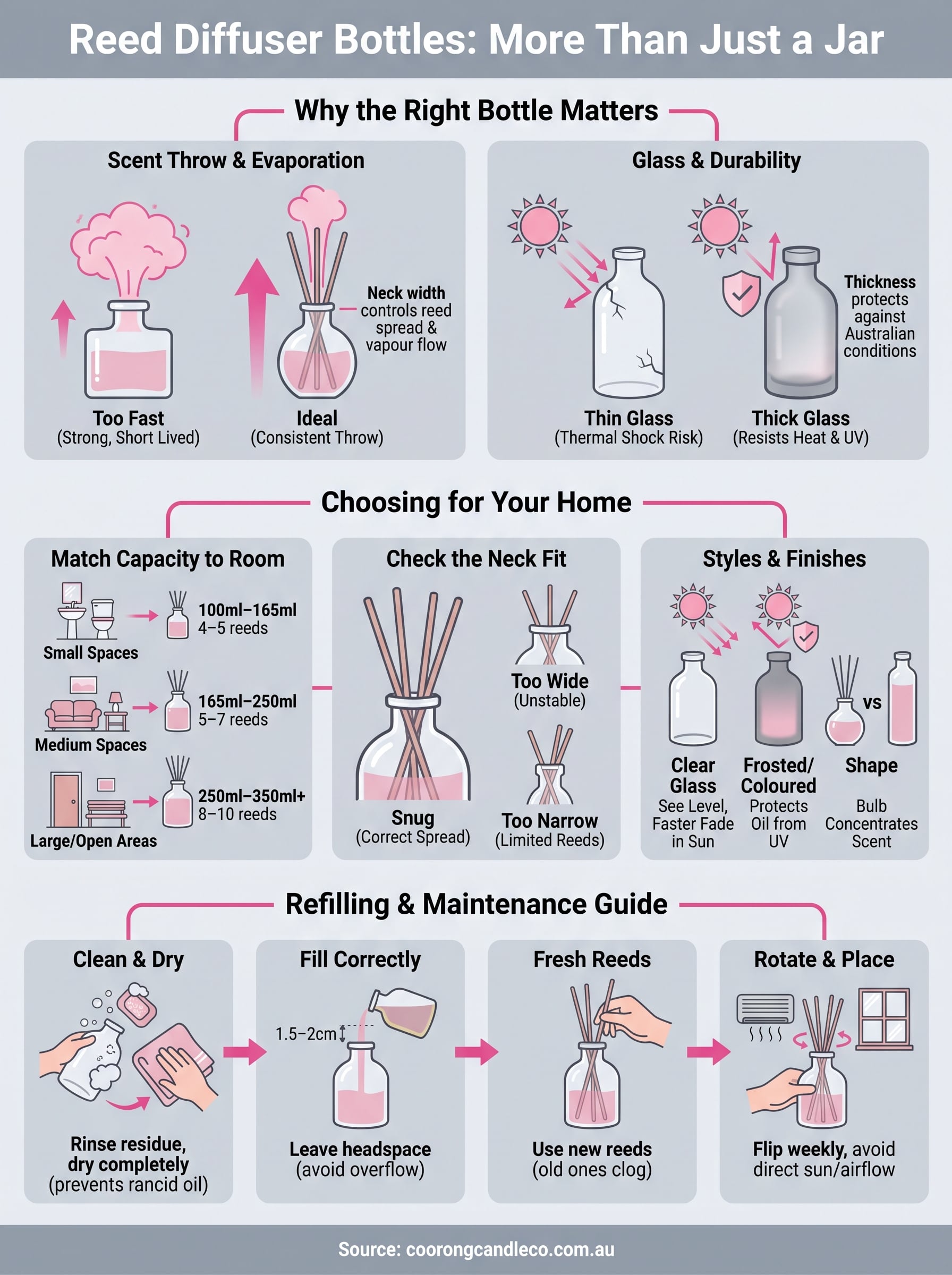
Glass shape and neck width decide how much fragrance actually reaches the room, no matter how good the oil inside is. A bottle with a wide belly and a narrow neck concentrates vapour and pushes it up through the reeds faster, which is why our own luxury reed diffusers, like the Fleurieu strawberry champagne reed diffuser, use that exact profile rather than a plain cylinder. Squat, wide-necked bottles let fragrance evaporate too quickly near the opening instead of travelling up the reeds, so you get a strong smell for a week and then almost nothing. The scent throw you notice in the first few days isn't the full story; it's the evaporation rate over the following weeks that tells you whether the bottle design is doing its job.
A reed diffuser bottle is doing half the work of the fragrance itself, not just holding it.
Cheap glass cracks under real conditions
Glass thickness matters more in Australia than in milder climates, because diffusers often sit near windows, on sunlit shelves, or in cars during a hot commute. Thin, mass-produced glass can develop micro-fractures from thermal shock when a bottle goes from a cool cupboard to a hot windowsill, and fragrance oil eventually finds those cracks. We've seen customers lose entire bottles of oil this way, not because the fragrance was faulty but because the glass thickness wasn't built for real household conditions. Coastal humidity around the Coorong adds another layer of stress, since condensation forms on cheap glass and can degrade the base or label adhesive over time. Solid, hand-checked glass with an even wall thickness resists this far better and simply lasts longer between refills.
Neck width shapes fragrance intensity
The diameter of the neck controls how many reeds you can fit and, in turn, how strong the fragrance sits in a room. A narrow neck limits you to four or five reeds and suits smaller spaces like bathrooms or hallways, while a wider neck accommodates eight to ten reeds for open-plan living areas. Getting this wrong is one of the most common reasons people feel a diffuser is
How to choose a reed diffuser bottle for your home
Picking the right bottle starts with the room it's going in, not the fragrance you already have in mind. Bottle capacity and neck width should be decided before you even look at scent notes, because a beautiful bottle that's wrong for the space will underperform no matter what oil you pour into it. Think about airflow too, since a diffuser sitting near an air conditioning vent or an open window needs a slightly larger capacity, as moving air speeds up evaporation.
Match capacity to the room
Smaller spaces like bathrooms, ensuites, and hallways do well with a 100ml to 165ml bottle, which keeps the fragrance noticeable without overwhelming a confined area. Open-plan living rooms, entries, and larger bedrooms usually need 200ml to 350ml to maintain a consistent scent throw across the space, and it's worth seeing which reed diffusers suit large rooms before you commit. Guessing the size is one of the fastest ways to end up disappointed, since an undersized bottle in a big room fades within days and an oversized one in a small room can feel heavy-handed.
| Room type | Recommended bottle size | Reed count |
|---|---|---|
| Bathroom or hallway | 100ml–165ml | 4–5 reeds |
| Bedroom | 165ml–250ml | 5–7 reeds |
| Living room or open-plan area | 250ml–350ml | 8–10 reeds |
| Entryway or large foyer | 300ml+ | 8–10 reeds |
Check the neck before the label
Look at the neck diameter before you look at anything else on the packaging, because this single measurement decides how many reeds you can actually use. Hold a reed against the opening if you can; it should sit snugly without wobbling loose or jamming tight against the glass. A neck that's too wide lets reeds lean and drip against the rim, while one that's too narrow will only take three or four reeds no matter how much fragrance sits in the bottle.
Get the neck width right and the rest of the diffuser almost looks after itself.
A quick pre-purchase checklist
Running through a short checklist before buying saves you from returning bottles that don't suit your space:
- Confirm the capacity suits the room (see the table above)
- Check the neck fits four to ten reeds depending on room size
- Look for even, bubble-free glass with a flat, stable base
- Choose a finish that won't fade or discolour near sunlight
- Check the bottle is refillable rather than sealed for single use
Finally, don't overlook how the bottle will sit in your home day to day. A refillable design with a stable base and a neutral finish will outlast several fragrance changes, which matters if you're building a small collection of scents to rotate through the seasons. Our own reed diffuser range sticks to this approach deliberately, favouring reusable glass over disposable designs, and there's more on how to choose and use a reed diffuser at home if you're starting out.
Reed diffuser bottle styles and finishes explained
Style isn't just decoration on a reed diffuser bottle, it changes how the fragrance is perceived and how well the bottle fits your decor. Coorong Candle Co. ships several glass finishes across our natural reed diffusers collections, and the differences go beyond looks. Choosing between clear, frosted, or coloured glass affects light exposure inside the bottle, which in turn affects how long the fragrance oil stays stable.
Clear glass shows you what's happening inside
Clear glass lets you see the oil level and reed saturation at a glance, which makes it easier to judge when a refill is due. Direct sunlight breaks down fragrance oils faster in clear bottles, so this style suits shaded spots like hallways, bathrooms, or shelves away from windows. If your home gets strong afternoon light, clear glass isn't the wrong choice, but you'll want to position it somewhere the sun doesn't hit for hours at a stretch, or reach for a room spray in those spots instead.
Frosted and coloured glass protect the oil
Frosted or tinted glass blocks a good portion of UV light, which slows oxidation and helps fragrance oils hold their scent profile for longer. Amber and smoked glass are the most protective, followed by frosted white, then lightly tinted pastels that offer a milder barrier. This matters more in Australia than most places selling reed diffuser bottles, since UV exposure here is genuinely stronger than in the UK or northern Europe.
A darker bottle isn't hiding the fragrance, it's protecting it.
Shape changes both look and function
Bottle shape isn't only about aesthetics; the silhouette affects vapour concentration and how the reeds sit. A teardrop or bulb shape narrows sharply at the neck, which pushes fragrance upward more efficiently than a straight cylinder. Square and hexagonal bottles suit modern interiors but often have wider necks, so check the reed count they support before matching one to your fragrance strength preferences.
| Style | Typical finish | Best for | Notes |
|---|---|---|---|
| Teardrop or bulb | Clear or frosted | Strong scent throw | Narrow neck concentrates vapour |
| Cylinder | Clear, tinted | Minimalist decor | Even reed spacing, moderate throw |
| Square or hexagonal | Frosted, coloured | Modern interiors | Wider neck, check reed fit |
| Textured or ribbed | Frosted, opaque | Coastal or rustic themes | Hides fingerprints and dust |
Caps, labels, and finishing touches
Removable caps matter more than people expect, since a snug-fitting cap keeps the fragrance sealed and fresh while you're not using the reeds, extending shelf life between openings. Labels should sit on a flat panel rather than wrapping around curved glass, both for a tidier look and because curved labels peel faster once oil residue builds up on the outside of the bottle. Our own regional diffuser collections use flat-panel labelling and screw caps for exactly this reason, pairing practicality with the coastal, landscape-inspired look that ties back to the Coorong itself.
Whatever combination of shape and finish you land on, treat it as a functional decision first and a styling one second. The prettiest bottle on a shelf still needs to hold scent properly, and that comes down to glass quality and neck design more than colour or texture.
How to fill and refill an empty reed diffuser bottle
Refilling an empty reed diffuser bottle is straightforward once you know the order of steps, but skipping any one of them shortens the life of both the bottle and the fragrance oil. Empty reed diffusers collect residue at the neck and base over time, and pouring fresh oil into a dirty bottle mixes old, oxidised fragrance with the new batch, dulling the scent throw before it even starts. Getting the process right takes a few extra minutes and pays off across every refill after, and our step-by-step guide to refilling reed diffuser oil walks through it in detail.
Clean the bottle before every refill
Start by tipping out any leftover oil and rinsing the bottle with warm water, since residue left in the base slowly turns rancid and taints new fragrance. Isopropyl alcohol removes stubborn oil film from the glass walls better than water alone, and a quick rinse with it before the final water rinse leaves the interior properly clear. Drying matters too, because trapped moisture dilutes the next fill and can cloud clear glass over several refills.
- Empty and discard old reeds; they don't get reused
- Rinse with warm water, then a splash of isopropyl alcohol for stubborn residue
- Turn the bottle upside down on a paper towel until fully dry
- Wipe the neck and rim, since oil collects there even when the bottle looks clean
Pour to the right level, not to the top
Filling a reed diffuser bottle to the very top leaves no room for the reeds to displace oil, which forces excess fragrance up and out around the neck. Leave roughly 1.5 to 2 centimetres of headspace below the neck opening so the reeds sit comfortably without pushing oil over the rim once they're inserted. Overfilling is one of the most common mistakes people make when buying and topping up diffuser oil refills at home, and it's also one of the messiest to clean up if it happens near fabric or timber furniture.
Fill for the reeds, not for the bottle, and you'll never deal with an overflow again.
Insert fresh reeds and let them saturate
New reeds absorb fragrance far better than reused ones, since the fibres inside old reeds clog with dried oil and stop drawing liquid upward, which is why diffuser reed refills are worth keeping on hand. Insert the full length into the bottle and give the fragrance around fifteen minutes to travel up before flipping them for the first time, which speeds up the initial scent throw. Rotating the reeds fully every three to four days afterwards keeps the fragrance consistent, since the saturated ends dry out and slow the wicking effect the longer they sit facing the same direction.
Lastly, resist the urge to top up a half-empty bottle with a different fragrance, even one of the best fragrance oils for reed diffusers. Mixing leftover oil with a new scent muddies both, and it's the fastest way to waste a good reed diffuser bottle on a smell you can no longer quite place.
Reed diffuser bottle sizes and how much oil to use
Size determines almost everything else about how a reed diffuser performs, from how many reeds it can support to how long a single fill lasts before you're back at the shelf reaching for more oil. Buying based on capacity alone, without checking how long a reed diffuser lasts in weeks of scent, is how people end up either topping up constantly or throwing out half-used bottles because the fragrance faded before the oil ran out. Getting the size right from the start saves both money and the hassle of guessing again later.
Matching bottle size to oil volume
Most bottles are sold by their maximum capacity, but you rarely fill them to that mark, so it helps to think in terms of usable fill volume instead. A 100ml bottle typically takes around 80ml of oil once you account for headspace and reed displacement, while a 350ml bottle comfortably holds 280ml to 300ml. Smaller reed diffuser bottles suit compact rooms and shorter fragrance cycles, whereas larger ones are better suited to spaces where you want consistent scent throw over a longer stretch without intervention, whichever oils for reed diffusers you settle on.
| Bottle size | Usable oil volume | Reed count | Approximate lifespan | |---|---|---| | 100ml | 70ml–80ml | 4–5 reeds | 4–6 weeks | | 165ml | 130ml–140ml | 5–6 reeds | 6–8 weeks | | 250ml | 200ml–220ml | 6–8 reeds | 8–10 weeks | | 350ml | 280ml–300ml | 8–10 reeds | 10–12 weeks |
Bigger isn't always better, the right size is whatever matches your room and how long you want between refills.
How reed count affects consumption
Reed count changes how fast a bottle empties, sometimes more than the fragrance oil itself does. Every reed you add draws liquid upward continuously, so a bottle with ten reeds will pull through oil noticeably faster than the same bottle fitted with only five, even though the capacity hasn't changed at all. Rooms that need a stronger presence, like open kitchens or entryways, justify the extra reeds and the shorter lifespan that comes with them, while quieter spaces do better with fewer reeds stretched over more weeks.
Topping up without wasting oil
Oil doesn't need to run completely dry before you refill; letting it get too low just means the last few days deliver weak, patchy scent as the reeds struggle to draw from a shallow pool. A few habits keep consumption predictable:
- Check the oil level every two weeks rather than waiting for the smell to disappear
- Top up once the level drops below a third of the bottle's usable volume
- Avoid mixing old and new oil batches, even of the same fragrance, since oxidised oil dulls fresh scent
- Keep a spare set of reeds on hand so you're not tempted to reuse tired ones just to avoid a shopping trip
Once you know roughly how many weeks a given size and reed count gets you, restocking stops being guesswork and becomes routine, the same way you'd track any other household consumable.
Common mistakes to avoid with reed diffuser bottles
Most problems with reed diffuser bottles come down to a handful of habits repeated across thousands of Australian households, not faulty glass or bad fragrance. Once you know what to look for, these mistakes are easy to spot and even easier to fix before they cost you a bottle of oil.
Placing the bottle in direct sunlight or airflow
Sunny windowsills and shelves under air conditioning vents both accelerate evaporation rate far beyond what the bottle was designed for, and neither spot does the fragrance any favours. Direct sun also breaks down oil compounds chemically, not just physically, which changes the scent profile over time rather than simply making it fade faster. Air vents dry reeds out unevenly, leaving one side saturated and the other stiff and useless. Moving a bottle just a metre away from either problem spot often adds weeks to its useful life without changing anything else about the setup, and there are other simple ways to make reed diffusers last longer.
The fastest way to ruin a good fragrance is to leave the bottle where the sun or the aircon can reach it.
Overloading the neck with too many reeds
Squeezing extra reeds into a neck that wasn't designed for them seems like a shortcut to stronger scent, but it usually backfires. Overcrowded diffuser reed bottles struggle to draw oil evenly, since reeds pressed tightly together compete for the same surface area and end up wicking less overall than a properly spaced set would. It also strains the glass at the rim over repeated use, particularly on narrower necks not built to flex under pressure. Stick to the reed count the bottle's neck width supports rather than assuming more reeds always means more fragrance.
Skipping cleaning between fragrance changes
Reusing a bottle without rinsing it between scents is one of the most common mistakes people make, and it's also one of the easiest to avoid. Old oil residue lingers in the glass and mixes with whatever you pour in next, muddying both fragrances and shortening how long the new one smells true. This matters even more when switching between strongly contrasting scents, like moving from a citrus blend to something woody or musky, since the leftover notes clash rather than blend.
Letting reeds sit without rotating them
Reeds left facing the same direction for weeks slowly clog at the saturated end, and once that happens, no amount of topping up the oil brings the scent throw back to where it started. A quick flip every few days keeps the wicking action working properly.
| Mistake | Why it hurts the bottle | Simple fix |
|---|---|---|
| Direct sunlight or vent placement | Speeds evaporation, breaks down oil | Move to a shaded, still spot |
| Too many reeds for the neck | Uneven wicking, strain on glass | Match reed count to neck width |
| No cleaning between scents | Old residue taints new fragrance | Rinse with warm water and alcohol |
| Reeds never rotated | Saturated ends clog and stop drawing oil | Flip reeds every 3–4 days |
| Topping up instead of refilling | Oxidised oil dulls fresh fragrance | Empty, clean, then refill fully |
Avoiding these five habits keeps a reed diffuser bottle performing the way it was designed to, refill after refill, without any of the guesswork that leads most people back to buying replacement bottles far sooner than they should need to.
Getting your diffuser bottle right
A good reed diffuser bottle isn't just a vessel, it's half the fragrance experience. Glass thickness, neck width, and capacity decide whether a scent lasts six weeks or fades in ten days, and finish decides whether that scent stays true under Australian sun. None of this is complicated once you know what to check, but skipping the checklist is exactly how people end up with cracked glass, patchy throw, or oil that never quite matches the fragrance they paid for.
Before your next purchase, run through capacity, neck fit, and glass quality rather than choosing on looks alone. Clean between refills, rotate your reeds, and keep the bottle out of direct sun and airflow, and you'll get every week of scent it's capable of giving.
If you'd rather skip the sourcing altogether, our home fragrance gift sets pair a 200ml reed diffuser with matching candles in bottles already built to get this right from the first pour.