
If you've just poured a batch of soy candles and you're wondering how long to cure soy candles before lighting them, you've probably already noticed that the internet can't seem to agree on a number. Some makers say two days. Others insist on three weeks. That gap is wide enough to make anyone second-guess their process, especially when scent throw hangs in the balance.
At Coorong Candle Co., we hand-pour every soy candle in small batches from our South Australian workshop. Curing isn't an abstract concept for us; it's a step we build into every production run before a candle ships. Over years of testing fragrances inspired by the Coorong region, from coastal salt air to native botanicals, we've dialled in what actually works versus what's just repeated advice. That hands-on experience is what this guide draws from.
The short answer: 7–14 days produces the best hot throw for most soy wax candles. But the full picture depends on your wax blend, fragrance load, and vessel size. Below, we'll break down exactly why curing matters, what's happening inside the wax during that waiting period, and how to tell when your candles are genuinely ready to burn.
What curing means for soy candles
When candle makers talk about curing, they mean the deliberate rest period that follows a pour, once the wax has cooled and solidified. During this window, fragrance oil molecules integrate more fully into the soy wax matrix, which directly affects how much scent the candle releases when it burns. Without adequate curing, a candle will often produce a weaker or uneven scent throw, even when you've used a generous fragrance load.
Curing is not the same as waiting for your candle to harden. A soy candle can feel solid within a few hours, but the chemical bonding between wax and fragrance oil continues working for days afterward.
The science of fragrance binding
Soy wax is derived from hydrogenated soybean oil, and it forms a porous, crystalline structure once solid. Fragrance oils are complex mixtures of aromatic compounds that need time to migrate into and adhere to those wax crystals. When you pour a candle, the heat keeps fragrance molecules suspended throughout the liquid wax. As the wax cools, it contracts and builds a lattice structure, and the fragrance begins anchoring into that lattice. This bonding process continues well past the point of solidification, which is why the cure window matters far more than most new makers realise.
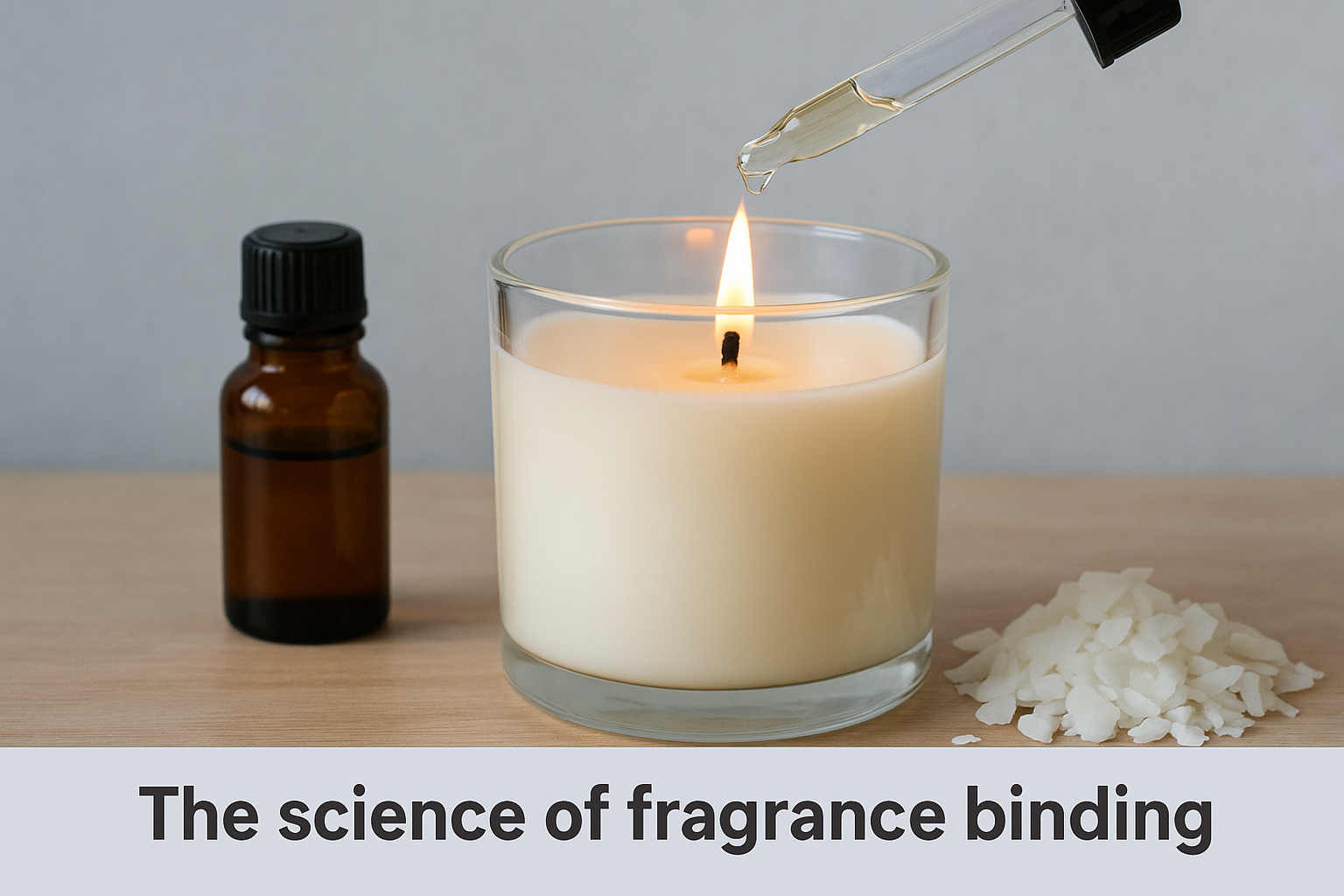
The longer the fragrance and wax molecules interact at rest, the more evenly distributed the scent compounds become throughout the candle body. A candle burned at day two versus day ten can smell noticeably different, with the latter producing a fuller, more sustained hot throw from the very first burn.
How curing differs from cooling
Many first-time candle makers treat cooling time and cure time as the same stage. They are not. Cooling refers to the physical process of wax moving from liquid to solid, which typically takes a few hours depending on vessel size and room temperature. Curing is a slower chemical process that unfolds over days as the fragrance oil and wax molecules form stronger, more stable bonds.
Understanding the difference matters when you're figuring out how long to cure soy candles before you sell or gift them. A candle that looks and feels finished after cooling still needs time to reach its full fragrance potential before you light the wick.
Why cure time changes scent throw and burn
Scent throw is the term candle makers use to describe how effectively a burning candle releases fragrance into the surrounding space. Hot throw refers to scent released during burning; cold throw is what you detect from an unlit candle. Cure time directly shapes both of these outcomes, but its effect on hot throw is the more significant one for most buyers.
How fragrance release works during a burn
When you light a soy candle, the heat from the flame melts the wax around the wick and creates a melt pool. Fragrance molecules suspended in that melt pool evaporate into the air, producing the scent you experience. A well-cured candle has fragrance that is more evenly distributed throughout the wax body, which means each successive melt pool carries a consistent concentration of scent compounds from the first burn through to the last.
The difference between a cured and an uncured soy candle is most obvious during the first burn, when an uncured candle often produces noticeably less scent than it will later in its life.
What happens when you skip the cure
Burning a soy candle before it has had adequate time to cure often produces uneven scent throw and inconsistent melt pool behaviour. The fragrance hasn't fully bonded with the wax, so it can release in bursts rather than steadily. Understanding how long to cure soy candles before the first burn protects both the performance and longevity of the finished product. Watch for these signs that your candle needed more cure time:
- Noticeably weak scent during the first few burns
- Tunnelling down the centre of the vessel
- An uneven melt pool that doesn't reach the jar edges
How long to cure soy candles for best results
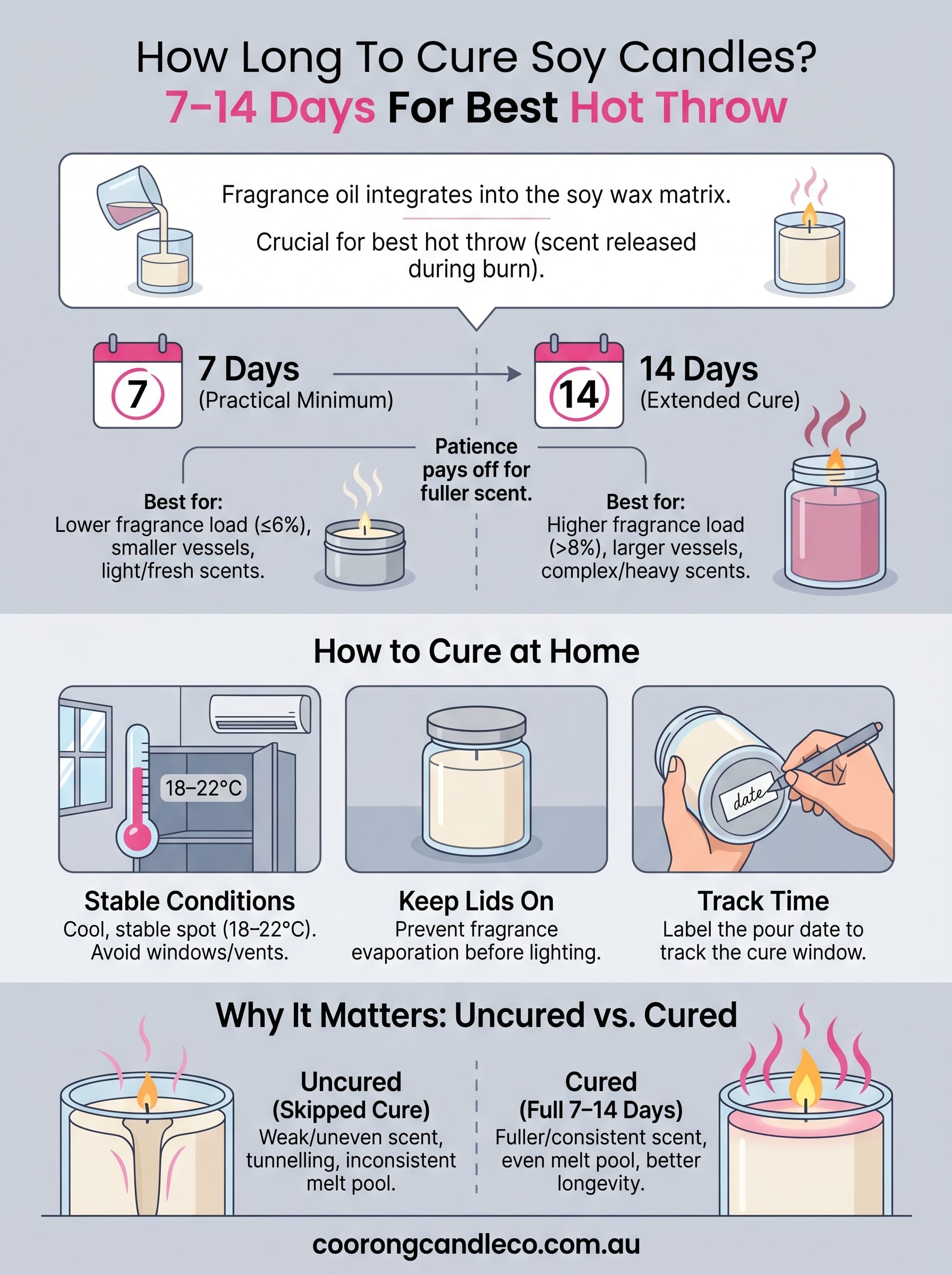
The standard answer for how long to cure soy candles is 7 to 14 days, and that range exists because different wax blends, fragrance loads, and vessel sizes all influence the bonding process. Most 100% soy wax candles reach a solid baseline of fragrance integration around the one-week mark, making 7 days the practical minimum before you burn or sell them. Candles cured for less than this often deliver a noticeably weaker first burn, regardless of how well-formulated the fragrance load is.
The 7-day minimum
Seven days gives the fragrance oil and wax matrix enough time to form stable bonds under normal room conditions. At this point, your candle will produce a reliable hot throw and a consistent melt pool from the first light. A 7-day cure works well when:
- Your fragrance load sits at or below 6%
- You're working with a smaller vessel like a 165g travel tin
- The fragrance is built around light top notes such as citrus, aquatic, or fresh accords
When to extend to 14 days
Some candles genuinely benefit from the full 14-day window, and knowing when to extend saves you from disappointing burns. Complex fragrance blends with high vanillin content, heavier resinous or woodsy notes, or fragrance loads above 8% tend to need more time to fully integrate with the wax.
Larger vessels like 350g jars also reward patience. The greater wax mass means bonding takes longer throughout the candle body, and cutting the cure short shows up as uneven scent distribution across early and later burns.
If you're ever unsure, cure for longer. A 14-day candle rarely performs worse than a 7-day one, but a 4-day candle almost always underperforms.
How to cure soy candles at home
Curing soy candles doesn't require specialist equipment. What it does require is consistent conditions and a bit of patience. Once your candle has cooled fully from the pour, you can shift into cure mode with a few simple steps that protect the wax surface and fragrance integrity over the rest period.
Storage conditions that matter
The environment where your candles cure has a real impact on the final result. Temperature and light exposure are the two variables that matter most. Store your candles in a cool, stable spot away from direct sunlight, ideally between 18 and 22 degrees Celsius. Fluctuating temperatures cause the wax to expand and contract, which can disrupt the fragrance-binding process and lead to surface cracking or uneven texture.
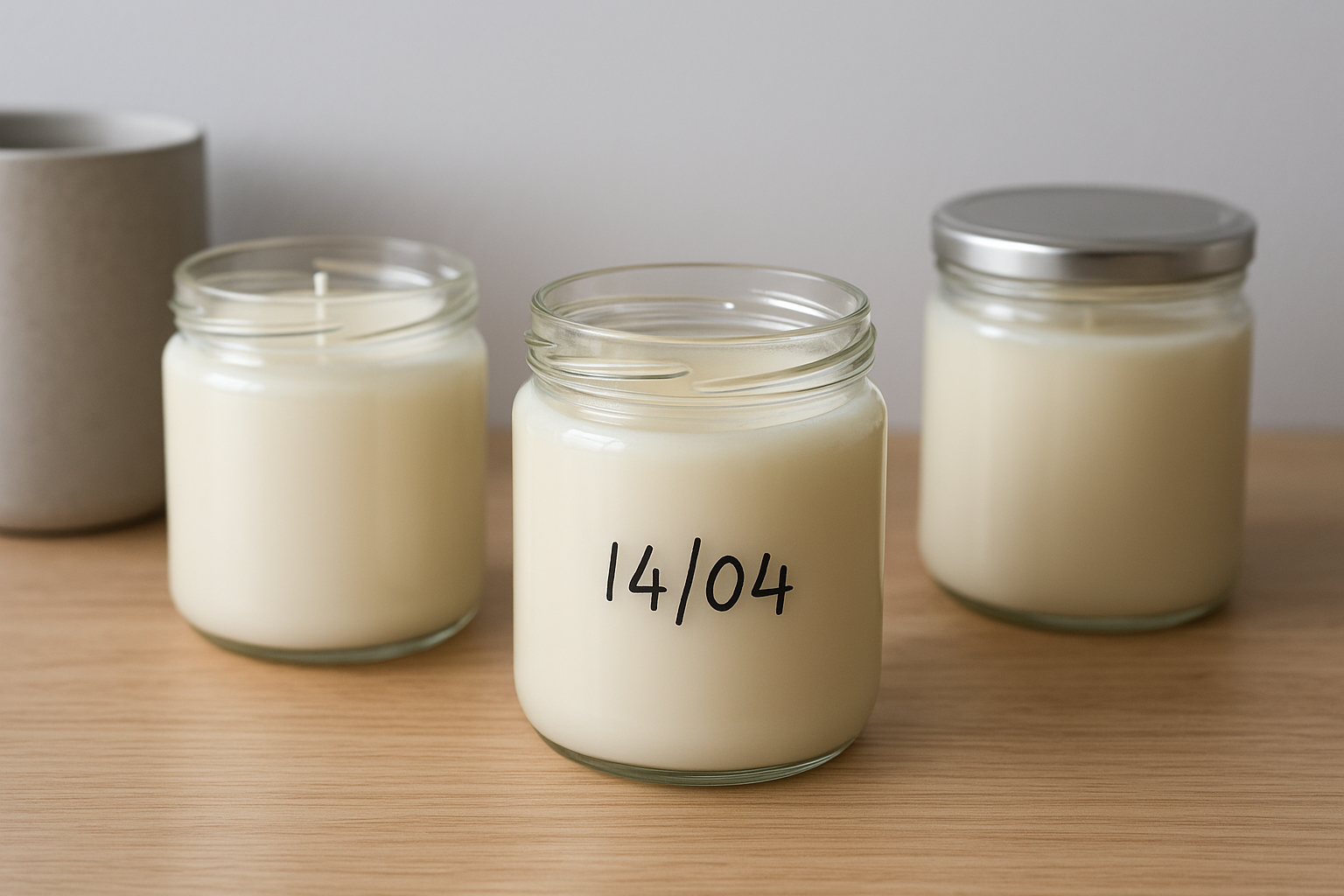
Keep lids or dust covers on your jars during curing to prevent fragrance from evaporating off the surface before you've even lit the wick.
Avoid curing candles near windows, air conditioning vents, or anything that introduces temperature swings throughout the day. A drawer, cupboard, or dedicated shelf in a temperate room works well for most home setups.
Tracking your cure time
When you're figuring out how long to cure soy candles across a batch, a simple labelling system removes the guesswork. Write the pour date directly onto the base of each vessel with a marker or sticker. That way, you know exactly when the 7 or 14-day window closes without relying on memory.
Check the candle surface daily during the first few days. A smooth, consistent top indicates the wax has settled properly and the cure is progressing as expected.
Troubleshooting and common cure time questions
Even when you follow the recommended timeframe, questions come up. The most common ones tend to cluster around why a candle still smells weak after curing and what to do when the surface doesn't look right. Below are straightforward answers to the issues candle makers run into most often.
My candle still has weak scent after 14 days
If your candle has completed a full cure and still delivers poor hot throw, the issue likely sits with your fragrance load rather than your cure time. Soy wax typically holds between 6% and 10% fragrance oil by weight. Anything below that range, especially for heavier or complex scent profiles, will produce a muted result no matter how long you cure it.
Check your pour temperature as well. Adding fragrance oil to wax that is too hot or too cool disrupts how well the two bind. Most soy waxes accept fragrance best between 60 and 65 degrees Celsius, so a thermometer is worth using on every pour.
Can you over-cure a soy candle
Knowing how long to cure soy candles also means understanding the upper limit. Curing beyond 14 days will not damage a soy candle, but fragrance intensity can begin to plateau after around three weeks. Some light top notes may fade slightly with an extended rest, particularly citrus and fresh accords that are naturally more volatile.
Store candles with lids on during any extended cure to slow surface evaporation and protect the scent load you worked to build.
A sensible cap for most candles is 21 days, after which you're unlikely to see further performance gains from waiting longer.
Final thoughts before you burn
Understanding how long to cure soy candles removes most of the frustration that comes from a disappointing first burn. The answer sits between 7 and 14 days for the vast majority of soy wax candles, with complex or heavier fragrance blends benefiting from the longer end of that range. Give your candle a cool, stable place to rest, keep the lid on, and note the pour date so you're not guessing when the window closes.
Your patience during the cure period is what separates a candle that performs from one that just looks the part. Every step in the process, from the pour temperature to the rest conditions, builds toward that first clean, fully scented burn. If you'd rather skip the production side entirely and go straight to burning something that has already been through this process, browse our hand-poured soy candle collection and find a fragrance worth waiting for.