
Your diffuser has gone quiet. The bottle's still half full, but you can't smell a thing when you walk past it, and the sticks look tired and clogged with dust. Before you toss the whole thing out, it's worth knowing that swapping in fresh reeds for reed diffusers is usually all it takes to bring the scent back to life.
Not all reeds are created equal, and that's the bit most people miss when they're standing in an aisle wondering why their diffuser never seemed to work as well as the display model. The material, thickness and length of your reed sticks for a diffuser all affect how much fragrance oil travels up and out into the room, so buying the wrong ones can leave you with a diffuser that looks the part but does nothing.
This guide walks you through exactly what to look for, from natural rattan versus synthetic fibre reeds to how many sticks you actually need for a proper scent throw, so your next purchase gives you a home that smells as good as it looks.
Why the reeds you choose affect your diffuser's scent throw
Reed diffusers work through a process called capillary action, where liquid fragrance oil is drawn up through tiny channels in each stick and evaporates once it reaches the surface. Scent throw simply means how far and how strongly that fragrance spreads through a room, and it depends entirely on how efficiently your reeds move oil from bottle to air. Cheap, dense reeds barely wick any oil at all, which is why so many diffusers end up sitting there looking decorative but doing nothing.
How porosity determines performance
Good reeds need an open, porous structure so oil can travel freely along thin internal channels rather than pooling at the base. Natural rattan reeds are prized for exactly this reason: the plant's fibrous, hollow structure acts almost like a wick in an oil lamp, pulling liquid upward and releasing it steadily. Synthetic or heavily varnished reeds, by contrast, often have their pores partially sealed during manufacturing, which chokes the flow and mutes the fragrance no matter how good the oil underneath is.
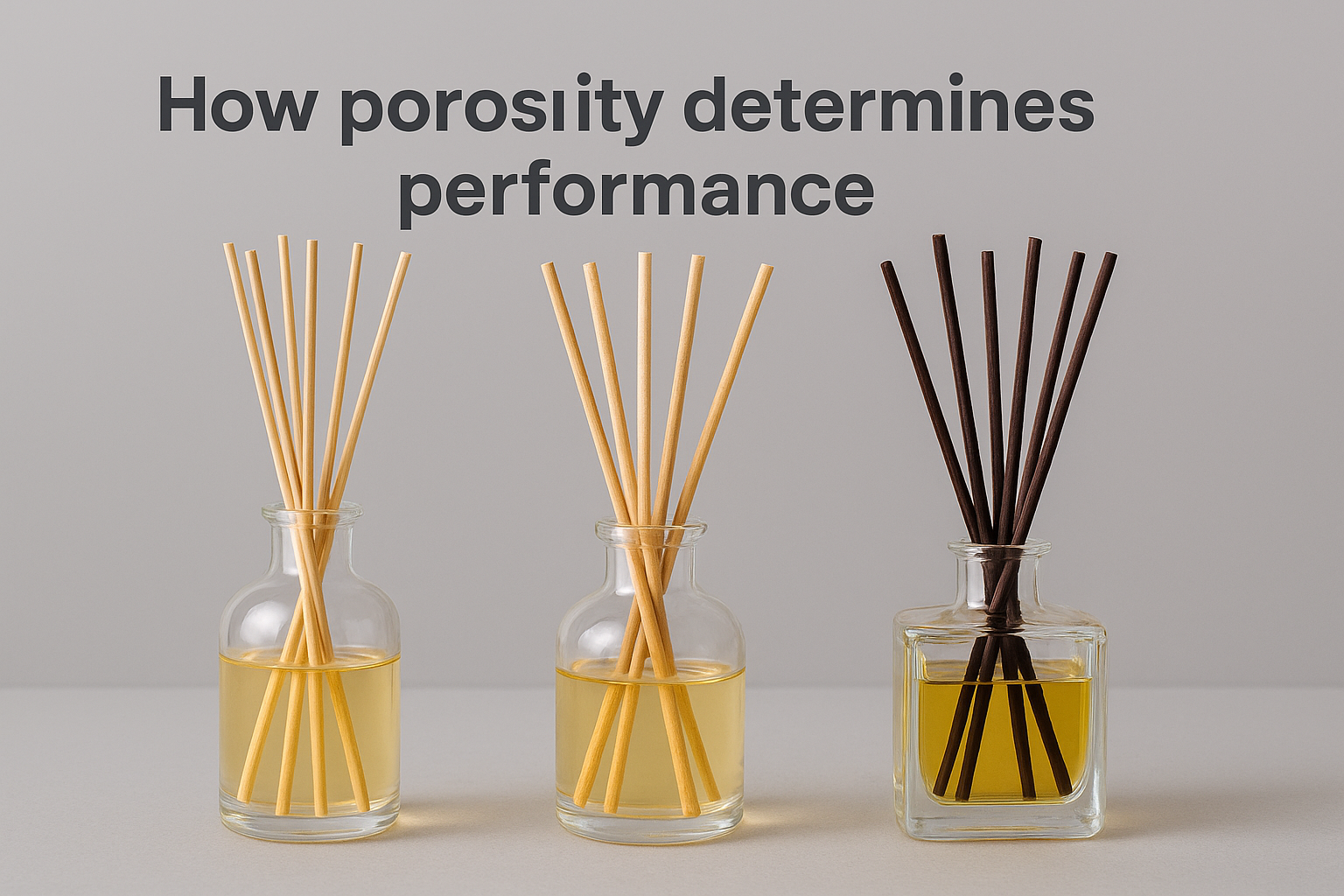
The reed is doing the actual work of releasing your fragrance, not the bottle.
Diameter matters just as much as the material itself. Thinner reeds, typically around 3mm, have less surface area and draw oil more slowly, which suits stronger or more concentrated oils. Thicker reeds, closer to 5mm, pull more liquid and release fragrance faster, making them better suited to larger, open-plan rooms or lighter scent bases. Mismatching diameter to oil concentration is one of the most common reasons people think their diffuser has failed when really the sticks were never right for the job.
| Reed Type | Diameter | Best For |
|---|---|---|
| Thin rattan | ~3mm | Small rooms, strong oils |
| Standard rattan | ~4mm | Everyday use, balanced throw |
| Thick rattan | ~5mm | Large or open-plan rooms |
| Synthetic fibre | Varies | Low-maintenance, subtler scent |
Length and reed count change the strength
Longer reeds expose more surface area to the air, so a 25cm stick will generally throw more scent than a 15cm one using the same oil. Number of reeds counts too, since each stick is an independent channel for evaporation. Four reeds in a small bathroom might be plenty, while an open living area often needs six to eight to fill the space properly.
Understanding this relationship between porosity, diameter, length and quantity explains why two diffusers using the exact same fragrance oil can smell completely different from room to room. It's rarely the oil that's underperforming. More often, it's the reeds for reed diffusers doing far less work than they should, which is exactly what you can fix before assuming the whole product needs replacing.
How to choose and replace reed diffuser sticks
Knowing when to swap your sticks matters just as much as knowing which ones to buy. Most diffuser reed refills are needed every four to six weeks, sooner if you've noticed the fragrance fading or the wood turning a dull, waxy brown near the base. That discolouration is oil residue clogging the internal channels, and no amount of flipping the reeds will fix it once the pores are sealed shut.
Flipping tired reeds only buys you a few days, replacing them buys you weeks.
Start by pulling the old reeds out completely rather than topping up around them, since half-saturated sticks won't wick fresh oil efficiently. Match the new reeds to the bottle's neck width so they sit snugly without oil pooling around the rim, and always trim them at an angle if you're cutting rattan down to size, as a flat cut seals the fibres and blocks the flow. Here's the quick replacement routine worth sticking to:
- Remove all old reeds and discard them, don't reuse them in a new bottle
- Check oil level and top up if it's dropped below a third of the bottle
- Insert fresh reeds, angled cut facing down into the liquid
- Wait 15 minutes, then flip once to prime the dry ends
- Reposition away from direct sunlight or airflow that can evaporate oil unevenly
Buying reeds separately from your fragrance oil gives you more control over cost and lets you refresh scent throw without replacing a whole bottle, especially once you know how to refill reed diffuser oil properly. If your diffuser came with a specific stick diameter, stick to that measurement when restocking, since mismatched reeds are the most common cause of a diffuser that suddenly seems weaker than it used to be.
Rattan or fibre reeds: which suits your space
Rattan remains the gold standard for most homes because its natural, porous structure wicks oil steadily without any coating getting in the way. Natural rattan gives you a warmer, more organic look on the shelf too, which matters if your diffuser sits somewhere visible like an entryway or living room. Fibre reeds, on the other hand, are manufactured to a consistent density, so they draw oil at a more predictable rate and tend to last a touch longer before clogging.
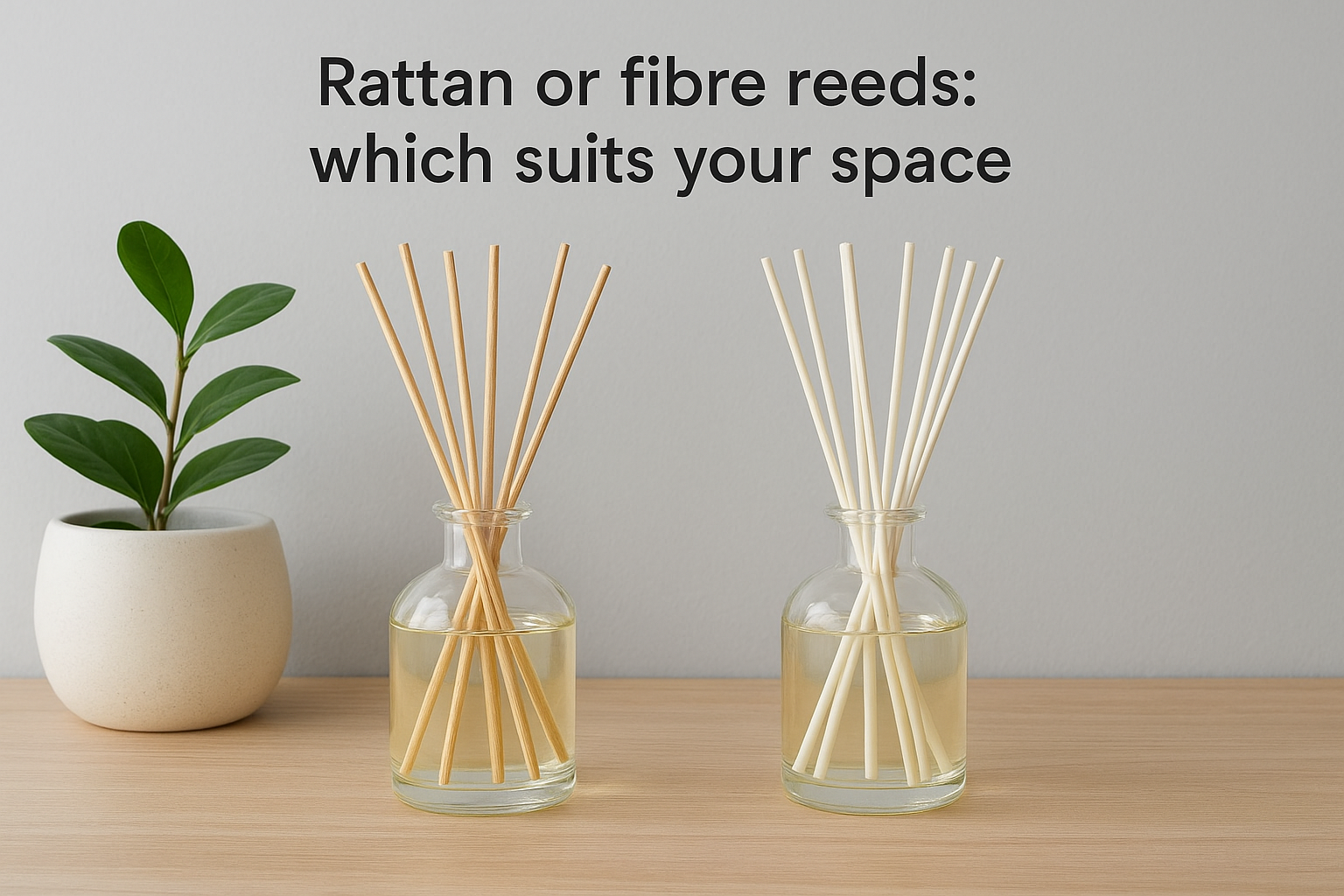
When fibre reeds make more sense
Bathrooms and laundries with high humidity or steam can swell rattan reeds slightly, slowing the wicking process and shortening their lifespan. Fibre reeds resist that swelling, so they're a better pick if your diffuser lives somewhere damp. They also suit anyone after a subtler, more consistent scent throw rather than the stronger bursts rattan can produce once oil concentration builds up near the base.
Choose rattan for character, fibre for consistency, but never mix the two in one bottle.
A quick side-by-side
| Feature | Rattan | Fibre |
|---|---|---|
| Scent throw | Stronger, more variable | Steadier, more subtle |
| Best rooms | Living areas, bedrooms | Bathrooms, laundries |
| Appearance | Natural, textured | Uniform, synthetic look |
| Lifespan | 4-6 weeks | Often 6-8 weeks |
| Humidity resistance | Lower | Higher |
Mixing rattan and fibre reed diffusers sticks in the same bottle is worth avoiding altogether, since they wick oil at different rates and one set will always underperform the other. If you're restocking a diffuser that came with rattan originally, stay with rattan rather than switching for the sake of a longer lifespan, because the scent character will noticeably change. For most South Australian homes, especially open-plan living spaces, rattan still gives the most reliable balance between visible style and genuine fragrance performance.
Getting the most fragrance from your reeds
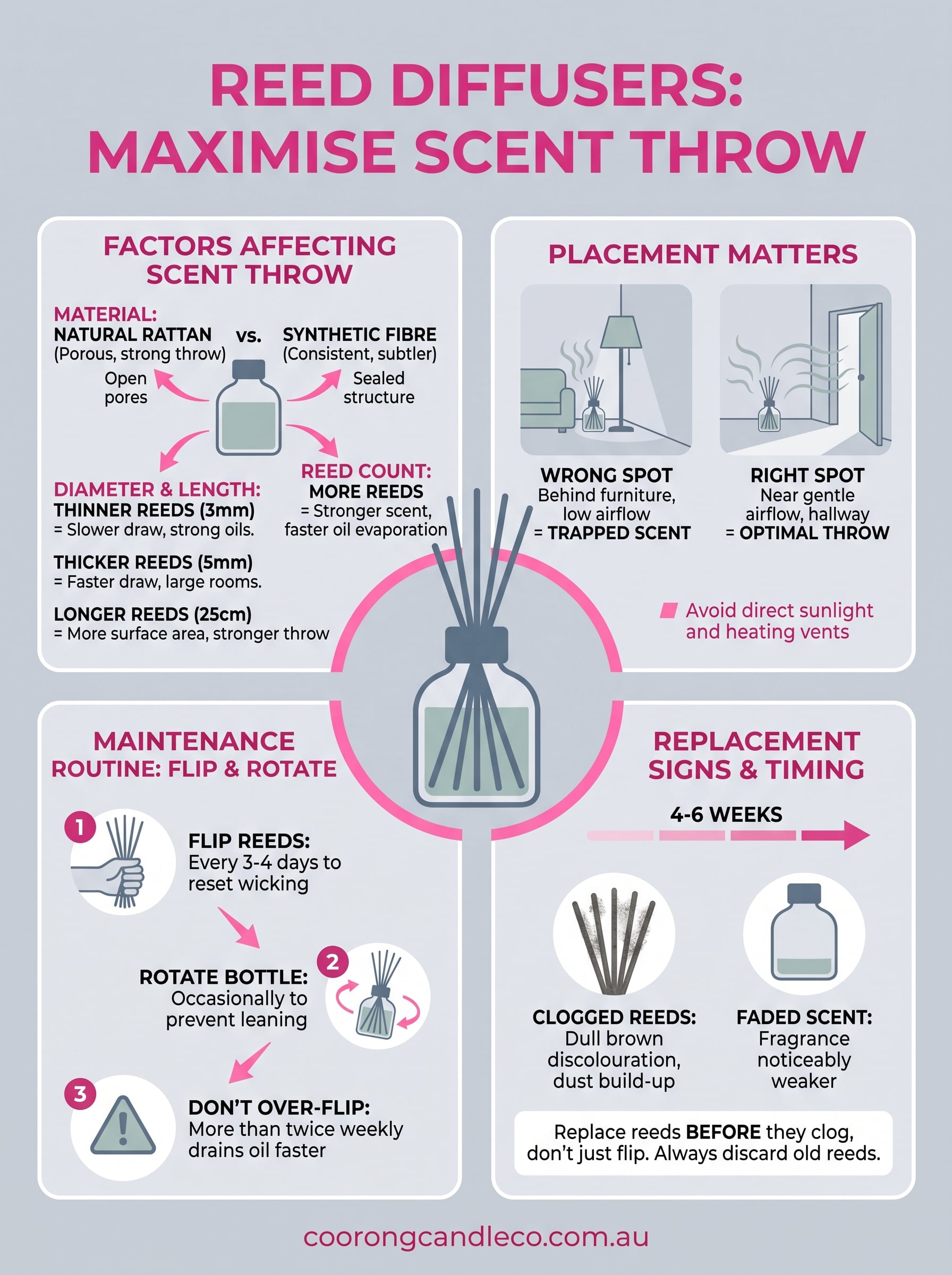
Getting the most out of your reeds for reed diffusers isn't only about buying the right sticks, it's about how you manage them day to day. Placement matters more than most people realise: a diffuser tucked behind a lamp or wedged into a corner shelf traps the fragrance before it ever reaches the room. Position your bottle somewhere with gentle airflow, like near a hallway or open doorway, and the scent will carry noticeably further, one of the simplest ways to make a reed diffuser last longer in any room without touching the oil formula at all.
A diffuser in the wrong spot will always smell weaker than the same one moved two metres over.
Flip and rotate on a schedule
Flipping your reeds isn't just an old trick, it genuinely resets the wicking process by exposing a saturated end to open air again. Doing this every three to four days keeps the fragrance consistent rather than tapering off in the second and third week. Skipping this step is one of the quiet reasons people assume their reed diffusers sticks have failed when really they've just gone stale sitting in one position.
- Flip all reeds together, not just one or two
- Wipe excess oil from your fingers before touching furniture
- Rotate the bottle itself occasionally so reeds don't lean
- Avoid flipping more than twice a week, as it drains oil faster
Match reed count to room size
Adding extra reeds temporarily boosts throw for a gathering or open house, then pulling a couple out afterwards extends the life of your oil for everyday use. Heating and cooling vents dry oil out faster too, so keeping your diffuser away from direct airflow from a split system protects both the fragrance and the reeds themselves. If you're topping up scent across the whole house, our guide to buying and topping up diffuser oil refills covers the oils and stick sets designed to work together properly.
Finding the right reeds for your home
Getting reeds for reed diffusers right comes down to a few simple habits: pick a material and diameter that suits your oil and room size, replace the sticks before they clog rather than after, and give them a decent flip every few days so they keep pulling fragrance instead of sitting stale. None of this is complicated once you know what to look for, and it's usually the difference between a diffuser that quietly disappears into the background and one that actually fills your home the way it's meant to.
If your current bottle is running low on scent or the sticks look past saving, don't just replace the reeds and hope for the best. Browse our full range of natural reed diffusers, hand-blended in South Australia with 10 rattan reeds included in every gift box, and get your home smelling the way it should again.