
If you've ever picked up a candle or reed diffuser and wondered what gives it that specific scent, the answer is almost always fragrance oils. They're one of the most common ingredients in home fragrance products, yet most people don't know much about what's actually in them or how they're made.
At Coorong Candle Co., we use fragrance oils in every hand-poured soy candle and reed diffuser we create, each one inspired by the natural landscapes of South Australia. Choosing the right fragrance oils matters to us because it directly affects scent quality, burn performance, and safety for your home. That's why we think it's worth understanding what these oils actually are.
This article breaks down the basics: what fragrance oils are composed of, how they differ from essential oils, where they're used, and what to look for if candle safety is a priority for you.
Why fragrance oils matter in home fragrance
Understanding what are fragrance oils is one thing, but knowing why they're used so widely in home fragrance is another. Scent is one of the most powerful sensory triggers we have, linked directly to memory and emotion. When you walk into a room and smell something familiar, your mood can shift in seconds. Home fragrance products tap into that response deliberately, using fragrance oils to create consistent, long-lasting scents that shape the atmosphere of an entire space.
How scent affects your daily environment
The fragrance in a room does more than smell pleasant. Studies suggest that certain scents actively reduce perceived stress and support a sense of calm, which is why candles and reed diffusers have become such a fixture in home wellness routines. When you light a well-made candle, the scent fills the room gradually and evenly, rather than spiking immediately and fading within minutes.
The way a fragrance behaves in a room depends almost entirely on the quality and composition of the oils used to create it.
Fragrance oils give makers the ability to design specific scent profiles that natural ingredients alone cannot reliably deliver. A blend inspired by coastal scrubland, for example, might need both natural-derived and synthetic components to get the balance right. Without fragrance oils, that kind of precision simply isn't achievable.
Why consistency matters for candle makers
For small-batch candle producers, consistency is everything. Every pour needs to smell the same as the last, and the scent needs to hold up through the entire burn. Essential oils, while popular, can be unpredictable in a candle environment. They evaporate at different rates and don't always bind well with wax, which directly affects how the scent travels across a room.
Fragrance oils are formulated specifically for use in products like candles and diffusers. They're designed to:
- Bind effectively with soy and paraffin waxes
- Release scent steadily during a burn, rather than all at once
- Remain stable over time, so your candle smells the same weeks after purchase as it did on day one
- Perform consistently across different batch sizes and production conditions
This reliability is why most professional candle makers, including small artisan producers, use fragrance oils as their primary scenting ingredient.
What fragrance oils are made from
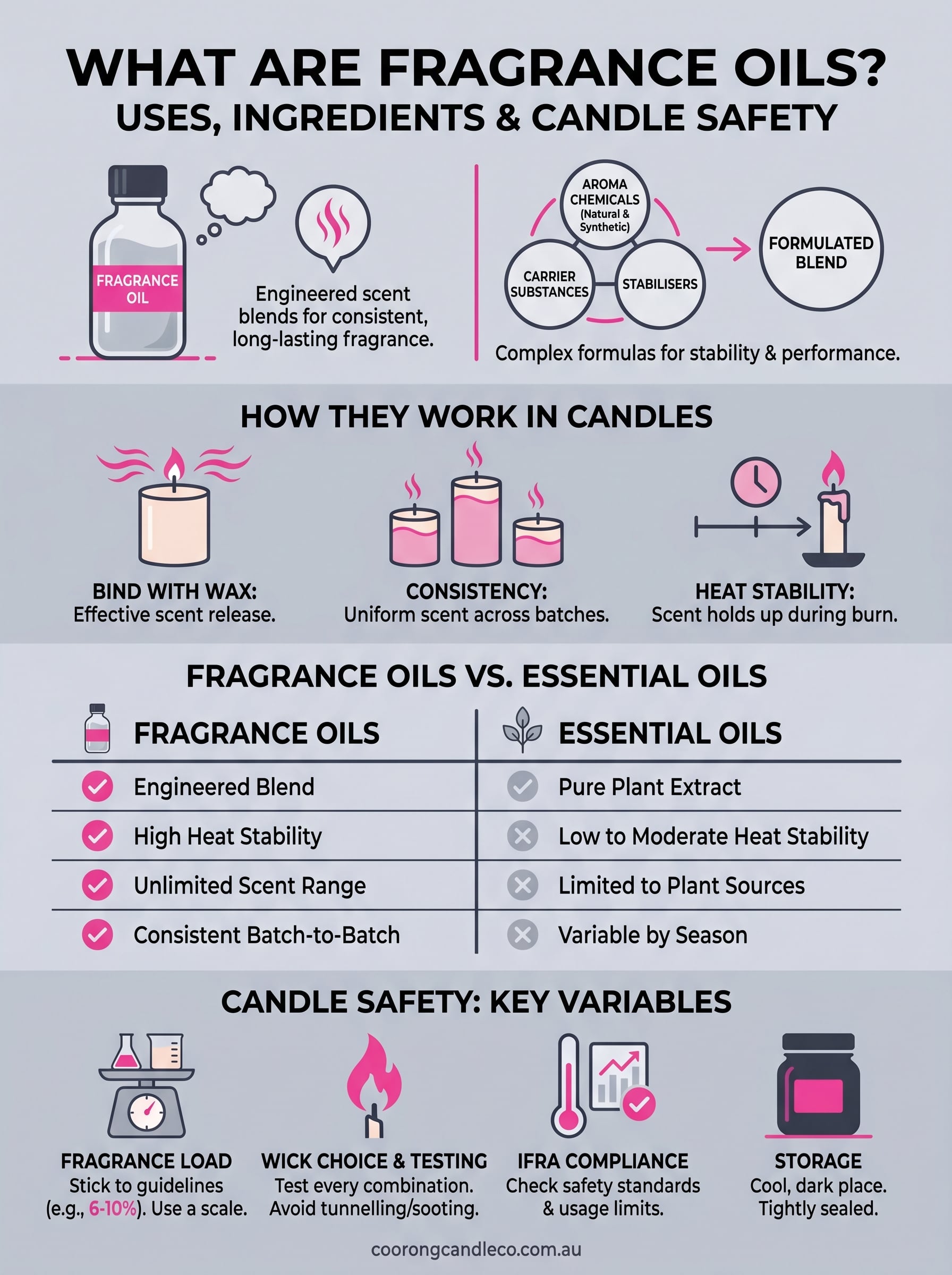
When people ask what are fragrance oils at a chemical level, the answer involves a combination of aroma chemicals and carrier substances blended to create a stable, consistent scent. Most fragrance oils you encounter in candles, diffusers, and personal care products are not a single ingredient; they're a carefully balanced formula that can contain dozens of individual components working together.
Synthetic and natural aroma chemicals
Fragrance oils draw from two main sources of aroma compounds. Natural aroma chemicals are extracted from plant material, including flowers, resins, and woods, through processes like steam distillation or cold pressing. Synthetic aroma chemicals are created in a laboratory to either replicate natural scents or produce entirely new ones that have no direct equivalent in nature.
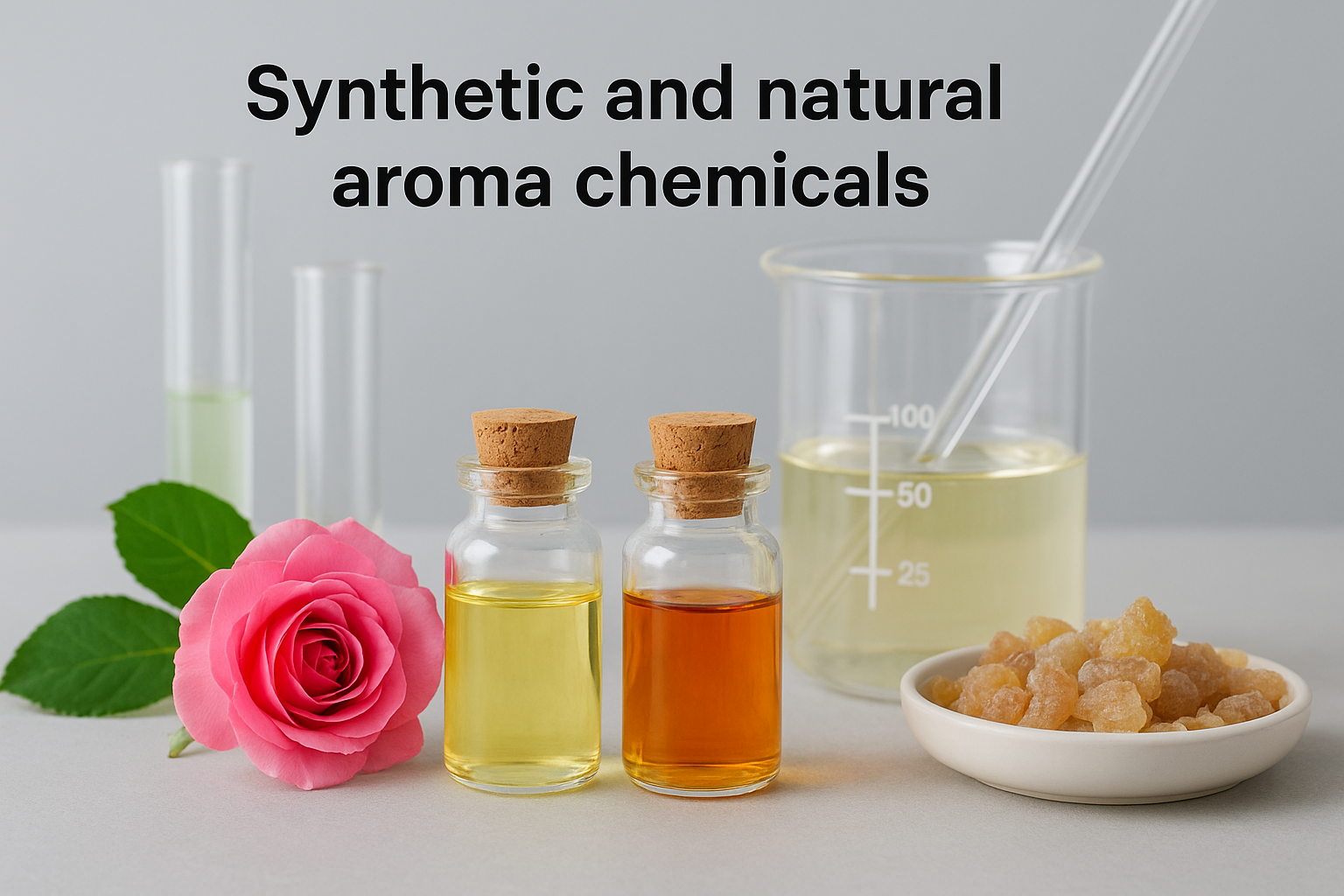
Synthetic aroma chemicals are not inherently harmful, and many are safer and more stable than their natural counterparts when used in finished products.
Both types are governed by international safety standards set by the International Fragrance Association (IFRA), which publishes usage limits for individual aroma chemicals across different product categories including candles, rinse-off products, and leave-on skin applications.
Carrier components and stabilisers
Beyond the aroma chemicals themselves, fragrance oils also contain carrier substances, typically a solvent like dipropylene glycol (DPG), which dilutes the concentrate and helps it blend evenly into wax or other bases. Some formulas also include fixatives to slow the rate of evaporation, which is what allows a candle or diffuser to release scent gradually over time rather than all at once. These carrier components are generally odourless and do not alter the final scent profile.
How fragrance oils differ from essential oils
If you've spent any time researching home fragrance, you've likely come across both terms. Fragrance oils and essential oils are not interchangeable, and understanding the difference helps you make better decisions about the products you bring into your home. The most important distinction comes down to composition and purpose: one is a formulated blend, the other is a pure plant extract.
What essential oils actually are
Essential oils are 100% natural extracts derived directly from plant material, including flowers, bark, leaves, and roots. They're produced through distillation or cold pressing and contain no synthetic additions. Because they come straight from the plant, their scent strength and consistency can vary significantly depending on the season, growing conditions, and harvest quality. That natural variability is part of their appeal for some uses, but it creates real challenges in candle making.
Essential oils are not designed for high-heat environments, which means they can evaporate too quickly or behave unpredictably in wax.
Key differences in composition and performance
Fragrance oils, by contrast, are engineered for specific applications. They're stable at higher temperatures, bind well with wax, and deliver a consistent scent throw across every single burn. When considering what are fragrance oils versus essential oils, the practical gap is significant:
| Factor | Fragrance oils | Essential oils |
|---|---|---|
| Consistency | Batch to batch uniform | Variable by season |
| Heat stability | High | Low to moderate |
| Scent range | Virtually unlimited | Limited to plant sources |
| Cost | Generally lower | Often significantly higher |
Your choice between the two ultimately depends on what you're making and the result you want to achieve.
How to use fragrance oils safely in candles
Once you understand what are fragrance oils and how they're composed, the next practical question is how to use them without creating hazards in your home. Fragrance oils are concentrated chemical blends, and using them incorrectly in candles can affect both burn quality and indoor air safety.
The single most important variable in candle safety is the fragrance load: how much oil you add relative to the wax.
Getting the fragrance load right
Most soy wax formulations can hold between 6% and 10% fragrance oil by weight, though the exact limit depends on the specific wax you're using. Going beyond the recommended load doesn't make a candle smell stronger during the burn; it actually causes the excess oil to pool on the surface or seep out of the wax entirely. Always check the fragrance load guidelines for your wax before you pour.
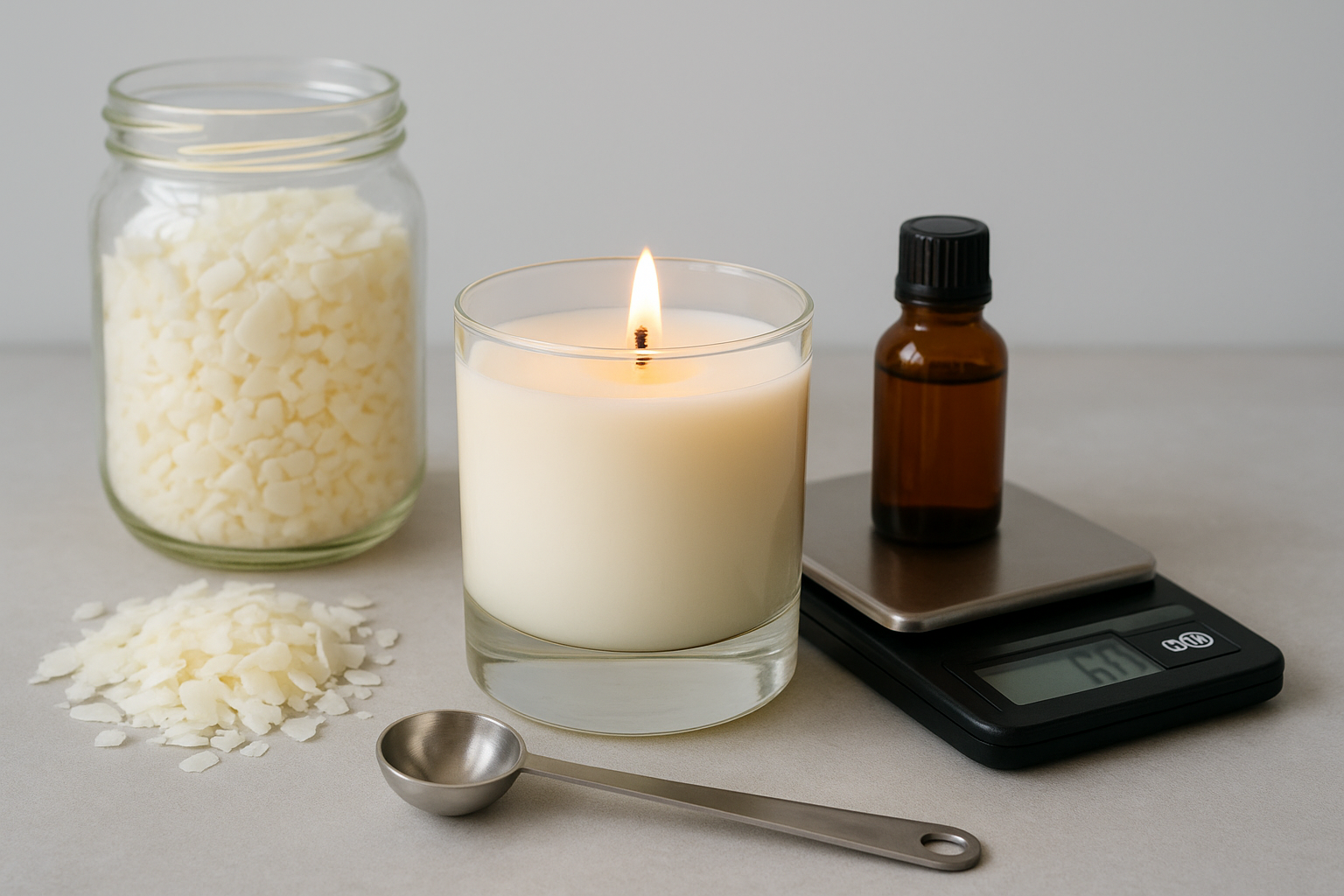
- Use a kitchen scale rather than measuring by volume for accuracy
- Start at 6% and test before increasing
- Keep records of each batch so you can replicate results consistently
Choosing wicks and testing burns
The wick you choose interacts directly with the fragrance oil in your wax. A wick that's too small will cause the candle to tunnel and leave pooled oil around the edges. A wick that's too large burns too hot, which releases the fragrance too quickly and can generate excessive soot.
Test every new fragrance oil and wick combination with at least three full burns before considering a candle finished or ready to give as a gift.
How to choose and store fragrance oils
Once you understand what are fragrance oils and how they work in a candle environment, the next step is knowing how to select the right ones and keep them in good condition. Not all fragrance oils perform equally across different wax types, and buying without checking compatibility first is a common and costly mistake.
Selecting a fragrance oil for your product
When you're choosing a fragrance oil, the most important thing to verify is whether it's tested and rated for the specific application you have in mind. A fragrance oil designed for soap may not perform well in soy wax, and vice versa. Always look for a supplier's usage guidelines that specify the recommended fragrance load, the wax types it's compatible with, and whether it has passed IFRA safety assessments.
Buying a fragrance oil without checking its IFRA compliance puts both the quality of your product and the safety of your home at risk.
- Check the flash point (the temperature at which the oil vapour can ignite) before using it in a candle
- Confirm the recommended fragrance load percentage for your specific wax
- Start with a small quantity to test scent throw before committing to a bulk order
Keeping fragrance oils in good condition
Proper storage extends the shelf life of your fragrance oils significantly and protects the integrity of the scent. Keep your oils in dark glass or opaque containers, away from direct sunlight, heat sources, and fluctuating temperatures. Most fragrance oils will stay stable for 12 to 24 months when stored correctly. Always seal the lid tightly after each use to prevent oxidation, which gradually dulls the scent over time.
Final thoughts
Knowing what are fragrance oils gives you a real advantage when choosing home fragrance products. The quality of the oil directly shapes how a candle burns, how long a diffuser lasts, and whether a scent holds up over weeks of regular use. When you understand what goes into a fragrance oil, including its aroma chemicals, carrier components, and IFRA compliance status, you're in a much better position to judge whether a product is actually worth your money.
At Coorong Candle Co., every scent we develop starts with fragrance oils tested for candle performance and home safety. Each candle is hand-poured in small batches using pure soy wax and lead-free cotton wicks, so the fragrance behaves exactly the way it should from the first burn to the last. If you'd like to experience that for yourself, browse our natural soy candle collection and find a scent inspired by the landscapes of South Australia.