
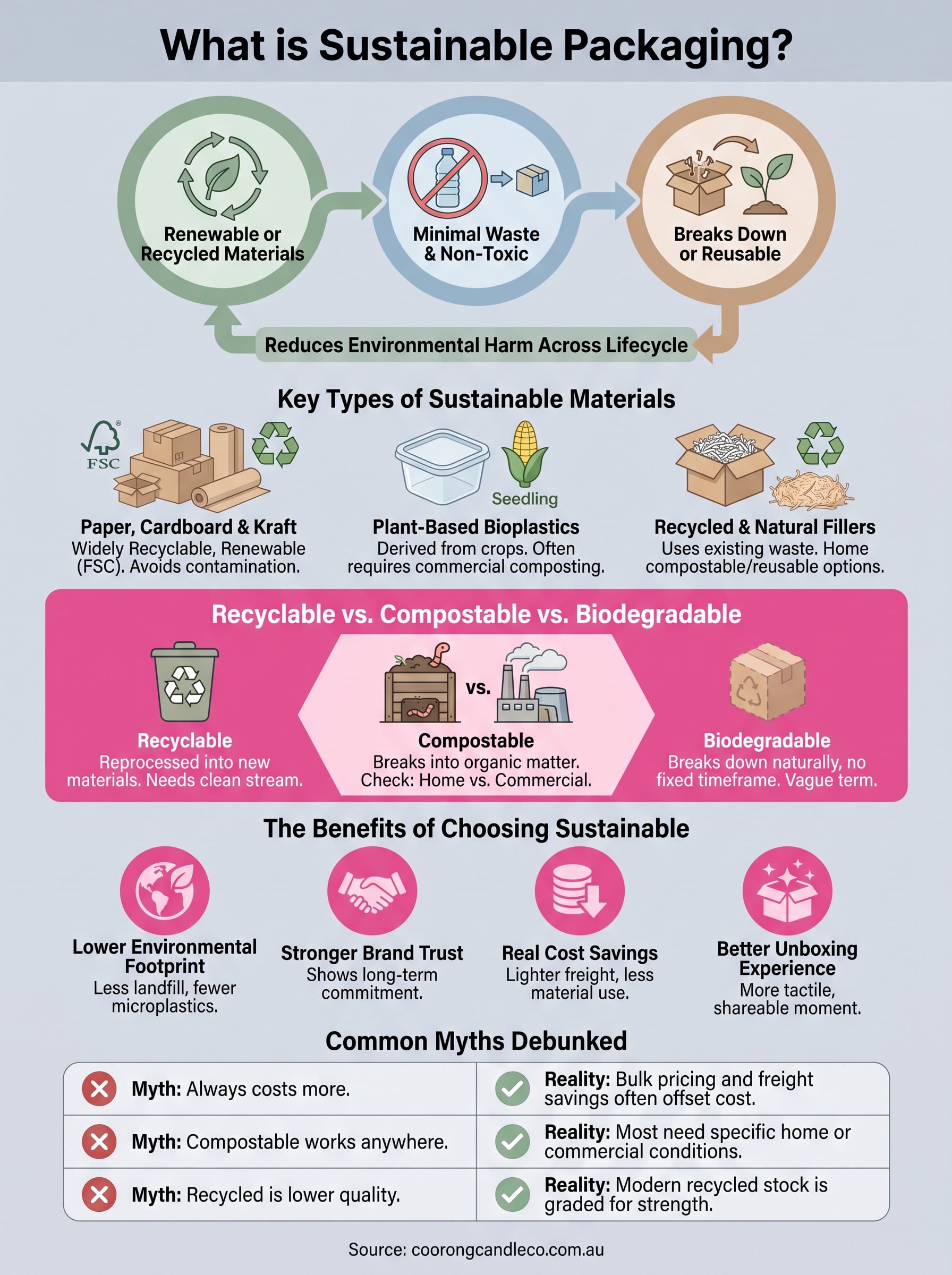
If you've ever unwrapped a parcel and wondered why the box, the filler, and the wrapping all seemed designed to be tossed straight in the bin, you're asking the right question. What is sustainable packaging, really? It's not just a marketing label slapped on a box. It means materials and design choices that reduce environmental harm across the whole lifecycle, from sourcing raw materials through to what happens after you've unwrapped your order.
In plain terms, sustainable packaging relies on renewable or recycled materials, avoids unnecessary plastic, and is designed to break down, biodegrade, or be reused rather than sit in landfill for centuries. It follows a few core principles: minimal waste, non-toxic inks and adhesives, and packaging that's genuinely fit for purpose rather than oversized for show.
We've built this guide around what we've learned packaging soy candles and bath products at Coorong Candle Co., where eco-friendly choices matter as much as what's inside the box. Below, we break down the materials that qualify as sustainable, the environmental benefits worth understanding, and how to spot genuine sustainable packaging versus greenwashing dressed up in kraft paper.
Why sustainable packaging matters more than ever
Right now, packaging waste is piling up faster than most systems can process it, and shoppers have noticed. Every parcel that lands on a doorstep carries a hidden cost: the resources used to make it, the energy spent shipping it, and the fate it faces once it's torn open. Sustainable packaging has shifted from a niche selling point to a baseline expectation, particularly for small Australian brands competing against overseas retailers that ship in bubble wrap and polystyrene by the tonne. Understanding why this shift happened helps explain what's driving the changes you're seeing on shelves and in your letterbox.
The scale of the packaging waste problem
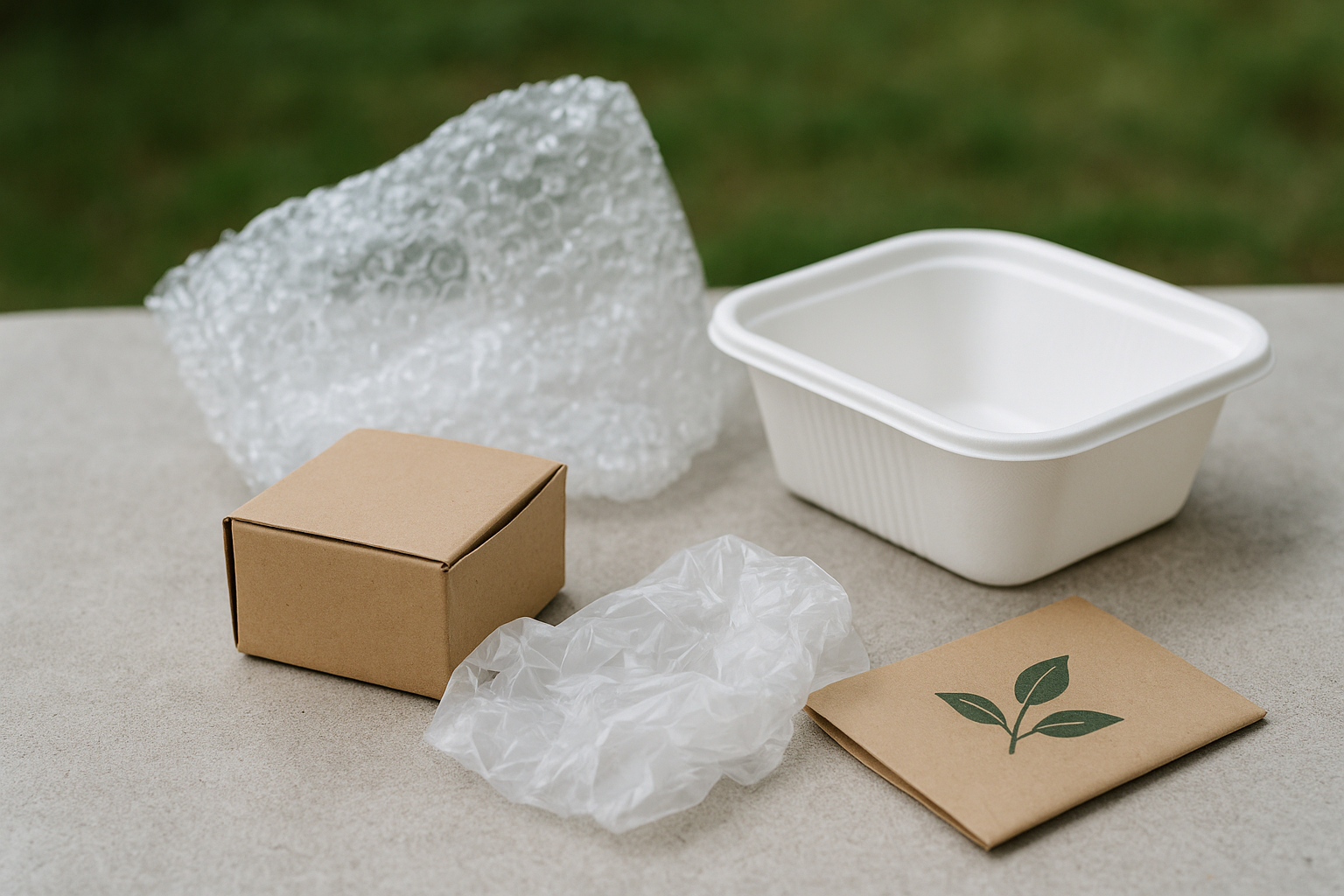
Australia generates an enormous volume of packaging waste every year, and a meaningful share of it still ends up buried in landfill rather than recovered and reused. Cardboard and paper break down reasonably fast, but the plastic films, laminated pouches, and polystyrene inserts common in older packaging designs can persist for centuries, shedding microplastics into soil and waterways long after the product inside has been forgotten. Recovery rates for materials like glass and steel remain relatively strong across the country, but plastic packaging recovery lags well behind, a gap tracked closely by the Australian Packaging Covenant Organisation (APCO), the industry body coordinating the nation's packaging targets.
| Material | Typical breakdown time | Common problem |
|---|---|---|
| Plastic film or bubble wrap | Hundreds of years | Fragments into microplastics |
| Polystyrene foam | Effectively indefinite | Rarely recycled, disperses into waterways |
| Cardboard or kraft paper | Weeks to months | Recyclable only if uncontaminated |
| Starch-based compostable fillers | A few weeks in the right conditions | Needs a commercial composting facility |
Packaging that takes centuries to break down but seconds to unwrap is a bad trade, and consumers are starting to say so with their wallets.
Regulation is catching up with the problem
Governments have stopped waiting for industry to fix this on its own. Under the 2025 National Packaging Targets, coordinated by APCO, Australian businesses are expected to move towards 100% reusable, recyclable, or compostable packaging, while the federal government continues progressing a national approach to phasing out problematic single-use plastics, as outlined by the Department of Climate Change, Energy, the Environment and Water. State by state, container deposit schemes and plastic bag bans have already reshaped what's allowed on shop shelves and in warehouses, and packaging that ignores these shifts risks running into rules that only get stricter from here.
That regulatory pressure isn't limited to big manufacturers either. Smaller producers, including handmade and artisan brands, are increasingly expected to demonstrate the same commitment, since retailers and marketplaces now build sustainability checks into their supplier requirements. Falling behind on this isn't just a reputational risk anymore, it can mean losing shelf space or wholesale accounts altogether.
Consumers are voting with their wallets
Shoppers increasingly treat packaging as part of the product itself, not an afterthought destined for the bin. Buying decisions are tilting towards brands that visibly commit to eco-friendly materials, and that shift shows up clearly in how often packaging gets mentioned in reviews, unboxing videos, and repeat-purchase behaviour. Small business owners across Australia report that customers now photograph their unboxing moments specifically to show off recyclable mailers or seed-embedded tissue paper, turning good packaging choices into unpaid advertising for the brands that get it right.
Unsurprisingly, this preference tends to run strongest among the exact audience most home fragrance and gifting brands are chasing: people buying for wellness, home styling, or thoughtful gift-giving occasions. Gifting a candle wrapped in plastic film undercuts the whole point of the gift, and buyers notice the mismatch immediately.
The business case runs deeper than good PR
Underneath the ethical argument sits a straightforward commercial one: lighter, simpler packaging usually costs less to produce, store, and ship. Reducing packaging weight cuts freight costs directly, and materials sourced from recycled or renewable inputs are becoming increasingly price-competitive with virgin plastic as demand for them scales up across the supply chain. Brands that delay the switch aren't only risking reputational damage, they're leaving efficiency gains on the table that competitors are already banking.
Very little of this is theoretical anymore. It's playing out in freight invoices, in retailer onboarding forms, and in the comments section under every unboxing post. Sustainable packaging has moved from a values statement to a practical requirement for staying competitive, which is exactly why the next section matters: knowing how to tell genuine sustainability from a well-designed label.
How to identify genuinely sustainable packaging
Walk into any gift shop and you'll see the word "eco" printed on half the shelf. Spotting genuinely sustainable packaging means looking past the language on the box and checking three things: what it's actually made from, whether that claim is backed by a real certification, and what you're supposed to do with it once you've unwrapped your candle or diffuser. Get those three checks right and you'll rarely be fooled by a kraft-coloured box that's secretly lined with plastic film.
Spot the greenwashing red flags
Vague wording is the first warning sign. Terms like "eco-friendly," "green," or "natural" printed on a box mean nothing on their own, because no Australian regulator polices how loosely those words get used on packaging. Brown paper and a leaf logo don't guarantee recyclable materials any more than a brown wrapper guarantees a healthy snack. If a supplier can't tell you the exact material composition, the recycling stream it belongs to, or the certification behind the claim, treat the label as marketing rather than fact.
If a brand can't tell you what its packaging is made from or where it goes after use, the sustainability claim is decoration, not fact.
Look for verifiable certifications
Real sustainability claims come with a paper trail. Certifications exist precisely because self-reported claims can't be trusted at face value, and a handful of well-known Australian and international marks do the verification work for you.
| Certification or label | What it verifies |
|---|---|
| Australasian Recycling Label (ARL) | Confirms exactly how to recycle each packaging component |
| FSC (Forest Stewardship Council) | Paper or cardboard sourced from responsibly managed forests |
| Seedling logo (Australasian Bioplastics Association) | Material meets Australian home or commercial composting standards |
| APCO membership | Business is publicly reporting on packaging sustainability targets |
The Australasian Recycling Label is worth checking specifically, since it removes the guesswork by telling you which bin each part of the packaging belongs in, rather than leaving you to assume.
Check the end-of-life instructions
Genuine sustainable packaging tells you what happens next, not just what it's made of. Instructions printed directly on the box, whether that's "compost at home," "recycle with soft plastics," or "reuse as a gift box," show a brand has actually thought through the product's full lifecycle rather than stopping at the point of sale. Missing instructions usually mean the packaging wasn't designed with disposal in mind at all.
Before trusting a sustainability claim, run through this quick checklist:
- Does the packaging list its exact material, not just a general category like "eco material"?
- Is there a recognised certification mark, and can you verify it independently?
- Are disposal instructions printed on the packaging itself?
- Would the packaging actually break down or get recycled in your local council system, not just in ideal conditions?
- Does the brand publish any information about its packaging choices beyond the box itself?
Running through these questions takes less than a minute at checkout, but it separates a brand that's genuinely reduced its footprint from one that's simply repainted a familiar problem in earthy tones.
The main types of sustainable packaging materials
Once you know how to spot a genuine claim, the next question is what actually counts as sustainable packaging material. The answer isn't one material but a small family of them, each suited to a different job, from wrapping a soy candle to cushioning a glass diffuser bottle in transit. Knowing the strengths and limits of each type helps you judge whether a brand has matched the material to the product, or just grabbed whatever looked eco-friendly on a supplier catalogue.
Paper, cardboard and kraft materials
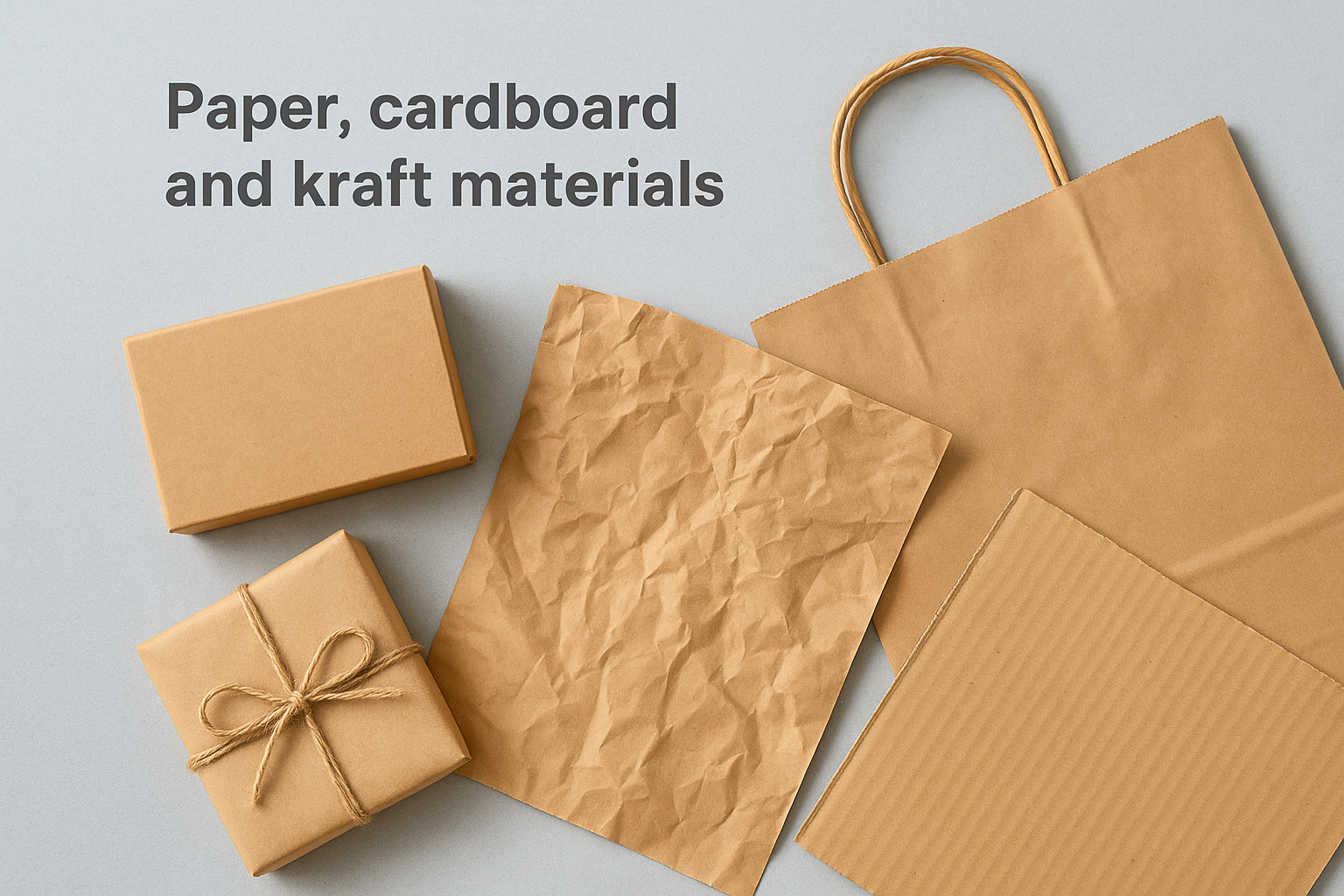
Paper-based packaging remains the workhorse of sustainable design because it's widely recyclable, renewable when sourced from certified forests, and familiar to every kerbside collection service in Australia. Kraft paper in particular has become the visual shorthand for eco-friendly packaging, and for good reason: it's uncoated, unbleached, and breaks down without leaving synthetic residue behind. The catch is contamination. Grease, wax coatings, or a hidden plastic laminate can knock an otherwise recyclable box out of the recycling stream entirely, which is why checking for an FSC mark matters more than judging paper by colour alone.
Plant-based bioplastics
Bioplastics, most commonly PLA (polylactic acid) made from corn starch or sugarcane, look and feel like conventional plastic but are derived from renewable crops rather than petroleum. They're useful where a rigid or clear material is genuinely needed, such as a window in a gift box or a protective shrink layer. Bioplastic packaging isn't automatically compostable at home though. Most PLA needs the higher temperatures of a commercial composting facility to break down properly, so a bioplastic label without a Seedling logo or clear disposal instructions is only half the story.
Recycled and post-consumer materials
Recycled content, whether it's post-consumer cardboard, recycled paper pulp, or rPET plastic reclaimed from used bottles, cuts demand for virgin resources without needing new farmland or drilling. Recycled materials are often the most immediately impactful choice for a small brand because they close the loop on waste that already exists rather than betting on a new material breaking down later. The trade-off is consistency: recycled stock can vary in strength and finish batch to batch, which matters if you're shipping something fragile like a glass reed diffuser.
The most sustainable material is often the one that already exists in the recycling stream, not a new one invented to sound green.
Natural fillers and cushioning
Filling the gaps around a candle jar or bath bomb multipack used to mean bubble wrap or polystyrene chips. Natural alternatives, shredded kraft paper, cornstarch-based packing peanuts, and even wood wool, do the same cushioning job without the microplastic legacy.
| Material | Best used for | Disposal method |
|---|---|---|
| Kraft paper | Wrapping, boxes, void fill | Kerbside recycling |
| PLA bioplastic | Rigid windows, shrink wrap | Commercial compost only |
| rPET plastic | Bottles, clear inserts | Kerbside recycling (check local rules) |
| Cornstarch packing peanuts | Cushioning fragile items | Home compost |
| Wood wool | Cushioning, gift hampers | Home compost or reuse |
Matching the material to the job, rather than defaulting to whatever looks rustic, is what separates thoughtful packaging design from a marketing exercise.
Recyclable vs compostable vs biodegradable
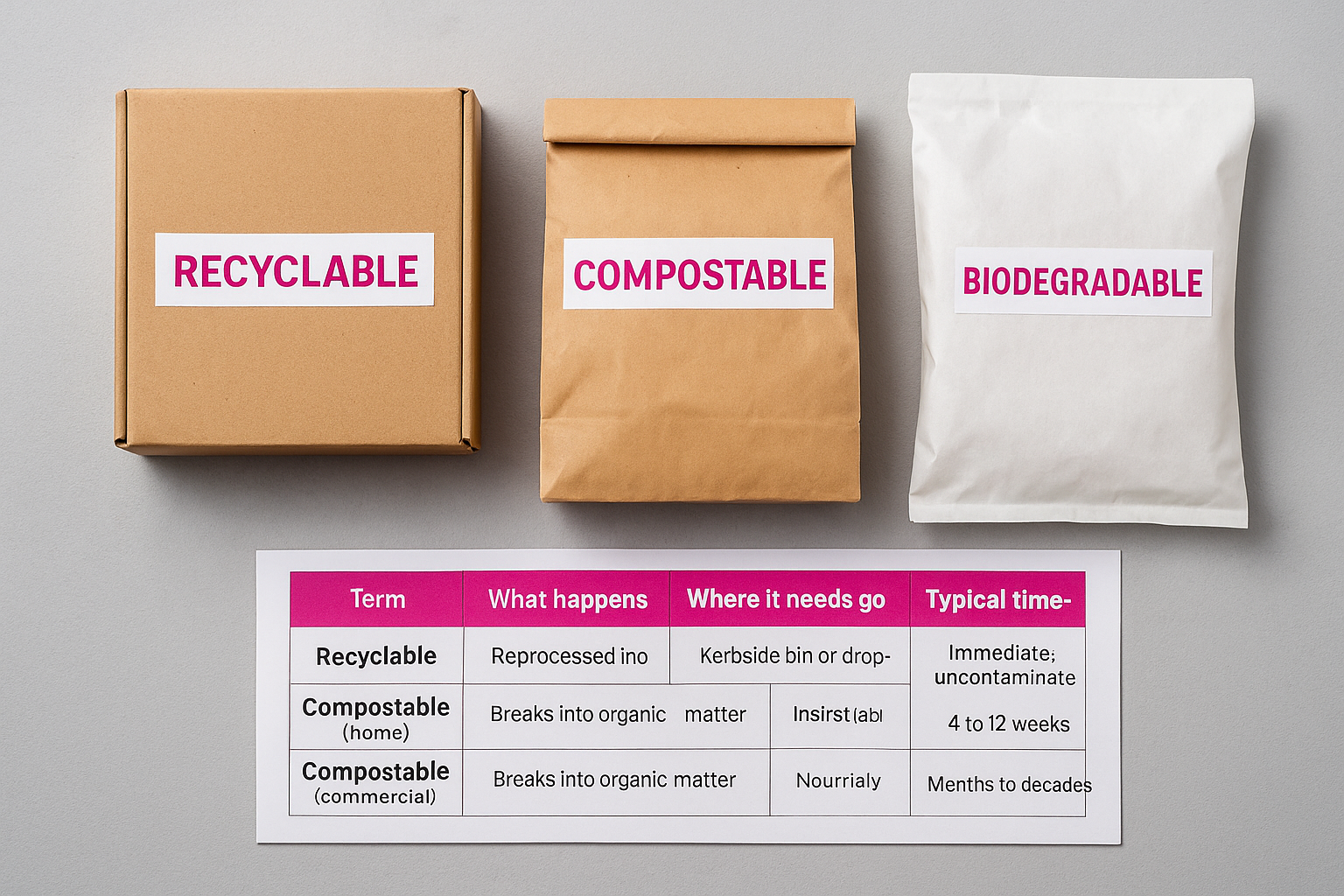
These three words get thrown around as if they mean the same thing, but each one describes a completely different fate for the box or wrapper in your hands. Confusing them is the single biggest reason well-intentioned packaging ends up in the wrong bin, contaminating a recycling load or sitting uselessly in landfill because it needed a compost heap instead. Understanding the difference matters just as much as choosing the right material in the first place, since even the greenest packaging fails if it's disposed of incorrectly.
What recyclable actually means
Recyclable packaging can be broken down and reprocessed into raw material for something new, but only if it reaches the right facility in a clean, uncontaminated state. Cardboard, glass, and rPET plastic all qualify here, provided grease, wax, or food residue hasn't ruined the batch. A recyclable label doesn't guarantee your council actually accepts it either, since soft plastics and some composite materials need drop-off points rather than kerbside collection.
What compostable actually means
Compostable packaging breaks down into nutrient-rich matter, but the conditions required vary enormously depending on the material. Home compostable items, like cornstarch packing peanuts or wood wool, break down in a standard backyard compost bin within weeks. Commercially compostable items, most PLA bioplastics among them, need the sustained heat of an industrial facility that most households simply don't have access to, so they're compostable in theory but not in your backyard.
What biodegradable actually means
Biodegradable is the loosest term of the three, and that looseness is exactly why it gets overused on packaging that doesn't deserve the label. Biodegradable technically just means a material will eventually break down through natural processes, but with no fixed timeframe and no guarantee it won't leave microplastic fragments behind along the way. A biodegradable claim without a certification or timeframe attached is closer to marketing than to a genuine environmental promise.
A material can be biodegradable and still take fifty years to disappear, so the word alone tells you almost nothing.
Comparing the three at a glance
| Term | What happens | Where it needs to go | Typical timeframe |
|---|---|---|---|
| Recyclable | Reprocessed into new material | Kerbside bin or drop-off point | Immediate, if uncontaminated |
| Compostable (home) | Breaks into organic matter | Backyard compost bin | 4 to 12 weeks |
| Compostable (commercial) | Breaks into organic matter | Industrial composting facility | Weeks, at high heat |
| Biodegradable | Breaks down naturally, no fixed process | No standard disposal route | Months to decades |
Getting the disposal right takes a few extra seconds of checking, but it's the difference between packaging actually delivering on its promise or quietly undermining it. Before you toss anything in the bin, run through this quick check:
- Does it say "recyclable", "home compostable", or "commercially compostable" specifically, rather than just "biodegradable"?
- Is there a Seedling logo or ARL mark confirming the claim?
- Does your council or local compost setup actually support that disposal method?
- If it needs commercial composting, is there a facility or collection service nearby?
Sorting this out properly turns good packaging design into an actual environmental outcome, rather than a well-meant claim that quietly fails at the bin.
The benefits of choosing sustainable packaging
Understanding what is sustainable packaging only matters if you can see what it actually delivers once you commit to it. The benefits split neatly into four groups: environmental impact, brand reputation, cost efficiency, and customer experience. Few packaging decisions tick all four boxes at once, but sustainable materials come closer than almost any other design choice a small business can make.
Lower environmental footprint
Swapping plastic film and polystyrene for recyclable or compostable materials cuts the volume of waste that never breaks down, and it reduces the carbon cost of extracting and processing virgin plastic in the first place. Renewable materials like FSC-certified paper draw from managed forests rather than fossil fuels, and that distinction compounds across thousands of parcels a year. Choosing packaging that biodegrades or composts properly also means less material ending up as microplastics in soil and waterways, a problem that outlasts the product inside the box by centuries.
Every box that breaks down instead of piling up is one less thing future generations have to clean up after you.
Stronger brand trust and loyalty
Customers remember packaging longer than they remember the marketing that sold them the product. Genuine sustainability builds trust because it shows a brand has thought beyond the sale, and that trust tends to translate directly into repeat purchases and word-of-mouth referrals. Shoppers buying candles, diffusers, or gift sets as presents are particularly sensitive to this, since gifting something wrapped in plastic undercuts the thoughtfulness the gift was meant to convey. Brand loyalty built on packaging choices is also harder for competitors to copy quickly, because it requires supplier relationships and process changes rather than a one-off marketing campaign.
Real cost savings over time
Lighter, simpler packaging isn't just better for the planet, it's usually cheaper to produce, store, and ship. Freight costs scale with weight and volume, so trimming excess packaging or switching to slimmer recyclable mailers reduces shipping bills on every single order. Reduced material use also means less warehouse space tied up in bulky void-fill and fewer supplier invoices for polystyrene or bubble wrap that customers throw away within minutes anyway. Over a full year of orders, these savings add up in a way that a single sustainability certificate never could on its own.
A better unboxing experience
Opening a parcel is part of the product experience, not separate from it, and sustainable packaging tends to feel more considered from the first tear of the tape. Recyclable boxes, natural fillers, and tissue paper free of dye or coating create a tactile, uncluttered moment that plastic wrap simply can't match. Unboxing experience has become genuinely shareable content too, with customers photographing kraft paper wrapping or seed-embedded tissue and posting it without being asked, which turns thoughtful packaging into free advertising.
Here's a quick summary of what each benefit actually delivers:
- Environmental: less landfill waste, fewer microplastics, lower carbon footprint
- Reputation: stronger customer trust, more repeat buyers, harder for competitors to copy
- Cost: lighter freight, less storage space, fewer material invoices
- Experience: a more satisfying unboxing moment that customers want to share
Taken together, these benefits explain why sustainable packaging has stopped being a niche add-on and become one of the more reliable ways a small brand can compete on value, not just price.
Sustainable packaging examples in everyday products
Abstract definitions only go so far, so it helps to look at where sustainable packaging already shows up in daily life. Real-world examples make the difference between recyclable and greenwashed packaging obvious, because you can hold the product in your hand and check the claims against what you learned above. Once you start noticing these choices, you'll spot them everywhere from the supermarket aisle to the parcel on your doorstep.
Grocery and food packaging
Supermarkets have shifted a lot of their own-brand ranges towards paper-based punnets for mushrooms and tomatoes, replacing the moulded plastic trays that used to be standard. Milk and juice cartons increasingly carry FSC certification, and soft plastic bags for bread and rice are being phased towards recyclable mono-material films that don't require separating layers before recycling. None of this happened overnight. It's the result of retailer sustainability targets pushing suppliers to redesign packaging line by line, aisle by aisle.
E-commerce and parcel delivery
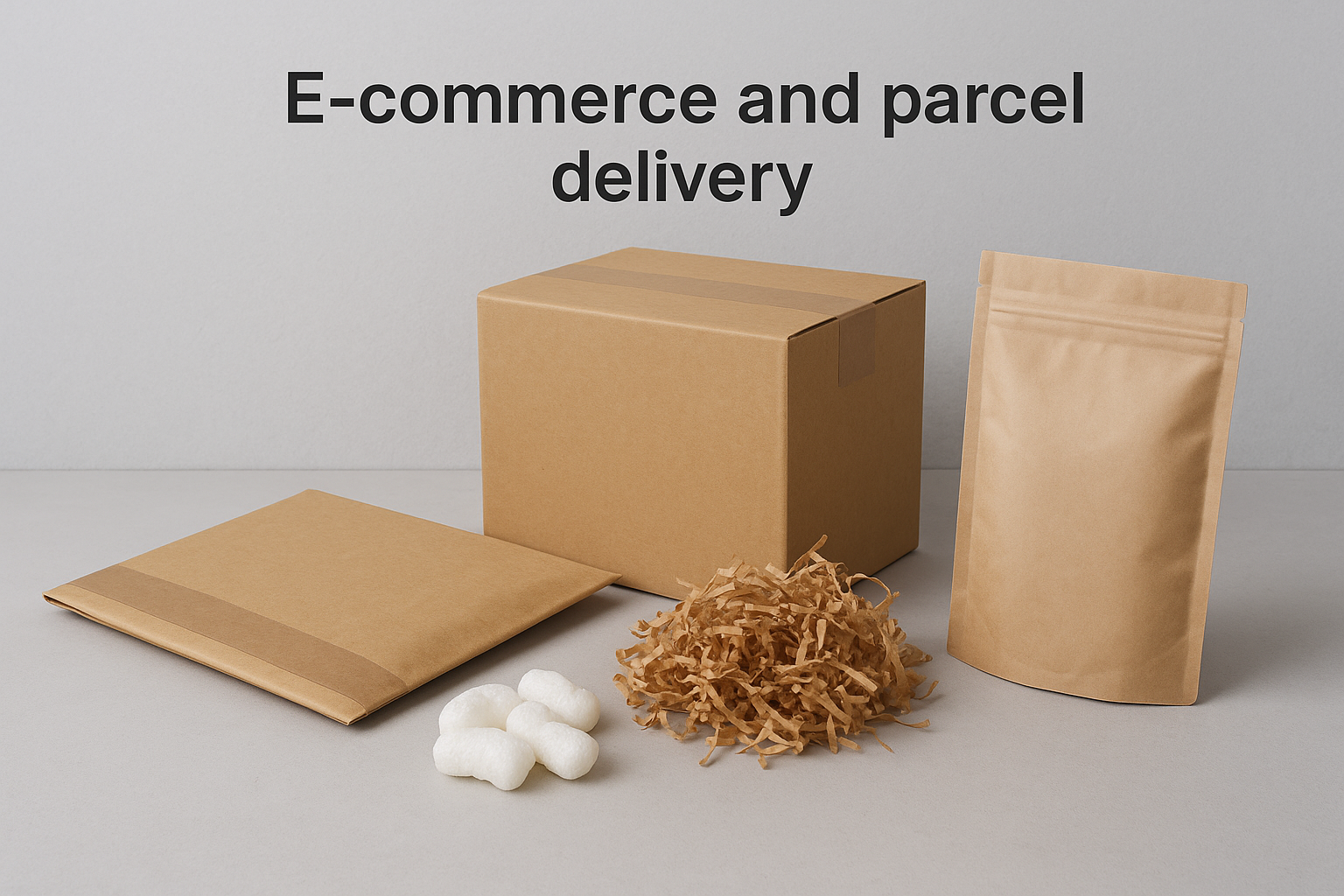
Online retailers have made some of the most visible changes, mostly because packaging is the first physical thing a customer touches. Recyclable mailers made from paper rather than plastic film are now common, and void-fill has largely moved from bubble wrap to shredded kraft paper or cornstarch peanuts. Compare the shift below:
| Old approach | Sustainable alternative |
|---|---|
| Plastic bubble mailer | Recyclable paper mailer |
| Polystyrene chips | Cornstarch packing peanuts |
| Plastic bubble wrap | Shredded kraft paper or wood wool |
| Printed plastic tape | Paper tape with water-based adhesive |
When a parcel arrives with no plastic film at all, that's not an accident, it's a supply chain decision that took real effort to make.
Cosmetics, candles and bath products
This is the category we know best. Soy candles shipped in cardboard boxes with tissue paper rather than moulded plastic inserts, bath bombs wrapped in compostable cellophane instead of standard plastic film, and diffuser bottles cushioned with wood wool rather than foam, all reflect the same principle applied to a smaller, more fragile product. At Coorong Candle Co., that means kraft boxes for our regional collections and paper-based fillers sized to the product rather than a generic box that leaves half the space to fill with plastic. Getting this right matters more for gifting products than almost any other category, since the unboxing moment is part of what's actually being given.
Fashion and homewares
Clothing retailers have swapped plastic garment bags for compostable versions made from cornstarch film, and homewares brands increasingly ship furniture and decor in moulded pulp packaging instead of polystyrene sheets. Moulded pulp, made from recycled paper fibre, has become a genuine polystyrene replacement for protecting corners and edges during transit, and it composts at home once it's served its purpose. These changes tend to spread fastest in categories where the packaging is highly visible on unboxing, which explains why fashion and gifting brands have moved quicker than industries where the box gets discarded unseen.
Across every one of these categories, the pattern repeats: paper and plant-based materials replace plastic film, cushioning shifts to something compostable, and disposal instructions start showing up printed on the box itself rather than left for the customer to guess.
Common myths about sustainable packaging debunked
A lot of outdated thinking still shapes how people talk about sustainable packaging, and some of it actively discourages small brands from switching materials that would genuinely help. Clearing up these myths matters because misinformation cuts both ways: it makes some sustainable options sound riskier than they are, and it lets some greenwashed packaging get an easy pass. Here are the ones we hear most often, and what's actually true.
Myth: sustainable packaging always costs more
Cost is the myth that stops most small businesses before they even look into alternatives. Bulk pricing on recycled cardboard, kraft mailers, and cornstarch fillers has closed much of the gap with virgin plastic as demand has scaled across the supply chain, and lighter materials often cut freight costs enough to offset any difference in unit price. The real cost problem tends to sit with custom-printed or highly specialised packaging, not with switching a standard mailer or box to a recyclable equivalent.
Myth: compostable packaging breaks down anywhere
This one causes more contamination than almost any other misunderstanding on this list. Commercial compostable materials like most PLA bioplastics need sustained industrial heat to break down, so tossing them in a backyard compost bin or a general recycling bin does nothing except create confusion at the sorting facility. Only packaging carrying a home compostable certification, such as the Seedling logo with that specific claim, will actually break down in a standard backyard setup.
A compostable label without a home or commercial distinction is a promise with no delivery date attached.
Myth: plastic-free automatically means sustainable
Removing plastic feels like progress, but it isn't automatically a win. Plastic-free packaging made from unsustainably sourced timber, or requiring far more raw material and transport weight than the plastic it replaced, can carry a heavier environmental cost overall. The material matters less on its own than the full picture: where it's sourced, how far it travels, and whether it's genuinely recyclable or compostable once it's served its purpose.
Myth: recycled materials are always lower quality
Recycled content still carries a reputation for being flimsy or dull-looking, but that's largely outdated. Recycled cardboard and paper now come in finishes strong enough for shipping fragile items like glass diffuser bottles, and many recycled stocks are visually indistinguishable from virgin material once printed. Where quality genuinely varies batch to batch, reputable suppliers test and grade their recycled stock rather than leaving it to chance, so a well-sourced recycled box protects a product just as reliably as a new one.
| Myth | Reality |
|---|---|
| Sustainable packaging always costs more | Often cheaper once freight and bulk pricing are factored in |
| Compostable works in any bin | Most need either a backyard setup or a commercial facility, not both |
| Plastic-free always means sustainable | Depends on sourcing, transport weight, and end-of-life disposal |
| Recycled materials are weaker | Modern recycled stock is graded and tested for strength |
Once you separate the myth from the material, choosing genuinely sustainable packaging stops feeling like a compromise and starts looking like the more sensible option it usually is.
Final thoughts on sustainable packaging
So, what is sustainable packaging when you strip away the marketing gloss? It's a material choice backed by evidence: genuine certifications, clear disposal instructions, and a lifecycle that doesn't end in landfill. You now know how to check a label, tell recyclable apart from compostable, and spot a myth dressed up as a fact. Genuine sustainability rewards the brands and shoppers willing to look past the kraft-coloured box and ask what's actually inside it.
We've applied everything in this guide to our own packaging, because a candle wrapped in plastic undercuts the whole point of giving one. If you'd like to see thoughtful packaging paired with a hand-poured soy candle, browse our candle collection and judge the unboxing for yourself.