
At Coorong Candle Co., we hand-pour every candle using renewable soy wax and lead-free cotton wicks, so choosing the right eco friendly candle making supplies isn't just a topic we write about, it's something we do daily in our South Australian workshop. The materials you start with directly shape the quality of your burn, the scent throw, and the environmental footprint of every finished candle.
Not all "natural" supplies are created equal, though. Some waxes still rely on palm oil linked to deforestation. Some wicks contain hidden metal cores. And plenty of packaging marketed as green ends up in landfill regardless. Sorting genuine eco credentials from greenwashing takes a bit of know-how, especially when you're buying supplies for the first time or switching from paraffin-based materials.
This guide breaks down nine specific supplies, from wax and wicks to vessels and packaging, that deliver a cleaner burn without compromise. Each pick is based on what actually works in practice, drawn from our own experience crafting small-batch candles with sustainability at the centre.
1. Soy container wax from responsibly grown soy
Soy wax is the most popular starting point for candle makers looking to move away from paraffin, and for good reason. Responsibly sourced soy container wax burns cleaner, performs predictably, and comes from a renewable agricultural crop rather than petroleum refining.
What it is
Soy container wax is a hydrogenated soybean oil that sets at a relatively low melt point, typically between 45°C and 55°C. It's formulated specifically for container candles like jars and tins, where the wax adheres to the sides of the vessel as it cools. Unlike pillar or votive waxes, container soy wax stays soft enough to grip the glass and deliver an even, consistent burn pool throughout the life of the candle.
Why it's a cleaner, greener choice
Soy wax produces significantly less soot than paraffin, which is a byproduct of petroleum processing. It's also biodegradable, so spills clean up with warm soapy water and leftover wax doesn't sit in landfill indefinitely. When the soy is grown without harmful pesticides and sourced from non-deforested land, the footprint of your candle drops considerably compared to standard petroleum-based alternatives.
Choosing soy from certified, traceable sources is one of the highest-impact decisions you can make when sourcing eco friendly candle making supplies.
How to choose it for your candle style
Look for soy wax that carries a non-GMO certification or comes with clear sourcing documentation from the supplier. For container candles, you want a wax with a low pour temperature of around 55°C to 65°C to reduce energy use and minimise frosting on the finished surface. If you're making strongly scented candles, select a soy wax with a high fragrance load capacity of at least 10%, which most quality container soy waxes support without performance issues.
What to avoid
Avoid soy waxes blended with undisclosed paraffin or sold under vague labelling like "soy blend" without specifying the actual soy content percentage. Some cheaper options also include synthetic stabilisers that undermine the cleaner burn you're aiming for. Always ask your supplier for a full ingredient list before committing to bulk orders.
2. Coconut and rapeseed wax blends
Coconut and rapeseed wax blends offer a compelling alternative for candle makers who want excellent scent throw and a smooth, creamy finish without relying solely on soy. These blends combine the best properties of both natural waxes into a single, versatile base that suits a wide range of container styles.
What it is
Coconut wax comes from cold-pressed coconut oil that has been hydrogenated into a solid form. Rapeseed wax (also called canola wax in some markets) is derived from European-grown rapeseed crops, making it one of the more locally sourced wax options available to candle makers who value shorter, more transparent supply chains.
Why it's a cleaner, greener choice
Both coconut and rapeseed waxes burn cleanly with minimal soot production, comparable to high-quality soy wax. Rapeseed in particular is typically grown without the same deforestation concerns linked to palm oil, making the blend a genuinely low-impact choice across the full range of eco friendly candle making supplies.
Coconut-rapeseed blends often outperform single-wax options on scent throw, meaning you can use less fragrance oil to achieve the same result.
How to choose it for your candle style
Look for blends that list exact wax ratios on the product data sheet. A 60/40 or 70/30 coconut-to-rapeseed split works well for container candles. Key things to confirm with your supplier include:
- Melt point between 50°C and 58°C for container use
- A minimum fragrance load capacity of 10%
What to avoid
Avoid blends that include palm wax as a low-cost filler, since palm production remains a leading driver of habitat destruction. Also steer clear of any blend where the supplier cannot confirm the origin of the coconut oil used.
3. Responsibly sourced beeswax
Beeswax is one of the oldest candle-making materials in existence, and when sourced responsibly, it remains one of the most genuinely natural options available to modern candle makers. Unlike synthetic or petroleum-derived waxes, quality beeswax comes directly from beehives managed by ethical apiarists, making provenance the key factor in its eco credentials.
What it is
Beeswax is a natural secretion produced by honeybees to construct honeycomb cells inside their hives. For candle making, it comes in two main forms:
- Filtered yellow beeswax: retains a warm, honey-like tone and natural fragrance
- Bleached white beeswax: produces a paler, neutral finish better suited to unscented candles
Both forms share a naturally high melt point of around 62°C to 65°C, which makes beeswax candles notably long-burning compared to soy alternatives.
Why it's a cleaner, greener choice
Beeswax burns with a naturally bright, warm flame and releases no synthetic chemicals, which puts it in strong company among genuinely clean eco friendly candle making supplies. It also emits negative ions when burning, which some studies suggest may help neutralise airborne pollutants indoors, a benefit no plant-based wax can replicate.
Beeswax is the only candle wax that offers this ionising effect, which sets it apart from every plant-based alternative.
How to choose it for your candle style
For your pillar or taper candles, beeswax is the stronger choice given its high melt point and natural rigidity. Look for beeswax certified by a recognised apiary association and sourced from local or regional beekeepers where possible to keep the supply chain transparent.
What to avoid
Avoid beeswax sold without any sourcing transparency, as unethical harvesting practices can harm bee colonies. Also steer clear of beeswax blended with undisclosed paraffin fillers, which some lower-cost suppliers use to reduce production costs without disclosing it on the label.
4. Lead-free cotton and linen wicks
Your choice of wick matters more than most beginner candle makers expect. The wick controls how your candle burns, and using the wrong material can introduce unnecessary toxins into the air inside your home, regardless of how clean your wax is.
What it is
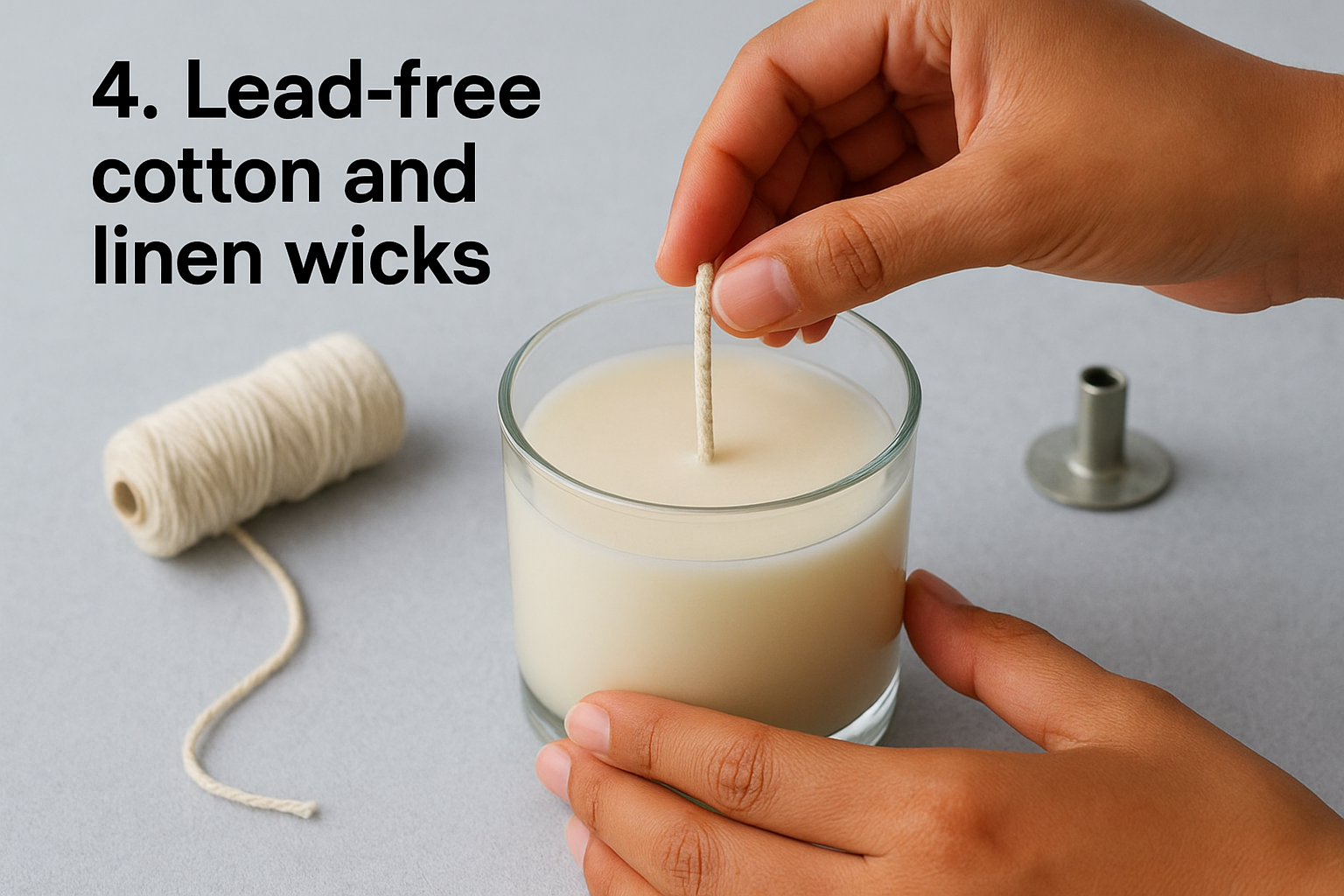
Cotton and linen wicks are natural fibre wicks braided without any metal core. Older wicks, and some cheaper imported options still on the market today, used a thin lead wire inside the braid to keep the wick upright during the pour. Modern lead-free cotton and linen wicks rely on a tight, stable braid structure to achieve the same effect without any metal content.
Why it's a cleaner, greener choice
Lead releases toxic fumes when burned, making lead-cored wicks one of the most significant indoor air quality concerns in conventional candles. By switching to untreated cotton or linen, you eliminate that risk entirely. These natural fibre wicks are also biodegradable and compostable, which reinforces the environmental case for using them as part of your eco friendly candle making supplies.
A clean wick is the foundation of a clean burn, and no amount of premium wax corrects for a wick that off-gasses harmful compounds.
How to choose it for your candle style
Match your wick diameter to your vessel width using the supplier's wick guide. A wick that is too narrow will tunnel; one that is too wide will soot. For natural waxes like soy or coconut blends, pre-waxed cotton wicks tend to centre more reliably during the pour.
What to avoid
Avoid wicks labelled simply as "natural" without specifying the exact fibre content. Also skip any wick with a zinc or tin core, as these metals, while less harmful than lead, still release trace compounds when burned and are unnecessary when quality cotton alternatives are widely available.
5. FSC-certified wooden wicks
Wooden wicks have grown in popularity as candle makers look for natural alternatives to cotton. When the wood carries FSC (Forest Stewardship Council) certification, you get a wick that delivers a distinctive crackling burn while coming from forests managed for long-term ecological health.
What it is
FSC-certified wooden wicks are thin, flat strips of sustainably harvested wood that stand upright in your wax and burn slowly from the top down. They come in single-ply and double-ply configurations, with width determining how large a burn pool they generate in your container.
Why it's a cleaner, greener choice
Wood is a fully biodegradable, renewable material, and FSC certification confirms the timber comes from responsibly managed forests where biodiversity and worker welfare are both protected. Unlike cotton wicks that require chemical treatments to stiffen the braid, wooden wicks need no additional processing to hold their shape during the pour, which reduces the chemical inputs involved in production.
Choosing FSC-certified wooden wicks is one of the simplest ways to add verified sustainability credentials to your eco friendly candle making supplies list.
How to choose it for your candle style
Wooden wicks work best in container candles with a wide diameter of 60mm or more, where their broad burn pool can form properly. Match wick width to vessel size using your supplier's size guide, and test with your specific wax blend before committing to a full production run.
What to avoid
Avoid wooden wicks sourced from suppliers who cannot provide FSC certification documentation on request. Also skip wicks that have been pre-treated with synthetic coatings or adhesives, as these burn off during use and undermine the clean, natural burn you are aiming for.
6. Safer scents: phthalate-free fragrance oils and essential oils
Scent is what sells a candle, but the fragrance category carries significant hidden risks in conventional candle making. Many standard fragrance oils contain phthalates, synthetic chemicals used as fixatives to help scent bind to wax. When burned, these compounds release into the air, making your fragrance choice one of the most health-relevant decisions across all your eco friendly candle making supplies.
What it is
Phthalate-free fragrance oils are synthetic scent compounds formulated without the phthalate fixatives found in standard fragrance oils. Essential oils are plant-derived aromatic extracts taken from flowers, leaves, bark, or roots through steam distillation or cold pressing. Both can deliver strong, lasting scent in finished candles when selected and loaded correctly for your specific wax type.
Why it's a cleaner, greener choice
Phthalates are classified as endocrine disruptors that can interfere with hormonal function after repeated exposure. Switching to phthalate-free or essential oil options removes this concern and keeps indoor air quality cleaner for anyone near a burning candle.
Phthalate-free fragrance oils perform just as well as conventional alternatives without the associated health trade-offs.
How to choose it for your candle style
Look for fragrance oils carrying IFRA compliance certification, which confirms the formula meets international fragrance safety standards. Essential oils that hold well in natural waxes at a 6 to 10% fragrance load include:
- Cedarwood
- Eucalyptus
- Lavender
- Clove
What to avoid
Avoid any fragrance oil where the supplier cannot provide a full Safety Data Sheet on request. Also skip products listed only as "fragrance" with no further ingredient detail, since this vague labelling commonly conceals phthalates and other undisclosed synthetic compounds that off-gas into your indoor air during burn time.
7. Cleaner colour: low-tox dyes and a minimalist approach
Colour adds visual appeal to finished candles, but conventional candle dyes often contain synthetic compounds that burn off into your indoor air. Treating colour as a deliberate, minimal-use decision rather than a default keeps your overall formulation cleaner from start to finish.
What it is
Low-tox candle dyes are cosmetic-grade or candle-specific colourants formulated without heavy metals, azo compounds, or other harmful additives. They come as liquid dye concentrates, dye chips, or natural plant-based pigments like annatto or spirulina. Some candle makers skip dye altogether, letting the natural cream or ivory tone of their soy or coconut wax become the finished look.
Why it's a cleaner, greener choice
Standard candle dyes can contain synthetic colourants derived from petroleum, which release compounds into the air when burned. Choosing cosmetic-grade or plant-based alternatives reduces this exposure significantly and aligns your colour choice with the rest of your eco friendly candle making supplies.
Skipping dye entirely is the cleanest option and often the most elegant choice for a natural, artisan-style candle.
How to choose it for your candle style
If you want colour, use candle dye chips or liquids rated safe for skin contact, as these carry stronger safety standards than industrial dyes. For deeply tinted candles, a 0.05 to 0.1% dye concentration by wax weight is typically sufficient to achieve a solid, even colour without overloading your formula.
What to avoid
Avoid fabric dyes or food colouring repurposed for candle making, as neither is formulated to withstand wax temperatures or burn safely. Also skip any dye where the supplier cannot provide a full ingredient disclosure.
8. Reusable and recyclable candle vessels
The vessel your candle lives in is the last thing to burn and the first thing your customer or recipient keeps. Choosing containers that can be reused, repurposed, or recycled closes the loop on waste and makes your candle a genuinely sustainable product from pour to final use.
What it is
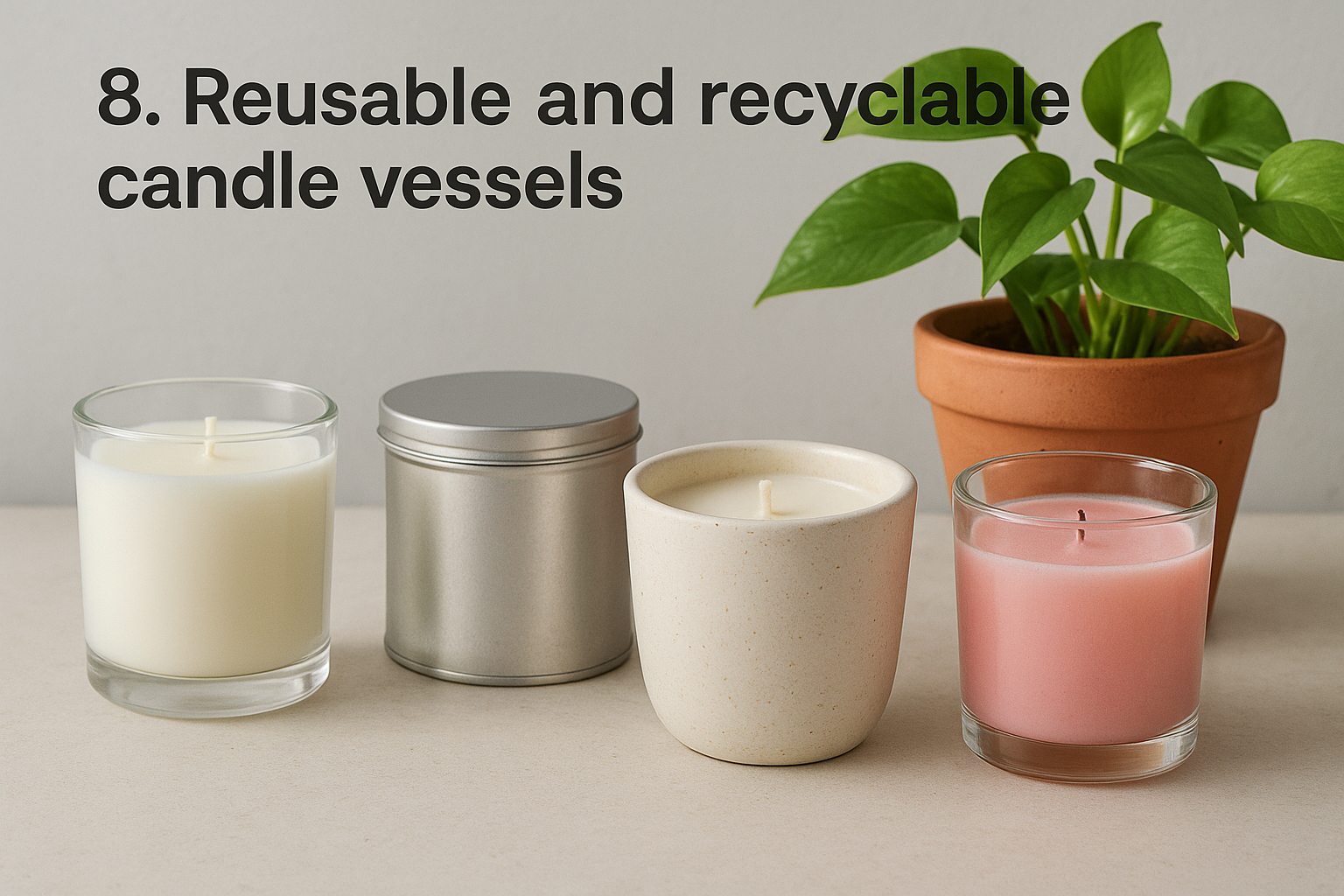
Reusable and recyclable candle vessels include glass jars, aluminium tins, and ceramic containers that retain their function after the wax is spent. A customer can clean out the leftover wax residue with hot water and repurpose the container as a storage pot, planter, or drinking glass, keeping it entirely out of the waste stream.
Why it's a cleaner, greener choice
Single-use plastic or mixed-material containers rarely get recycled in practice, even when labelled recyclable. Glass and aluminium, by contrast, are infinitely recyclable without quality loss, which gives your eco friendly candle making supplies a credible end-of-life story rather than a landfill destination.
Choosing a vessel your customer will actually keep is the most effective packaging sustainability decision you can make.
How to choose it for your candle style
Match your vessel material to your wax type. Aluminium tins suit travel or gift candles where portability matters, while wide-mouth glass jars work best for container soy wax that needs good adhesion to the vessel wall during cooling.
What to avoid
Avoid vessels with non-removable labels printed directly onto the glass, as these prevent recycling. Also skip any container bonded with plastic inserts or composite lids that cannot be separated for kerbside recycling.
9. Plastic-free packaging and labelling
How you present your candle matters beyond aesthetics. Plastic wrapping, synthetic tape, and petroleum-based label stock add up to a significant waste problem when your customer discards the packaging the moment they open their order. Choosing plastic-free alternatives across every packaging touchpoint completes the sustainability story you have built from wax to wick.
What it is
Plastic-free candle packaging covers every material that touches your product before it reaches the customer, including outer boxes, tissue paper, void fill, tape, and labels. Kraft paper boxes, recycled cardboard, paper-based tape, and FSC-certified tissue all qualify when sourced from verified suppliers.
Your labelling choices matter just as much as the outer packaging. Water-soluble label adhesives and paper-stock labels allow customers to remove and dispose of them without contaminating glass or aluminium for recycling.
Why it's a cleaner, greener choice
Plastic packaging typically ends up in landfill because most kerbside recycling systems cannot process soft plastics or mixed-material pouches. Switching to paper-based alternatives removes this uncertainty entirely. When paired with the rest of your eco friendly candle making supplies, plastic-free presentation gives your product a coherent sustainability position that customers notice and remember.
Plastic-free packaging is one of the few choices your customer experiences directly before they ever light the candle.
How to choose it for your candle style
For gift-ready candles, consider these options:
- Kraft gift boxes with a recycled content rating for postage protection
- Water-activated paper tape instead of standard plastic packaging tape
- Shredded recycled paper as void fill rather than bubble wrap
What to avoid
Avoid labels printed on synthetic vinyl or polyester stock, as these cannot be composted or recycled alongside your other paper waste. Skip any supplier who cannot confirm the recyclability of their materials through verified certification.
Next steps
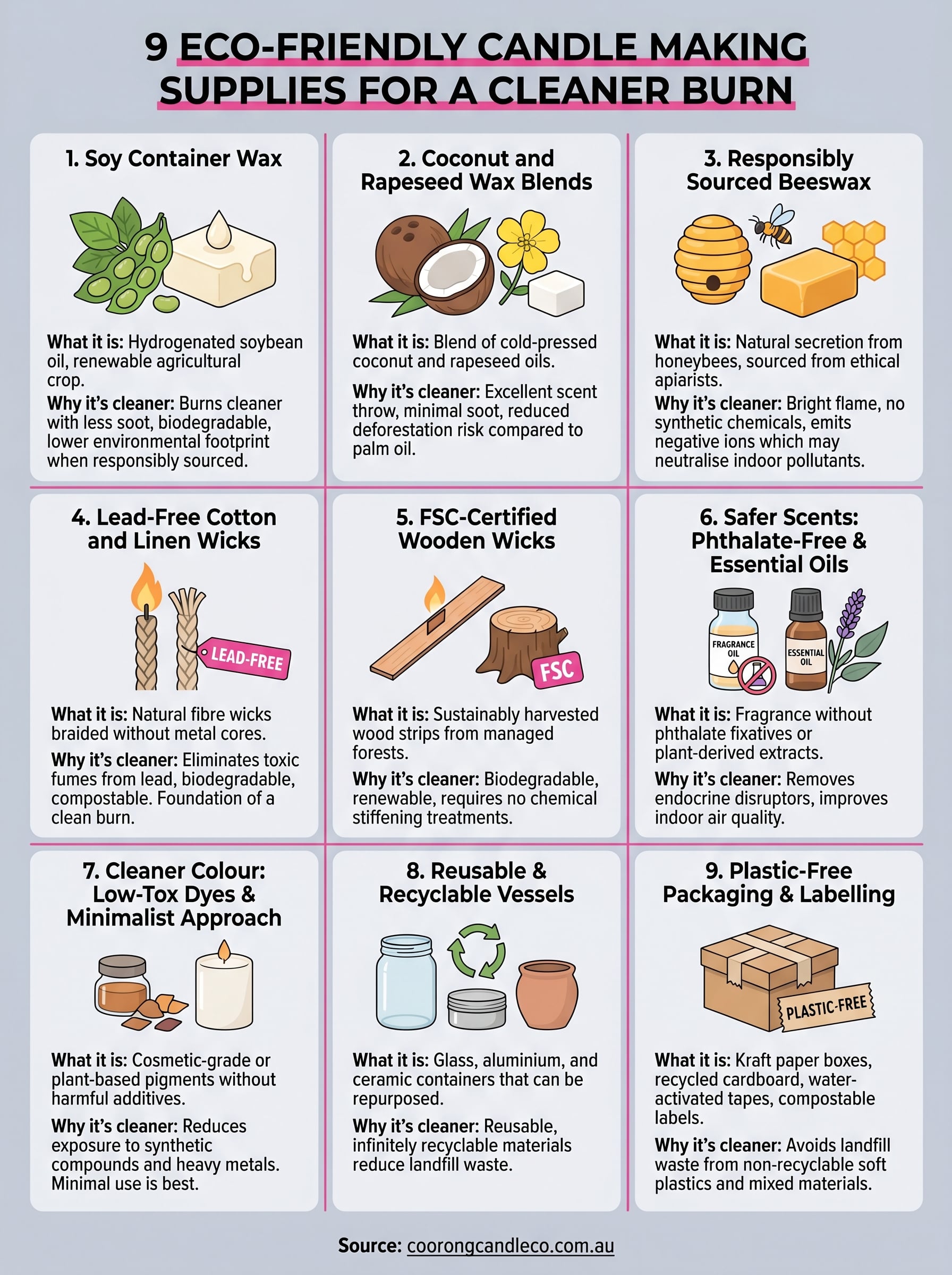
Working through all nine eco friendly candle making supplies covered here gives you a practical foundation to build candles that burn cleaner, perform better, and carry genuine environmental credentials at every stage. The choices you make at the supply level, from your wax and wick through to your label stock and packaging, add up to a product your customers can feel confident about bringing into their homes.
Start with the materials that have the biggest impact on indoor air quality first: your wax type, your wick, and your fragrance. Once those three are locked in with verified eco credentials, the rest of your supply chain is much easier to assess and improve incrementally.
If you'd rather skip the sourcing work and simply enjoy a finished result, Coorong Candle Co. hand-pours every candle using natural soy wax and lead-free cotton wicks in our South Australian workshop. Browse our handmade soy candle collection to find a scent that suits your space.