
If you've ever pulled a soy candle out of its mould only to find a white, chalky film across the surface, you've met frosting. It's one of the most common cosmetic issues in soy candle making, and it sends plenty of crafters straight to Google searching how to prevent frosting on soy candles. The good news? Frosting is purely aesthetic, it doesn't affect burn quality, scent throw, or safety. The not-so-good news? It can make an otherwise beautiful candle look unfinished.
At Coorong Candle Co., we hand-pour every soy candle in small batches from our South Australian studio. Working with 100% natural soy wax means we know frosting intimately, it's a natural characteristic of vegetable-based waxes and something every soy candle maker encounters sooner or later. Over years of refining our process, we've tested dozens of techniques to minimise its appearance across our range.
This guide covers exactly what causes frosting, why soy wax is particularly prone to it, and, most importantly, the practical steps you can take to reduce or prevent it in your own candles. We'll walk through everything from pouring temperatures and cooling methods to additives and container choices, so you can finish reading with a clear plan to troubleshoot frosting in your next batch.
What soy wax frosting is and why it happens
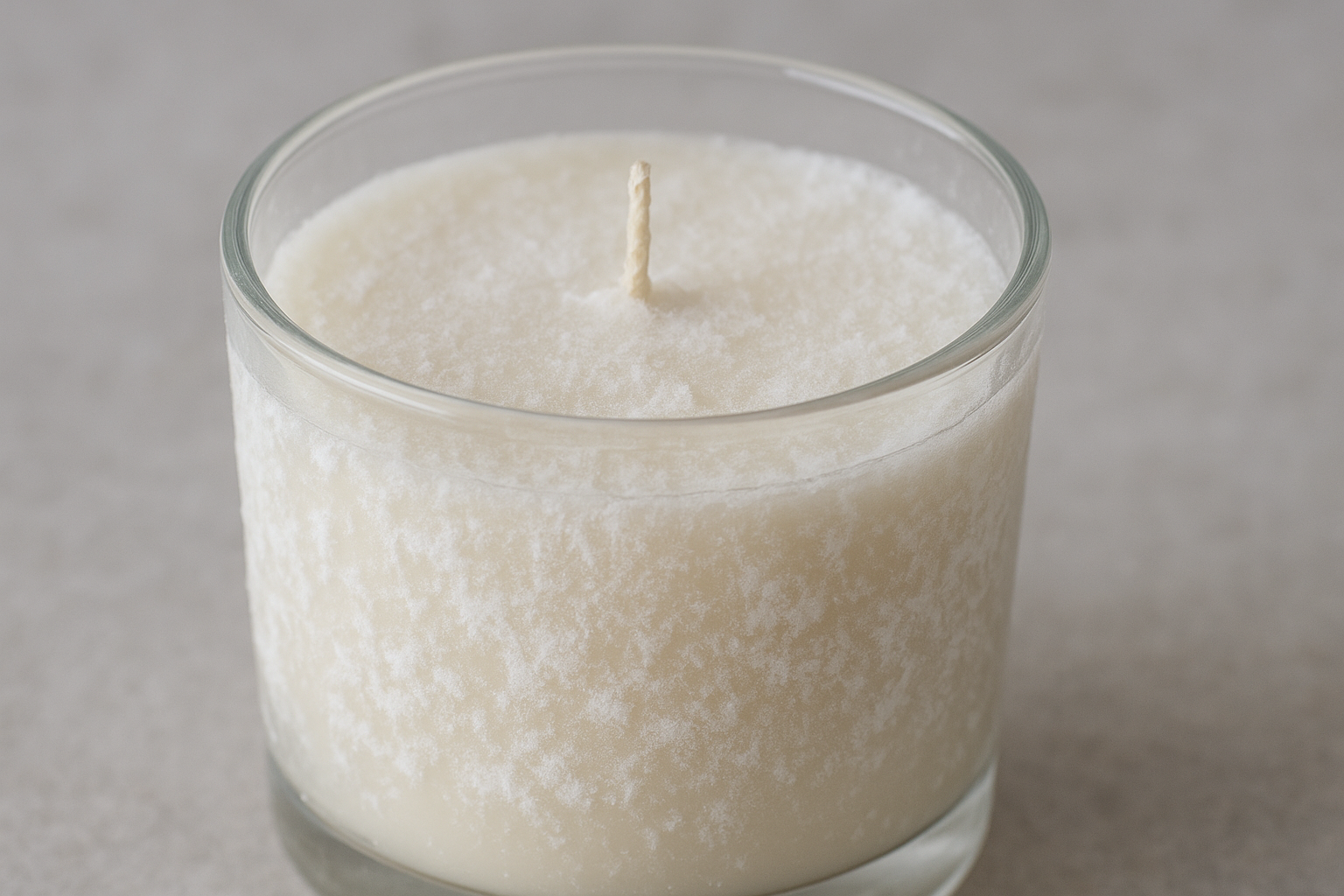
Frosting appears as a white, powdery, or chalky coating on the surface and sometimes the sides of a soy candle. It can look like a thin dusting of snow, rough patches, or a mottled white bloom across the wax. Many new candle makers assume they've made a mistake, but frosting is simply a natural characteristic of soy wax and has nothing to do with burn performance or scent quality.
The science behind soy wax crystallisation
Soy wax is derived from hydrogenated soybean oil, which means it retains a natural, organic structure made up of fatty acid chains. Those chains are not perfectly uniform. As soy wax solidifies and then continues to cool over hours and days, the molecules within the wax rearrange and recrystallise into more stable formations. This process is called polymorphism, and it's the same reason pure chocolate sometimes develops a white bloom after it sets.
Frosting in soy wax is not a defect. It's evidence that you're working with a genuinely natural, plant-based product rather than a heavily processed synthetic one.
The recrystallisation never fully stops. Even a candle that looks perfectly smooth when it first sets can develop frosting days or weeks later as the wax continues to stabilise at room temperature. This is worth knowing before you invest time in perfecting your pour, because some degree of frosting is almost inevitable with 100% natural soy wax over the long term.
Why soy wax frosts more than other waxes
Paraffin wax, which is petroleum-derived, has a more uniform molecular structure and doesn't recrystallise the same way. Blended waxes that combine soy with paraffin or other synthetic additives also frost far less because the blend disrupts the natural polymorphic behaviour of the soy. When you choose 100% soy wax, you're accepting some trade-offs in exchange for a cleaner, more natural burn, and frosting is one of them.
Coconut wax and beeswax have their own crystallisation tendencies, but soy wax is particularly prone to frosting because it has a lower melt point and a more complex fatty acid profile. That combination means the wax is sensitive to small temperature changes during cooling, and those temperature shifts are exactly what triggers the crystal formations you see as frosting on the finished candle.
What triggers frosting in your candles
Several specific factors accelerate or worsen frosting, and understanding these is the foundation of knowing how to prevent frosting on soy candles in a practical way. The main triggers include:
- Pouring temperature that is too high or too low, both of which can shock the wax and encourage rapid crystal growth
- Fragrance oil type and load, since some fragrance compounds interfere with the wax structure more than others
- Cooling speed, where candles that cool too quickly in cold or draughty environments are far more likely to frost heavily
- Dye and additive use, as certain colourants and botanicals can act as nucleation points that seed crystal growth
- Container temperature, because pouring into a cold glass jar causes the wax closest to the container walls to solidify unevenly
The environment in your workspace also plays a significant role. Seasonal temperature changes affect how quickly your candles cool, which is why a batch poured in winter may frost more than the same recipe poured in summer. Fragrance oils that contain a high proportion of vanilla or floral compounds are also known to accelerate frosting, so your choice of scent matters as much as your technique.
Before you pour: prep your wax and workspace
Good candle making starts before you melt a single gram of wax. Workspace conditions and the state of your equipment have a direct impact on how your soy wax behaves as it cools, and small oversights at this stage are one of the most common reasons frosting appears on finished candles. Getting your prep right is the first practical step in learning how to prevent frosting on soy candles.
Control your room temperature
The temperature of your workspace affects how quickly your wax solidifies once it's poured. A cold room, anything below around 20°C, causes the wax near the surface and container walls to cool much faster than the core. That uneven solidification creates the conditions for heavy crystal formation.
Aim to work in a room that sits between 21°C and 24°C, and close windows or turn off fans before you start a pour.
Keep a basic thermometer in your workspace so you're not guessing. If you're pouring during an Australian winter, a brief blast from a room heater before you start can make a measurable difference to your results.
Pre-warm your containers
Cold glass is one of the biggest contributors to side frosting, where that white bloom creeps up the inside walls of a jar. When you pour hot wax into a cold container, the temperature difference causes the wax closest to the glass to solidify before the rest of the candle, disrupting the crystal structure.
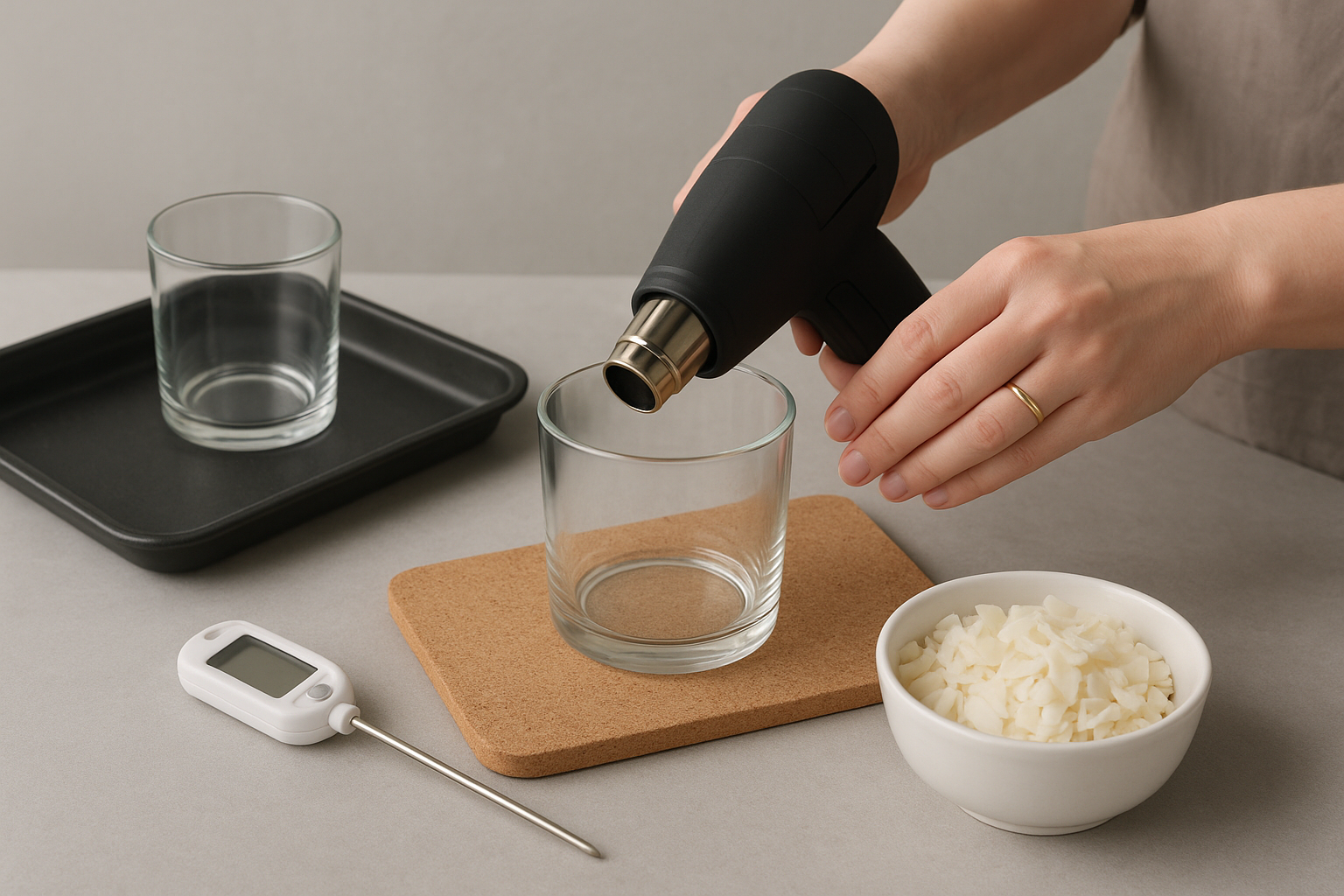
Warm your containers in one of the following ways before you pour:
- Place them in an oven on the lowest setting (around 50°C) for five to ten minutes
- Warm them with a heat gun for 20 to 30 seconds, moving in a steady circular motion
- Leave them on a heat-resistant mat near your melting station for at least 15 minutes before use
Your containers should feel warm to the touch, not hot. A jar that is too hot can cause its own problems, including sinkholes and poor wick adhesion.
Check your fragrance load
Fragrance oil percentage matters more than most beginners expect. Overloading your wax with fragrance is a direct trigger for frosting because the excess oil that the wax cannot fully bind to migrates to the surface as the candle cools. For most 100% soy waxes, a fragrance load between 6% and 10% by weight is the safe range. Weigh both your fragrance and wax on a digital scale every single time rather than measuring by volume, and follow the maximum load recommended for your specific wax.
Control heat: melt, add fragrance and pour
Temperature is the single biggest variable you can control when making soy candles, and small errors at the melting, blending, or pouring stage are responsible for a large proportion of frosting problems. Getting the temperature right at each step doesn't require specialist equipment, just a reliable digital thermometer and a consistent approach every time you sit down to pour a batch.
Melt your wax to the correct temperature
Most soy waxes perform best when melted to between 75°C and 85°C. Overheating above this range breaks down the natural fatty acid structure and makes the wax far more prone to frosting and uneven crystallisation as it cools. Under-heating produces a grainy, lumpy melt that doesn't blend fragrance oil evenly.
Use a double boiler setup rather than placing your pour jug directly on a heat source. Direct heat creates hot spots that overheat sections of the wax at different rates, which disrupts the crystal structure before the wax even leaves the jug. A double boiler keeps the temperature gradual and controllable from start to finish.
Add fragrance at the right moment
Fragrance oil binds most effectively when the wax sits at around 65°C to 70°C after you've removed it from the heat source. Adding fragrance to wax that is still at melting temperature causes the lighter aromatic compounds to evaporate before the candle sets, which reduces scent throw and affects how the wax solidifies once poured.
Stir your fragrance into the wax slowly and steadily for at least two minutes to ensure full, even binding before you pour.
Stir with a long-handled stainless steel spoon or silicone spatula, working in a consistent circular motion rather than a fast whisk. Whipping air into the wax creates bubbles and encourages uneven cooling, both of which make frosting worse in the finished candle.
Pour at the optimal temperature
For most 100% soy waxes, the ideal pouring temperature falls between 55°C and 65°C. Pouring too hot shocks the wax when it contacts the container and causes rapid crystallisation near the edges and walls. Pouring too cold means the wax has already begun setting unevenly in the jug before it reaches your containers.
Following this temperature discipline consistently is one of the most reliable answers to how to prevent frosting on soy candles, because it gives the wax the best possible chance to solidify slowly and uniformly from edge to centre once it's settled in the jar.
Slow cooling and curing to reduce crystals
Once your wax is in the jar, the work isn't finished. How the wax solidifies over the next few hours has a direct impact on how much frosting you'll see on the finished candle, and this stage is something many home candle makers rush through without realising it. Soy wax that cools too quickly locks crystals into the surface before they have a chance to settle uniformly, which is why controlling the cooling environment is one of the most reliable practical answers to how to prevent frosting on soy candles.
Give your candles a slow, controlled cool
The goal after pouring is to let the wax cool gradually and evenly from surface to base. The worst thing you can do is move freshly poured candles to a cold bench, a draughty area near an open window, or into a fridge to speed things up. Rapid temperature drops cause the outer layer of wax to solidify well ahead of the core, and that difference in solidification timing is what drives heavy crystal formation along the sides and top of the candle.
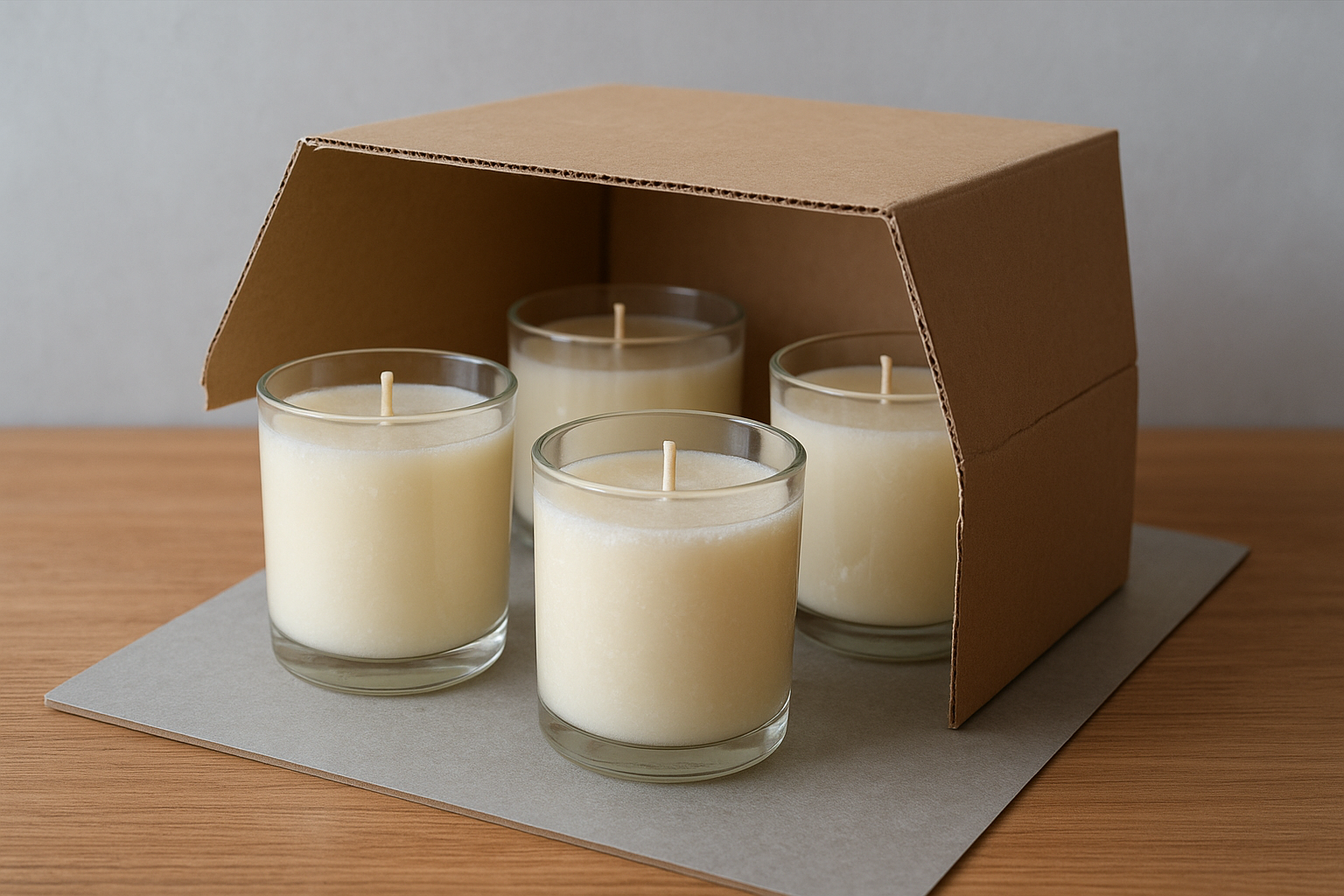
Keep your freshly poured candles in the same warm room where you made them, away from fans, air conditioning vents, and direct sunlight.
Follow these steps to set up a slow, controlled cooling environment:
- Leave candles on a flat, heat-resistant surface at room temperature (21°C to 24°C) immediately after pouring
- Cover them loosely with a cardboard box or wooden crate to slow heat loss without trapping moisture
- Avoid moving candles for at least four to six hours after the pour, even to inspect the surface
- Do not cluster jars tightly together, since grouped containers trap and release heat unevenly between them
Cure your candles before judging the surface
Soy wax continues to recrystallise and stabilise for days after the initial pour, which means the surface you see at the 24-hour mark is not the final result. Giving your candles a proper cure period before you assess, photograph, or sell them is an important part of the process that is easy to skip under time pressure.
Allow a minimum curing time of 48 hours for most soy waxes, and ideally up to two weeks for a full cure before burning. During this period, store your candles in a stable, room-temperature environment with lids on to protect the surface from dust and humidity fluctuations, both of which can trigger visible frosting after the wax has already set.
Additives and wax blends that reduce frosting
Technique alone won't always be enough to fully answer how to prevent frosting on soy candles, particularly if you're working with a wax that frosts aggressively or making candles in difficult seasonal conditions. The formulation you choose, meaning the wax itself and any materials you blend into it, is the other half of the equation. Small adjustments at the formulation stage can produce noticeably cleaner results across every batch you pour.
Blending soy with other waxes
One of the most reliable ways to reduce frosting is to move away from 100% soy wax and use a blended wax instead. When soy is combined with coconut wax, the different fatty acid profiles of the two waxes interrupt each other's recrystallisation behaviour. The result is a blend that still burns cleanly and carries fragrance well, but produces far less visible frosting on the surface and sides of the finished candle.
A solid starting point is 70% soy wax with 30% coconut wax by weight. You can adjust that ratio to suit your specific wax brands and fragrance oils, but this range gives you a workable baseline to test from. Paraffin blends also reduce frosting significantly, though they move away from the natural, plant-based positioning that many small-batch makers want to maintain.
If a cleaner finish is your priority and you're open to blended waxes, a soy-coconut combination involves the least trade-off in terms of burn quality and ingredient integrity.
Additives that stabilise the wax surface
Several additives work by slowing or disrupting the recrystallisation process within the wax, giving you a smoother, more uniform surface on the finished candle. The most commonly used options and their typical usage rates are:
| Additive | Typical usage rate | Primary effect |
|---|---|---|
| Vybar 103 | 0.5% to 1% by weight | Reduces frosting and improves fragrance binding |
| Stearic acid | 1% to 3% by weight | Hardens the wax and slows crystal formation |
| UV inhibitor | 0.1% to 0.5% by weight | Reduces colour fade, minor frosting improvement |
Add any of these to your melted wax before you introduce fragrance oil, and stir thoroughly to ensure even distribution throughout the batch. Start at the lower end of the stated usage range and test a small pour before scaling up, because too much additive can affect the melt pool behaviour, scent throw, or overall burn performance of your finished candle in ways that are harder to fix than frosting itself.
If frosting shows up: quick fixes and trade-offs
Even with solid technique, frosting can still appear on your finished candles, especially if you're working with 100% natural soy wax during cooler months or in a workspace with variable temperatures. Before you discard a whole batch, know that you have a few practical options available. Each one involves a real trade-off, so understanding what you're giving up before you reach for a fix is part of knowing how to prevent frosting on soy candles from becoming a recurring frustration.
Smooth the surface with a heat gun
A heat gun is the fastest and most practical tool for removing frosting from the top of a finished candle. Hold it roughly 10 to 15 centimetres above the surface and move it in a slow, steady circular motion for around 10 to 20 seconds. The frosted layer melts back into the wax almost immediately, and the surface re-solidifies with a much cleaner, more uniform appearance. This approach works well for the top of container candles but does almost nothing for frosting that has crept along the interior sides of a glass jar, since you can't direct the heat effectively through the glass wall.
Use the lowest heat setting on your gun to avoid scorching the wax surface or shifting the wick position.
Be aware that the cosmetic improvement is temporary. Because frosting is a natural recrystallisation process, the bloom will likely return within days or weeks, particularly on candles stored in fluctuating room temperatures. A quick heat gun pass before photographing or gifting a candle is a reasonable short-term measure, but it doesn't change the underlying behaviour of the wax itself.
Reframe frosting as a quality signal
Some candle makers lean into frosting rather than fight it, choosing to present it as visible proof that their candles contain no synthetic additives or petroleum-based wax. This is a legitimate position, and it shifts the conversation with buyers from "defect" to "characteristic." If you sell or gift your candles, a brief note on your label or care card explaining that natural soy wax frosting is a sign of genuine plant-based ingredients can turn a potential concern into a point of trust with customers who value ingredient integrity above flawless cosmetics.
The honest trade-off is simple: if a perfectly smooth, frost-free surface is your non-negotiable goal, a fully synthetic or heavily blended wax will get you there more reliably than 100% soy wax ever will. Choosing natural soy means accepting frosting as part of the product's character and managing it with consistent technique rather than expecting to eliminate it entirely.
Key takeaways and next steps
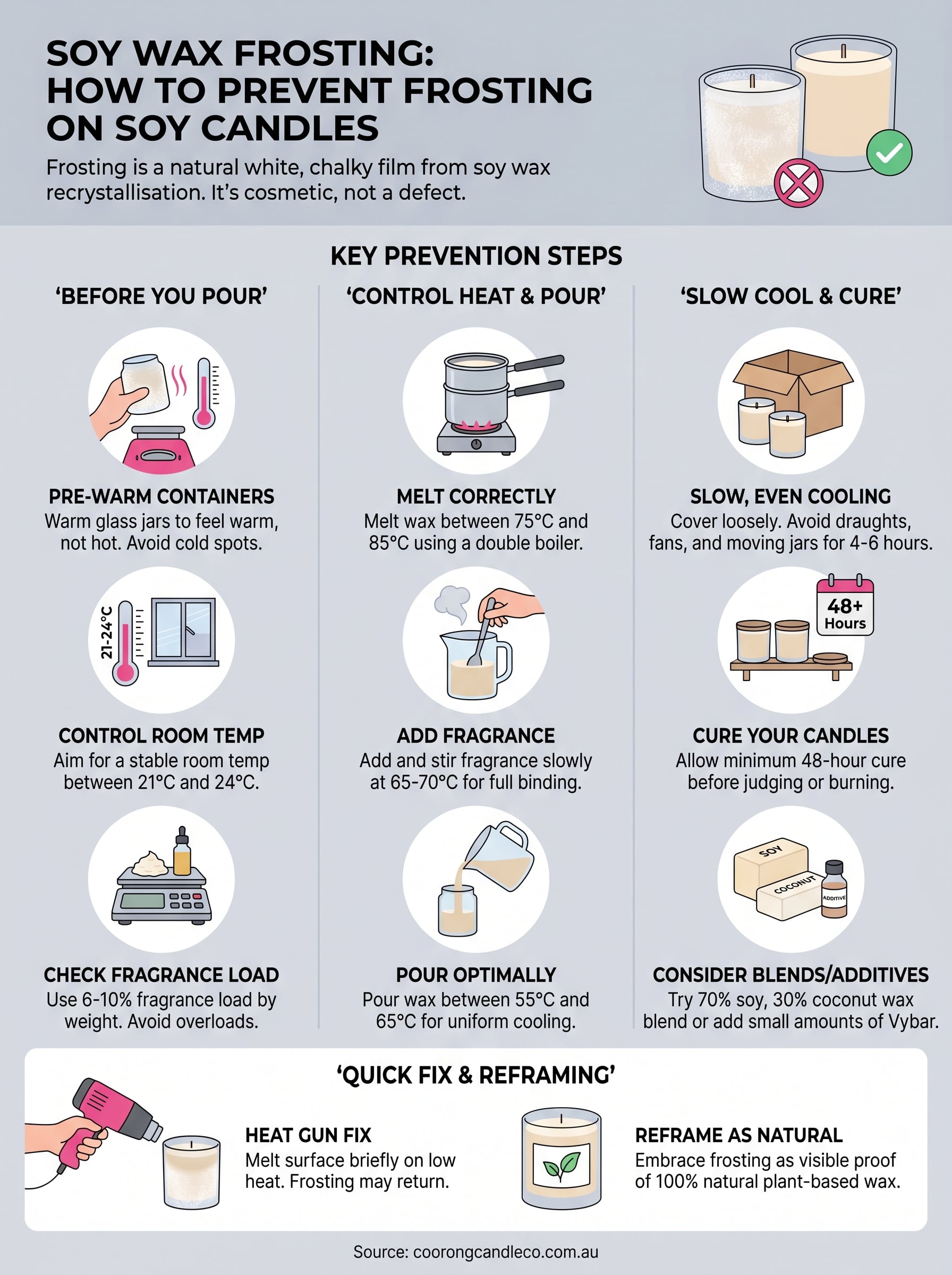
Frosting is a natural behaviour of soy wax, not a sign that you've done something wrong. The best answers to how to prevent frosting on soy candles come down to consistency across four areas: workspace temperature, pour temperature, cooling speed, and fragrance load. Warm your containers before you pour, stick to the 55°C to 65°C pouring window, let your candles cool slowly at room temperature, and keep your fragrance load within the recommended range for your specific wax.
If you want to reduce frosting further, a soy-coconut wax blend or a small addition of Vybar 103 will give you noticeably cleaner results without abandoning natural ingredients. Some frosting will always return over time because that's what plant-based wax does, and that's worth being honest about with anyone who receives your candles.
If you'd prefer to enjoy beautifully finished candles without the trial and error, browse our natural soy wax candle collection and find your next favourite scent.