
You've probably noticed that a single candle can shift the entire mood of a room. Now imagine combining that scent with a matching diffuser or bath product to create something richer and more personal. That's the basic idea behind scent layering, and once you understand how it works, you'll never go back to using fragrances in isolation.
Scent layering is the practice of combining two or more fragrance products to build a cohesive, multi-dimensional aroma that feels uniquely yours. It's not just a technique reserved for perfume enthusiasts. Anyone who uses candles, reed diffusers, or bath products at home is already halfway there. The key is learning which scents complement each other and how to use them with intention rather than by accident. Done well, it transforms your space into something that feels deliberately crafted.
At Coorong Candle Co., we handcraft soy candles, reed diffusers, and bath bombs across a range of nature-inspired fragrance profiles, which makes our collections a natural starting point for building layered scent combinations at home. In this guide, we'll walk you through exactly how scent layering works, which fragrance families pair well together, and how to use multiple products to create a signature scent that's entirely your own.
What scent layering is and why it works
Scent layering is the practice of combining multiple fragrance products to build a richer, more complex aroma than any single product delivers on its own. If you've been wondering what is scent layering, the short answer is: it's intentional fragrance stacking. You choose products with complementary notes, then use them together so each one adds a distinct dimension to the overall scent experience. This applies equally to your body routine and your home environment, which is why understanding the concept opens up a lot of creative control.
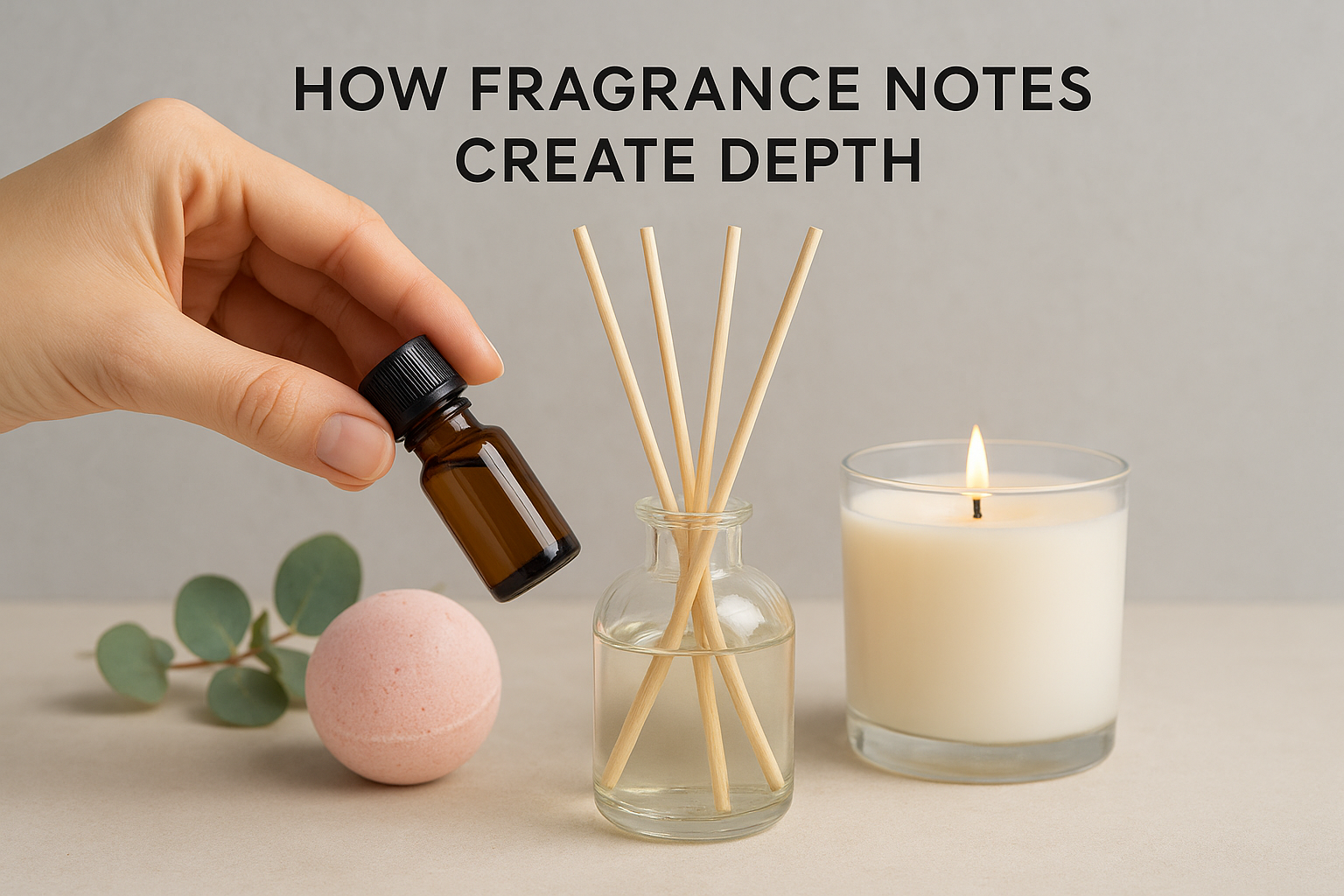
How fragrance notes create depth
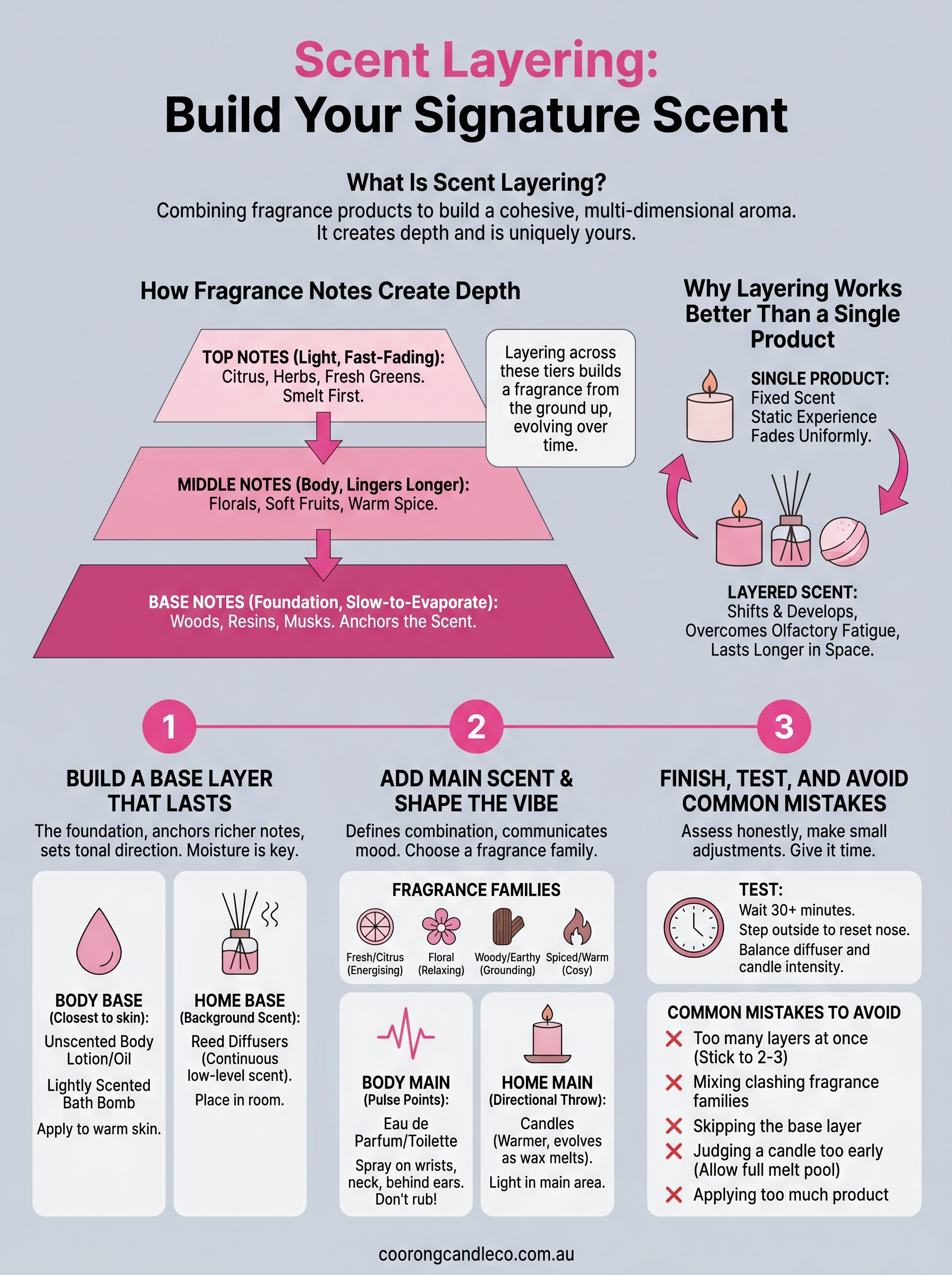
Every scent is built from a structure of fragrance notes, classified into three tiers: top notes, middle notes, and base notes. Top notes are what you smell first. They're light and fast-fading, typically drawn from citrus, herbs, or fresh greens. Middle notes form the body of the fragrance and linger longer; think florals, soft fruits, or warm spice. Base notes are the foundation: rich, slow-to-evaporate, and often sourced from woods, resins, or musks.
Understanding how these three tiers interact is what separates a well-layered scent from a random mix of products that clash or cancel each other out.
When you layer products across these tiers, you're building a fragrance from the ground up. A bath bomb carrying eucalyptus (a top note) combined with a soy candle built around warm sandalwood (a base note) gives you something that evolves over time, rather than sitting flat and fading all at once.
Why layering works better than a single product
A single candle or diffuser delivers a fixed scent profile. You get what the product gives you, and the experience stays static. Layering changes this because each product you introduce adds its own concentration, delivery method, and longevity, meaning the combined scent shifts and develops rather than fading uniformly.
There's also a neurological reason why layering works so well. The human nose adapts quickly to a constant smell, a phenomenon called olfactory fatigue. When you introduce fragrance from multiple sources at different intensities - a diffuser running at low background warmth alongside a candle burning at a closer focal point - your brain continues to register the fragrance instead of filtering it out. The layered result stays present in a space far longer than any single product would.
The difference between matching and layering
Matching scents means buying products from the same fragrance line and using them together. Layering goes further. You're deliberately selecting products with different but compatible notes and combining them to create something that neither product carries alone. A floral reed diffuser paired with a woody candle produces a third scent profile that belongs entirely to your space.
This is why knowing your fragrance families matters so much in the layering process. Florals sit naturally alongside musks and light woods. Citrus works well paired with herbs or a touch of spice. Earthy notes like vetiver or cedarwood ground almost any combination. Once you understand these relationships, you stop guessing and start building with intention.
Choose your layers for body and home
Before you start combining products, you need a clear picture of the fragrance tools available to you and how each one fits into a layered routine. Scent layering works across both your personal care products and your home environment, and the best results come from treating both as part of the same system rather than two separate things.
Body fragrance layers
Your body is the most intimate layer of any scent combination, so it's the right place to start. The products you apply directly to your skin carry fragrance closest to you and tend to anchor your overall scent profile. Here are the main options and how each one functions in a layered routine:
- Unscented or lightly scented body wash: Cleanses without competing, giving your other products a neutral base to build on.
- Scented body lotion or body oil: Hydrates skin and extends how long fragrance lasts, since moisturised skin holds scent better than dry skin.
- Eau de parfum or eau de toilette: Delivers the most concentrated fragrance and defines your signature note.
- Scented bath bombs: Introduce a light top-note experience at the start of your routine, setting the foundation before you apply anything else.
The order matters: apply products from the least concentrated to the most concentrated so each layer shows through cleanly.
Home fragrance layers
Your home gives you more control over fragrance intensity than your body does, because you can adjust placement, product strength, and the number of sources running at once. Understanding what is scent layering in a home context means recognising that each product type contributes differently to the overall atmosphere.
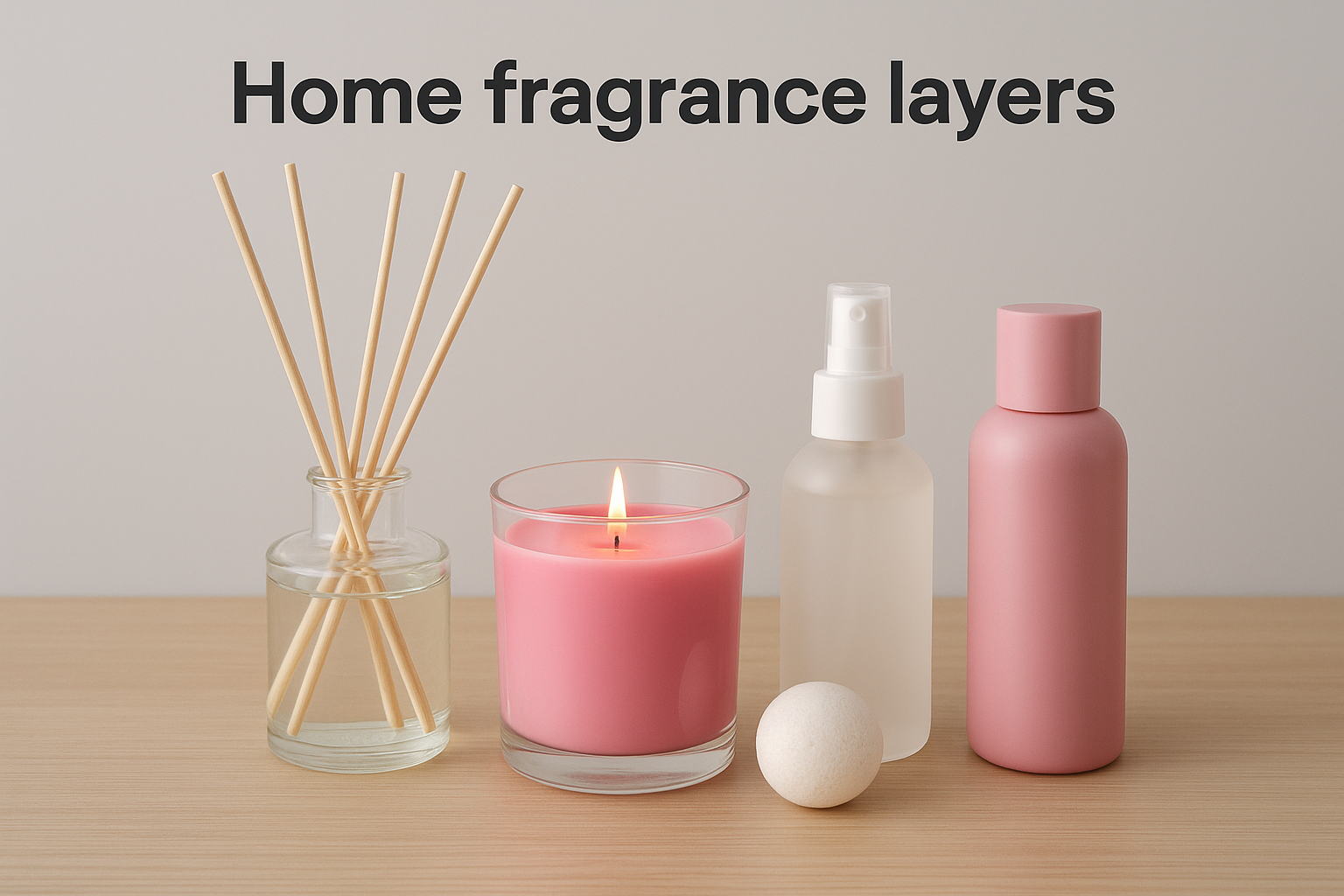
Reed diffusers provide continuous, low-level background scent that fills a room gradually over days. Candles deliver a warmer, more directional fragrance throw that shifts slightly as the wax melts and the scent develops. Linen sprays or room mists offer an immediate burst useful for resetting a space quickly. Combining a reed diffuser with a candle from the same fragrance family but with different note profiles gives your room a layered, evolving scent that stays noticeable over hours rather than fading uniformly into the background.
Step 1. Build a base layer that lasts
The base layer is the foundation of your entire scent combination. It's what sits closest to your skin, lasts the longest, and sets the tonal direction for everything you add on top. If you skip this step or choose the wrong product, the layers above it have nothing to hold onto, and your scent fades faster than it should.
Why the base layer matters
Your base layer works by anchoring the richer, more complex notes you introduce later. In the same way a primer helps paint adhere to a surface, a well-chosen base product extends the life of everything that follows. Understanding what is scent layering at a practical level means recognising that moisture is your single biggest ally here. Dry skin absorbs fragrance quickly and releases it just as fast. Hydrated skin slows that process down significantly, which means your scent stays present for longer without needing reapplication.
Applying fragrance to dry, unprepped skin cuts your scent's longevity by as much as half compared to moisturised skin.
What to use as your base
Your base product needs to be lightly scented or completely unscented so it doesn't compete with the layers above it. Here are the most effective options:
- Unscented body oil: Absorbs quickly and creates a smooth, moisturised surface that holds fragrance well.
- Fragrance-free body lotion: Easier to apply broadly and works especially well on pulse points like wrists, neck, and inner elbows.
- Lightly scented bath bomb: Used at the start of your routine, it deposits a soft top-note impression on your skin before you apply anything else.
How to apply your base layer
Apply your chosen base product immediately after a shower or bath, while your skin is still slightly warm. Warm skin has open pores, which means it absorbs product more thoroughly. Focus on pulse points first, then spread outward to larger areas like the forearms and décolletage. Let the product absorb for at least two minutes before you move on to the next layer. Rushing this step means the layers above it sit on the surface rather than bonding properly, and the whole combination breaks down faster than intended.
Step 2. Add your main scent and shape the vibe
Once your base layer is in place, you're ready to introduce the main scent that defines your overall combination and communicates the mood you're building toward. Understanding what is scent layering at this stage means recognising that your main scent isn't just the product you like most; it's the tonal anchor that ties every layer together. Choose it deliberately based on the fragrance family you want to lead with, and let that choice guide everything else you layer around it.
Pick a fragrance family that fits your intention
The fragrance family you choose shapes the entire atmosphere of your space or personal scent. Each family carries a different emotional register, from the clean and airy feel of fresh citrus to the warm, grounded quality of woods and resins. Before you pick a product, decide what mood you want to create.
| Fragrance Family | Typical Notes | Best For |
|---|---|---|
| Fresh/Citrus | Lemon, lime, sea salt, green tea | Morning routines, energising spaces |
| Floral | Rose, jasmine, peony, freesia | Relaxing rooms, everyday wear |
| Woody/Earthy | Sandalwood, cedarwood, vetiver | Grounding, evening routines |
| Spiced/Warm | Vanilla, amber, cinnamon, clove | Cosy interiors, cooler months |
Apply your main scent with precision
After choosing your fragrance family, apply your main scent product with care. For body layering, spray or dab your eau de parfum or eau de toilette directly onto warm pulse points: the inner wrists, the base of the throat, and behind the ears. Avoid rubbing your wrists together after application, as rubbing breaks down the top notes prematurely and flattens the overall scent profile.
Applying your main scent to pulse points rather than clothing allows your body heat to activate the fragrance continuously throughout the day.
For home layering, light your main candle in the room where you spend the most time and allow it to burn for at least one hour before you assess the combination. The scent throw develops as the wax pool deepens, so a candle assessed too early won't give you an accurate read of how all the layers are working together.
Step 3. Finish, test, and avoid common mistakes
With your base and main scent in place, the final step is to assess the combination honestly and make small deliberate adjustments before you commit to it as your everyday routine. Understanding what is scent layering fully means accepting that your first attempt won't always land perfectly. Testing and refining is a normal part of the process, not a sign that something has gone wrong.
Test your combination before giving it a final verdict
Give your layered scent at least 30 minutes before you judge it. Fragrance evolves as the top notes fade and the middle and base notes come forward, so what you smell immediately after applying products is rarely the full picture. Step outside briefly, then re-enter the room or smell your wrist again with a freshly reset nose. This short break clears olfactory fatigue and gives you a far more accurate read of how the layers actually sit together.
If a combination feels sharp or overwhelming, reduce the intensity of one layer rather than removing it entirely.
For home layering, assess the balance between your diffuser and candle by sitting at normal distance in the room for a few minutes. The combined scent should feel present but not heavy. If one product is clearly overpowering the other, move the diffuser to a secondary position or choose a candle with a lighter scent throw for that particular space.
Common mistakes to avoid
Most layering problems trace back to a handful of predictable errors that are straightforward to fix once you recognise them. Use this checklist to course-correct quickly:
- Using too many layers at once: Stick to two or three products maximum until you understand how they interact.
- Mixing clashing fragrance families: Pairing a heavy resinous scent with a sharp citrus rarely produces a pleasing result. Stay within compatible fragrance families or adjacent ones.
- Skipping the base layer: Without a moisturised foundation, your scent fades within hours regardless of product quality.
- Judging a candle too early: Always allow a full melt pool to form across the surface before assessing the combined scent throw.
- Applying too much of each product: More product does not produce a better result. Each layer should complement the others, not compete with them.
Final thoughts
Scent layering is not complicated once you understand the basic structure behind it. You start with a moisturised base, introduce a main fragrance that reflects the mood you want to build, then refine the combination by testing how the layers develop together over time. The technique works just as well at home as it does in a personal care routine, and the results are noticeably richer than anything a single product delivers on its own.
What is scent layering if not a way to take control of how your space and your presence actually feel? The key is to keep your combinations simple and intentional rather than reaching for too many products at once. Two or three well-chosen layers will always outperform a cluttered mix.
If you want a ready-made starting point, explore our home fragrance gift sets, which pair candles, diffusers, and bath bombs in complementary fragrance profiles, giving you everything you need to layer with confidence from day one.